Buttons, Buttonholes, Snaps, and Rivets
Fasteners as small mechanisms: buttons and buttonholes as one tolerance, button materials and how they fail, machine and hand buttonholes, snap attachment, jeans tack buttons and rivets, the installed cost of a tiny part, and a ten-cycle fastener audit.
- 6 min
- 10 steps
- 3 questions
- Lesson 28 of 49
In this lesson
- Button and buttonhole are one tolerance
- Button materials change the failure
- Buttonholes are bound edges under abrasion
- Snaps convert pull into local attachment stress
- Tack buttons and rivets
- Why a tiny detail can be expensive
- A fastener audit
- Three value levels
- Rule of thumb
Open alongside this lesson
-
ASTM D13.54: Subassemblies Standards (opens in a new tab)
Attachment strength, impact, laundering, and dry cleaning are separate risks for buttons and snaps; ask which apply to the garment.
-
Button Making (opens in a new tab)
Dorset buttons show how local materials, cottage-industry organization, technique, fashion, and transmission can accumulate inside a tiny component.
Picking up where you left off.
Fasteners are tiny mechanisms that reveal a manufacturer’s priorities. They concentrate force, pierce material, receive repeated handling, pass through cleaning chemistry, and fail at inconvenient moments. Their cost is small relative to a garment, but their consequences are not.
Fineas Jackson focuses on hand-worked suit buttonholes and denim details in separate episodes 1 2. Both become more useful when you trace the load through the visible hardware into fabric and reinforcement.
Playback is optional. If the player is unavailable, open the video at its source.
Button and buttonhole are one tolerance
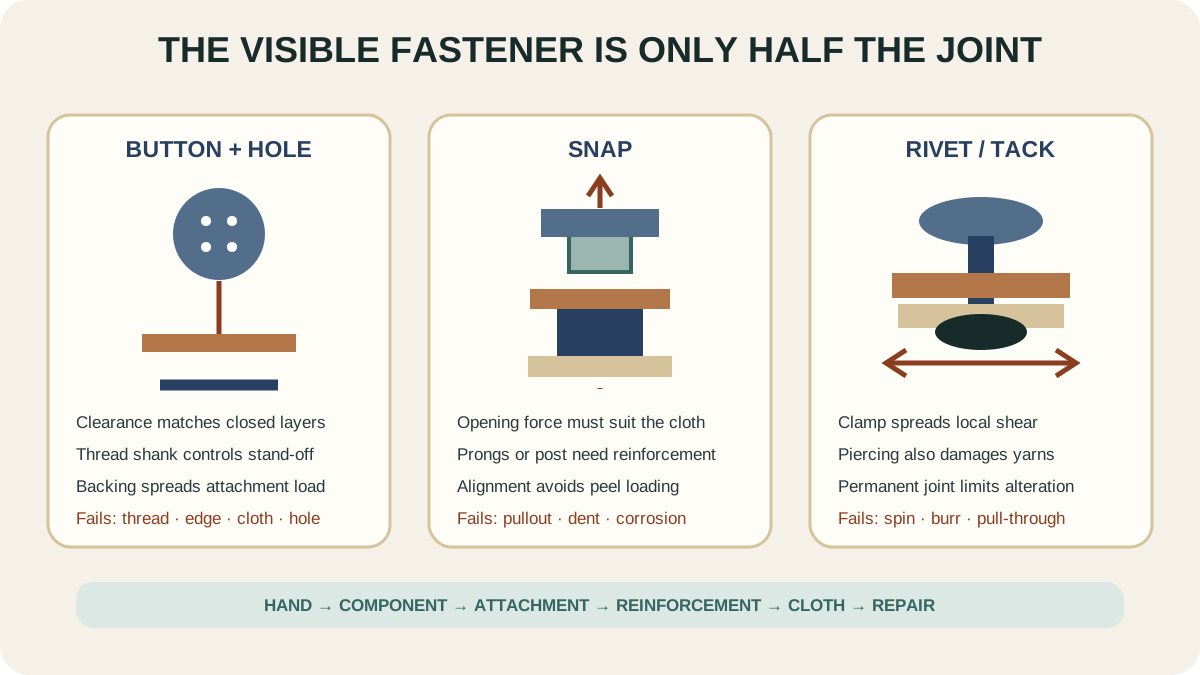
A button must pass through its hole with manageable force and resist slipping back out accidentally. The working relationship depends on:
- button diameter, thickness, edge shape, and shank;
- hole length and finishing bulk;
- fabric thickness and stiffness;
- layers captured when closed;
- direction and amount of tension;
- hand dexterity and expected speed;
- change through laundering and wear.
A thin flat sew-through button can sit directly on a shirt. On a coat, it may need a thread shank—a small wrapped stand-off—so multiple thick layers fit under it. Too little clearance crushes cloth and pulls the front. Too much lets the button wobble and catch.
A backing button or reinforcement patch can spread force on the inside. Without it, a strong button and strong thread may simply tear the cloth.
Button materials change the failure
Common choices include polyester or urea resin, nylon, metal, wood, shell, horn, corozo, leather, and covered forms. Material affects:
- impact and crack resistance;
- heat and cleaning chemistry;
- edge sharpness and thread wear;
- color variation;
- thickness at equal diameter;
- repair availability;
- cost and ethical sourcing.
Natural variation can be beautiful but is not automatically durable. A sharp metal hole can saw through attachment thread. A resin button can outperform horn in repeated industrial laundering. Fitness wins.
Heritage Crafts’ account of Dorset buttons shows an entirely different value proposition: thread and rings became a regional cottage industry with recognizable techniques and a knowledge lineage 3. Paying for such a button may support living skill and visual pleasure even if an industrial polymer version is more uniform.
Buttonholes are bound edges under abrasion
A machine lockstitch buttonhole can be fast, dense, repeatable, and excellent. A hand-worked buttonhole may allow the maker to place gimp, control purl, shape an eye, and repair the edge. Heritage Crafts’ finishing apprenticeship description names hand buttonholes among specialized tailoring skills alongside felling, prick stitch, pockets, and repair 4.
Useful distinctions:
- straight buttonhole: common for shirts and many light garments;
- keyhole or eyelet-end buttonhole: rounded end gives a shank room to settle and distributes distortion in heavier tailoring;
- bound buttonhole: fabric lips create a tailored opening; accurate cutting and reinforcement are critical;
- corded or gimped edge: an internal cord can add relief and stability.
Look for complete coverage of the cut edge, secure bar tacks, an opening that is neither ragged nor choked, and appropriate alignment. Decorative contrast is secondary.
Snaps convert pull into local attachment stress
A snap has male and female halves plus the way each half attaches. Components may be sewn, crimped, riveted, or pronged through material. Operating force must be high enough to stay closed and low enough that users do not yank the surrounding cloth apart.
Reinforcement matters especially in thin knits, laminated shells, leather, and children’s wear. Misaligned parts create peeling force rather than clean separation. Corrosion or coating wear can change feel and stain fabric.
The ASTM D13.54 standards inventory includes distinct methods for sew-through and shank buttons, tack- and prong-attached buttons, snaps, laundering, dry cleaning, and impact 5. “Secure” is not one universal test.
Tack buttons and rivets
Jeans waist buttons often combine a front button with a tack driven from behind. Rivets place a cap and post through layered cloth at pocket corners or other stress points.
Their legitimate jobs:
- clamp multiple layers;
- reduce stitch-line concentration;
- resist repeated shear or peel;
- provide a low-profile permanent joint.
Their tradeoffs:
- piercing cuts yarns and creates a hole;
- hard edges can abrade skin, furniture, or adjacent cloth;
- a permanent component complicates alteration and recycling;
- excess hardware adds weight and stiffness;
- a poorly set post can loosen or expose a sharp end.
Rivets should support a sensible pocket and seam design, not compensate for fragile cloth everywhere.
Why a tiny detail can be expensive
Component price is only one term:
installed fastener cost = component + reinforcement + hole preparation + setting/sewing time + inspection + rejects + replacement inventory
A hand buttonhole adds minutes of concentrated labor and requires consistency across a row. Patterned shell or horn may require grading and matching. Custom hardware needs molds, plating development, minimum orders, and color control. A low-volume maker spreads those costs across fewer garments.
But custom logos and heavy metal can be pure signaling. Ask what changed in function, life, repair, or meaningful craft.
A fastener audit
Close and open each fastener ten times, then inspect:
- Is force reasonable and consistent?
- Does fabric distort before release?
- Is there reinforcement behind the attachment?
- Do button edges cut attachment thread?
- Are snaps centered rather than peeling sideways?
- Do metal parts show burrs, loose caps, or corrosion?
- Can a common repairer replace the component?
- Is a spare supplied when matching will be difficult?
For a bag, load it normally before testing. For a coat, include all clothing layers. Fasteners should be judged in use, not on a flat display.
Three value levels
| Level | Honest version | False premium |
|---|---|---|
| Efficient industrial | standard durable part, compatible attachment, reinforcement, easy replacement | lowest-cost part through unreinforced fabric |
| Refined production | controlled force, finish tested through care, custom shape for actual ergonomics | oversized logo hardware with no service |
| Artisan / heritage | hand-worked edge or locally made component with traceable skill and repair | irregularity presented as proof without functional control |
Rule of thumb
Read every fastener as a load path: hand → component → attachment → reinforcement → cloth. Pay more when the path is controlled, serviceable, or carries craft you genuinely value—not merely when the hardware is heavier.
Practice
The required stand-off depends on the thickness of the layers captured when the garment closes.
Practice
Rivets can reinforce high-stress intersections, but poor placement can create stiffness, snagging, abrasion, or repair difficulty.
Practice
Handwork can produce real functional and aesthetic results without becoming a proxy for every other construction decision.
Lesson complete
Nice work.
Sources for this lesson
- 1Fineas Jackson. Not all buttonholes are made the same. Why your coat and jeans have that strange keyhole shape…. Fineas Jackson on YouTube. 2026. verifiedChasing Beauty episode 55; 2:03. Used as a case or observation prompt, not as the sole authority for technical claims. Cited at: episode 55.
- 2Fineas Jackson. They look like decoration, but they’re why jeans exist. Behind those buttons on your jeans.... Fineas Jackson on YouTube. 2026. verifiedChasing Beauty episode 42; 2:51. Used as a case or observation prompt, not as the sole authority for technical claims. Cited at: episode 42.
- 4Gieves & Hawkes: Bespoke Tailoring Finishing Apprenticeship. Heritage Crafts. verifiedTraining description naming hand buttonholes, felling, prick stitch, rolled pockets, and repair as specialist finishing skills. Cited at: training route.
- 5ASTM D13.54: Subassemblies Standards. ASTM International. verifiedStandards inventory for sew-through and shank buttons, tack- and prong-attached buttons, snaps, laundering, dry cleaning, and impact resistance. Cited at: standards scope.
Previous: Down Insulation: Fill Power, Fill Weight, and Baffles