Leather Straps: Belts, Bags, Edges, and Saddle Stitch
Leather straps as load paths: four strap architectures, burnished, painted, and turned edges, saddle stitch versus lockstitch, hardware materials and attachment, where labor accumulates in a lined strap, three quality levels, and flexing a strap to inspect it.
- 6 min
- 10 steps
- 3 questions
- Lesson 21 of 49
In this lesson
- Start with the load path
- Four common strap architectures
- Edge styles are systems
- Saddle stitch, lockstitch, and honest handwork
- Hardware deserves the same scrutiny
- Where labor accumulates
- Three levels
- Field audit
- Rule of thumb
Open alongside this lesson
-
Saddlery (opens in a new tab)
Cutting, edging, creasing, stitch marking, stitching, punching, blocking, polishing, fitting, and repair make “handmade” inspectable.
-
Parachute Rigger Handbook (opens in a new tab)
Although written for parachute rigging rather than leather goods, its load-path discipline helps separate decorative stitches from engineered junctions.
Picking up where you left off.
A belt looks like a strip and a bag strap looks like a strip with hardware. In practice, the maker is controlling stretch, bending, hole tear, edge wear, lining creep, buckle geometry, skin contact, and appearance from both sides.
Playback is optional. If the player is unavailable, open the video at its source.
Start with the load path
The strap is only one member of a system:
body or bag → reinforcement → stitch or rivet → strap → hole/keeper/buckle → return path
Failure often occurs at a transition:
- a buckle tongue tears through an unsupported hole;
- a bag strap is strong, but its small attachment tab peels away;
- a rivet concentrates load into soft leather;
- stitches sit too close to a cut edge;
- a stiff edge coating cracks where the strap flexes;
- the leather stretches until the adjustment no longer fits.
The FAA’s rigging handbook concerns safety equipment, not fashion leather, but its central lesson transfers: seam pattern, material damage, thread, spacing, overlap, and direction must be designed as a junction 1. Never use casual leather-goods advice to build life-safety equipment.
Four common strap architectures
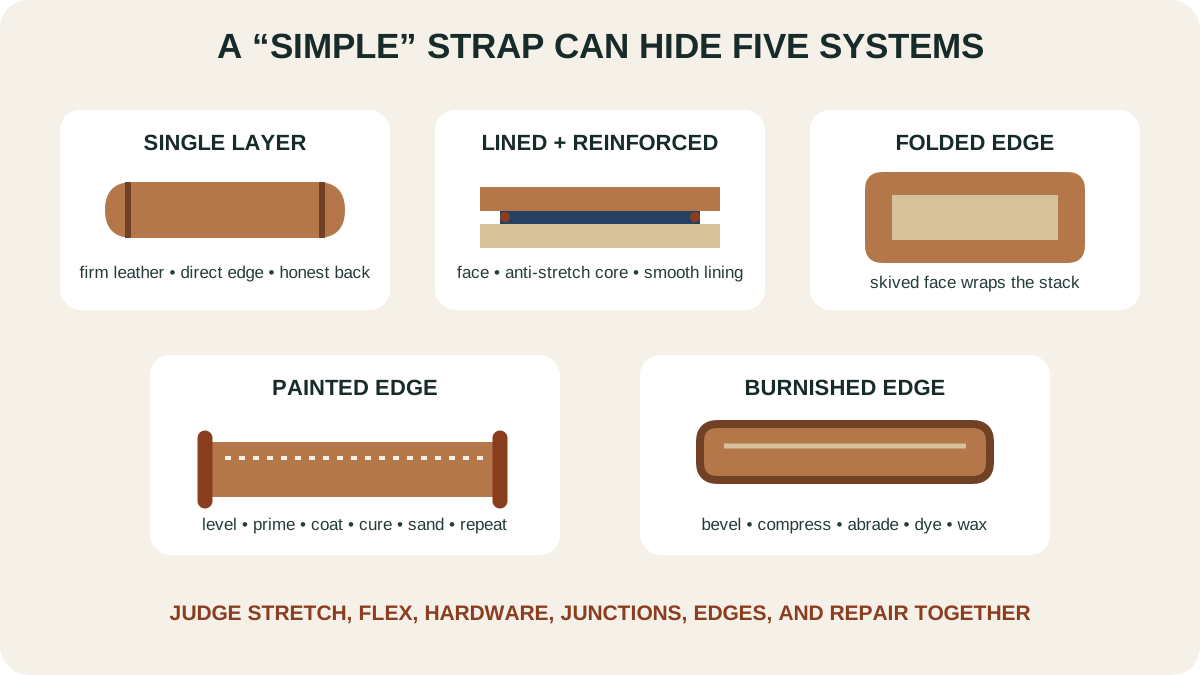
Single layer. A firm, thick leather is cut, holes are punched, and edges are finished. This can be direct, durable, and repairable. The flesh side and every thickness variation remain visible.
Face plus lining. A chosen outer leather is laminated and stitched to a lining. The maker can combine a beautiful face with a smoother skin-facing surface, but poor adhesive coverage or mismatched stretch can cause bubbling and creep.
Reinforced composite. A thin low-stretch layer sits between face and lining. This controls elongation near watch spring bars, bag anchors, or belt holes. Ends must be skived so the stack does not become a blunt lump.
Folded or bound. The face leather turns around the edge or a separate strip covers it. This protects the cut edge and can create a refined profile, but demands extra allowance, thinning, folding control, and careful corner work.
Edge styles are systems
Burnished edge
Dense vegetable-tanned leather can often be beveled, moistened or treated, compressed, abraded, dyed, waxed, and polished into a coherent edge. It is tactile, repairable, and shows the material directly. Loose, very soft, heavily oily, or laminated leathers may not burnish cleanly.
Painted edge
The edge is leveled, primed, coated, dried, sanded, and recoated. Good edge paint can seal difficult stacks and produce precise color. Its quality depends on preparation, compatible flexibility, coat thickness, curing, and renewal—not on whether paint exists.
Turned edge
The outer leather is skived thin and folded around a substrate. The cut edge disappears. Corners, overlaps, and transitions require skill, and an over-thinned fold can fail.
Raw or waxed cut edge
An honest low-process option for suitable leather and use. It should still be cut cleanly and should not shed, delaminate, or expose weak filler.
Saddle stitch, lockstitch, and honest handwork
In traditional saddle stitch, one thread has a needle at each end. Both needles pass through each pre-made hole from opposite sides. The craft can provide close control around curves, thick leather, repairs, and places a machine cannot reach.
A sewing-machine lockstitch interlocks a top and bobbin thread. An industrial machine can make extremely consistent, strong seams at speed. Needle-feed, walking-foot, post-bed, cylinder-bed, and other machines solve different access and feeding problems.
Do not repeat the slogan that a broken saddle stitch can never unravel while a machine stitch always does. Actual failure depends on thread, tension, backstitching, seam length, adhesive, hole size, abrasion, and how the object is loaded.
Look instead at:
- hole size relative to thread;
- stitch spacing relative to leather thickness;
- a groove or crease used deliberately, not deeply enough to weaken the edge;
- even slant and tension without puckering;
- backstitch or termination placement;
- thread protected from hardware abrasion;
- access for future repair.
Heritage Crafts lists a much broader saddlery process—cutting, edging, creasing, marking, stitching, punching, blocking, polishing, fitting, and repair 2. “Hand stitched” names one operation.
Hardware deserves the same scrutiny
Brass, plated zinc alloy, steel, aluminum, and titanium can all be appropriate. Ask:
- Is the buckle cast, stamped, machined, forged, or fabricated?
- Are contact edges rounded and polished?
- Does the finish expose a compatible base metal as it wears?
- Is the pin diameter appropriate to the holes?
- Can a screw, spring bar, swivel, or buckle be replaced?
- Does the metal cause staining or corrosion with wet vegetable-tanned leather?
Solid precious or high-performance metal may add material cost without improving this use. A well-shaped inexpensive steel buckle can outperform an ornate casting that has a sharp bar.
Where labor accumulates
A simple lined strap can require:
- grading and selecting two leathers;
- orienting and cutting long clean strips;
- splitting or skiving them to controlled thickness;
- tapering fold and buckle zones;
- adding reinforcement;
- applying and curing adhesive;
- trimming the laminated stack flush;
- marking and making holes;
- stitching;
- repeating several edge coats with drying and sanding;
- fitting hardware and checking alignment.
Long narrow pieces are unforgiving. A small drift becomes visible over the entire edge, and one deep sanding mark can spoil hours of work.
Three levels
| Level | Construction | What can still be good | What to inspect |
|---|---|---|---|
| Budget | coated split or thin leather, bonded filler, rapid machine stitching, plated cast hardware, one-pass edge | easy color consistency and low price | peeling surface, cracked edge, hole elongation, anchor size |
| Competent | suitable grain leather, controlled thickness, lining or reinforcement where needed, clean machine seam, serviceable buckle | high function per dollar | even feed, rounded hardware, fold thickness, replaceability |
| Exceptional | panels selected for temper and direction, exact skiving, coherent composite, refined hand or machine seam, repeated edge process, custom or superb hardware | comfort, aging, repair, visual continuity | whether the invisible work solves stretch, flex, load, and maintenance |
Field audit
Flex a strap gently in its normal direction and inspect both faces. Look at every hole, fold, anchor, keeper, seam end, and hardware contact. Measure whether the adjustment range works before being seduced by finish.
For a bag, add a modest known load and watch the anchors. For a belt, observe which layers take tension around the most-used hole. For a watch strap, inspect spring-bar clearance, sweat exposure, taper, and edge contact.
Rule of thumb
A fine leather strap is controlled softness: supple where the body bends, stable where the load pulls, thin where layers fold, protected where metal rubs, and accessible where wear will eventually demand repair.
Practice
Stitch performance depends on leather, holes, thread, spacing, seam design, and load. Handwork should solve a real construction problem.
Practice
One leather rarely supplies every desired property; a composite can place stiffness and strength where needed.
Practice
Painted, turned, bound, and burnished edges can all be good when material, preparation, and use agree.
Lesson complete
Nice work.
Sources for this lesson
- 1Parachute Rigger Handbook. U.S. Federal Aviation Administration. 2015. verifiedSafety-critical construction handbook explaining webbing junctions, stitch patterns, thread and needle variables, overstitching, re-sewing damage, and load-path design. Cited at: technical handbook.
- 2Saddlery. Heritage Crafts. verifiedCraft inventory describing cutting, edging, creasing, stitch marking, stitching, punching, blocking, polishing, dedicated tools, apprenticeship, and endangered sub-crafts such as traditional collar making. Cited at: craft inventory.
Further reading
- Fineas Jackson. $700 for a pair of leather loafers…why? How is that even possible? #leather #loafers #education. Fineas Jackson on YouTube. 2026. verifiedChasing Beauty episode 13; 3:00. Used as a case or observation prompt, not as the sole authority for technical claims.
- The Oak-Bark Tanning Process. J&FJ Baker & Co.. verifiedPrimary tannery process account documenting three months suspended in tanning liquor followed by nine months layered with bark for a twelve-month tannage.
Previous: Leather Cost Anatomy: Animal, Hide, Yield, and Time