Cut & Shape: Ease, Sleeves, Gussets, and Silhouette
How pattern cutting turns flat cloth into a shape that moves: blocks, ease, and silhouette, set-in, raglan, and other sleeves, grain and drape, articulated knees and gussets, cloth yield, three levels of cut, and reverse-engineering a jacket.
- 6 min
- 9 steps
- 3 questions
- Lesson 17 of 49
In this lesson
- Start with block, ease, and silhouette
- Sleeve architecture changes movement and appearance
- Grain changes drape
- Articulation: shape for the body in motion
- Cloth yield: the invisible cost of a clean exterior
- Three levels of cut
- Field audit: reverse-engineer a jacket
- Rule of thumb
Open alongside this lesson
-
The hidden reason your clothes look so strange (opens in a new tab)
Treat each strange line as a prompt to ask whether it creates room, structure, drape, protection, economy, or only a visual quotation.
-
Learning from the Master (opens in a new tab)
Follow how pattern pieces and cloth behavior create volume that cannot be read from the front view alone.
Picking up where you left off.
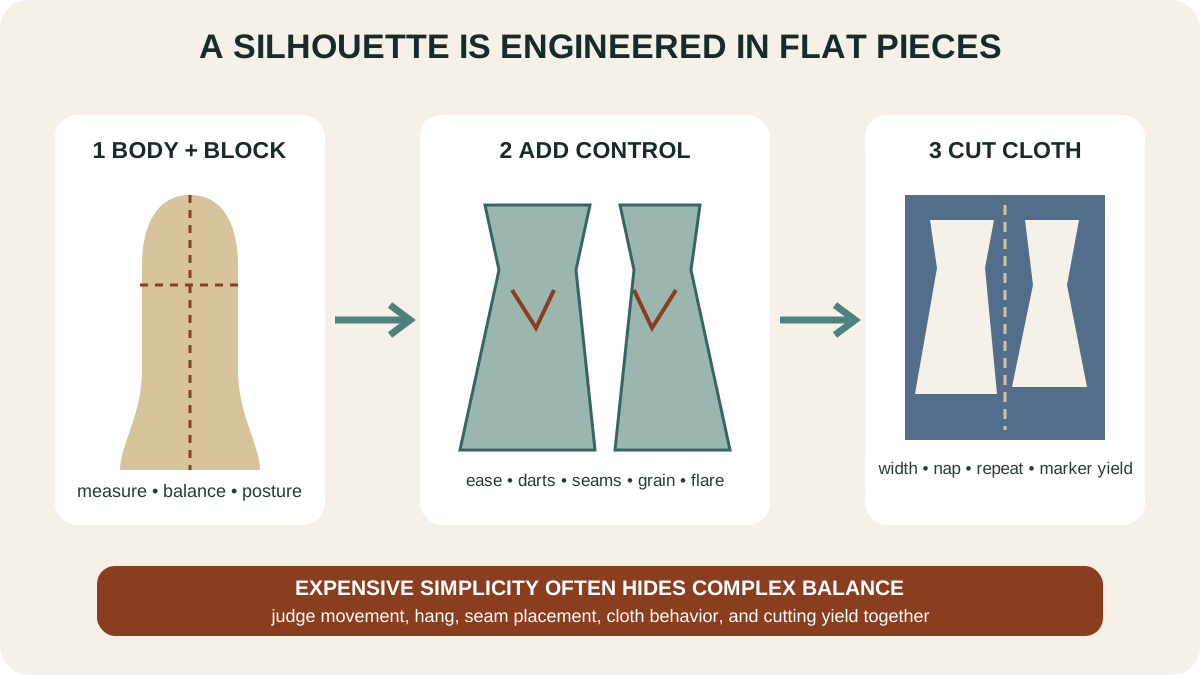
Cloth is flat. Bodies and movement are not. Pattern cutting is the negotiation.
Fineas Jackson’s “strange clothes” prompt 1 is useful because unfamiliar lines are often evidence of an older job: carrying volume, admitting movement, protecting a seam, fitting a body, or using a narrow loom efficiently.
Playback is optional. If the player is unavailable, open the video at its source.
Start with block, ease, and silhouette
A block or sloper is a close-fitting pattern foundation derived from measurements and tested for balance. Style is developed by moving darts, adding or removing volume, changing seams, and reshaping edges. FIT’s patternmaking curriculum treats finished measurements, fit, balance, collars, sleeves, and production specifications as one connected discipline 2.
Ease is the difference between body and garment measurement.
total ease = finished garment measurement − body measurement
Some is wearing ease: room to breathe, sit, bend, and reach. The rest is design ease: the deliberate slim, straight, boxy, cocoon, oversized, or draped silhouette.
Twenty centimeters of chest ease placed entirely at the side seams does not behave like the same amount divided among a dropped shoulder, back pleat, curved front, and underarm gusset.
Sleeve architecture changes movement and appearance
Set-in sleeve
The sleeve cap joins a defined armhole. It can give a clean shoulder point and tailored control, but cap height, bicep width, armhole depth, and rotation must work together. A low armhole may feel roomy while the arm hangs yet pull the whole jacket upward when the arm rises.
Raglan sleeve
The sleeve extends toward the neckline, creating diagonal seams. This can soften shoulder fit, distribute size variation, and give reach. It also changes the visual width of the upper body and can create excess cloth near the neck if poorly shaped.
Dolman or grown-on sleeve
Body and upper sleeve are cut together. It eliminates an armhole seam and creates a broad, flowing underarm, but consumes width and can lift the hem when the arm rises.
Gusset
A diamond, triangle, or shaped insert adds local area at underarm, crotch, or another stress point. It can preserve a close body while allowing reach. More pieces mean more cutting, seams, alignment, and inspection—but also more controlled movement.
Grain changes drape
The lengthwise grain usually runs parallel to the selvage and often stretches least. The cross grain often gives more. The bias, roughly 45 degrees to warp and weft in woven cloth, can deform substantially because yarns rotate relative to one another.
Bias cutting can create fluid cling and swing without elastic fiber. It also consumes cloth, complicates stabilization, and can grow unevenly. Pieces may need to hang before hemming. A careless bias garment twists; a controlled one uses grain as structure.
Knits have courses and wales rather than woven warp and weft, but orientation still matters. A rotated panel can shade differently, stretch differently, or spiral.
Articulation: shape for the body in motion
Outdoor trousers often use curved knees, darts, gussets, or rotated inseams. A climbing jacket may pre-shape the elbow and place seams away from pack straps. These choices create a three-dimensional resting shape that can look “strange” on a hanger.
A useful articulation test:
- photograph the garment flat;
- identify darts, curved seams, pleats, gussets, and elastic zones;
- put it on and assume the intended posture;
- note which features open, flatten, or align;
- compare hem movement and pressure with a simpler garment.
If a complex cut produces no measurable mobility, fit, pocket access, or silhouette benefit, it may be visual theater—or simply designed for a different body and job.
Cloth yield: the invisible cost of a clean exterior
Patterns must fit within fabric width while respecting grain, nap, one-way prints, flaws, size mix, and matching. Lectra treats marker efficiency, re-cuts, shrinkage, motif alignment, and rotation rules as cutting-room cost variables 3.
marker efficiency % = total area of pattern pieces ÷ marker area × 100
That is not the same as total factory yield. Add end loss, splice loss, shade separation, defects, test cuttings, and re-cuts.
Large checks, stripes, velvet nap, engineered prints, asymmetric motifs, and leather-like directional variation restrict rotation and placement. A jacket with perfectly matched plaid across front, pocket, lapel, and sleeve may consume much more material than its scale suggests.
Three levels of cut
Budget cut
- few pieces and straight seams;
- one broad block graded across many bodies;
- shallow hems and seam allowances;
- limited pattern matching;
- little allowance for alteration;
- fast marker nesting.
This can be excellent for a rectangular overshirt. Simplicity is a problem only when the body or job requires more.
Competent cut
- stable size specifications;
- sleeve and armhole balanced together;
- useful ease placed where movement occurs;
- grain and nap respected;
- pockets accessible in posture;
- shrinkage and seam behavior tested;
- repeat matching at the most visible points.
Exceptional cut
- a deceptively clear silhouette built from exact volume control;
- complex patterns justified by motion, drape, or proportion;
- careful matching and symmetry where appropriate;
- allowance for pressing, turn of cloth, internal structure, and alteration;
- repeated fittings or technically strong grading;
- clean appearance without starving seams or forcing the cloth.
The V&A’s Balenciaga reconstruction makes the central point: apparent simplicity can result from sophisticated pattern cutting, not from the absence of work 4.
Field audit: reverse-engineer a jacket
Mark the garment with removable sticky notes:
Vfor volume added;Mfor movement;Sfor structural support;Pfor pocket or interface;Efor economy;Dfor a primarily decorative line.
Then move through reach, bend, sit, carry, and close/open motions. A seam may hold more than one letter. The exercise turns “nice shape” into a defensible account of how cut produces behavior.
Rule of thumb
A good silhouette is not merely an outline. It is a distribution of cloth around a moving body. Pay more when the pattern solves fit, movement, drape, matching, or alteration—not merely because it contains more pieces.
Practice
Wearing ease permits movement; design ease creates the intended shape. The same chest measurement can be distributed differently.
Practice
Alignment adds placement constraints. More usable cloth may be sacrificed so seams and paired parts read coherently.
Practice
A gusset inserts material where a simple seam intersection would bind or concentrate stress.
Lesson complete
Nice work.
Sources for this lesson
- 1Fineas Jackson. The hidden reason your clothes look so strange. Fineas Jackson on YouTube. 2026. verifiedChasing Beauty episode 68; 3:33. Used as a case or observation prompt, not as the sole authority for technical claims. Cited at: episode 68.
- 2Patternmaking Course Descriptions. Fashion Institute of Technology. verifiedAcademic descriptions of slopers, finished measurements, fit, balance, draping, and production-ready pattern development. Cited at: academic patternmaking sequence.
- 3Your 7 Steps Roadmap to Reduce Material Waste in Your Fashion Cutting Room. Lectra. 2026. verifiedApparel cutting-system guidance on marker efficiency, fabric width, shrinkage, motif alignment, rotation rules, re-cuts, and first-pass quality. Cited at: cutting guidance.
- 4Learning from the Master. Victoria and Albert Museum. 2024. verifiedMuseum and London College of Fashion reconstruction project showing how apparently simple silhouettes can require complex pattern cutting and control of cloth. Cited at: reconstruction project.
Previous: Knitwear: Cut-and-Sewn, Fully Fashioned, and Seamless