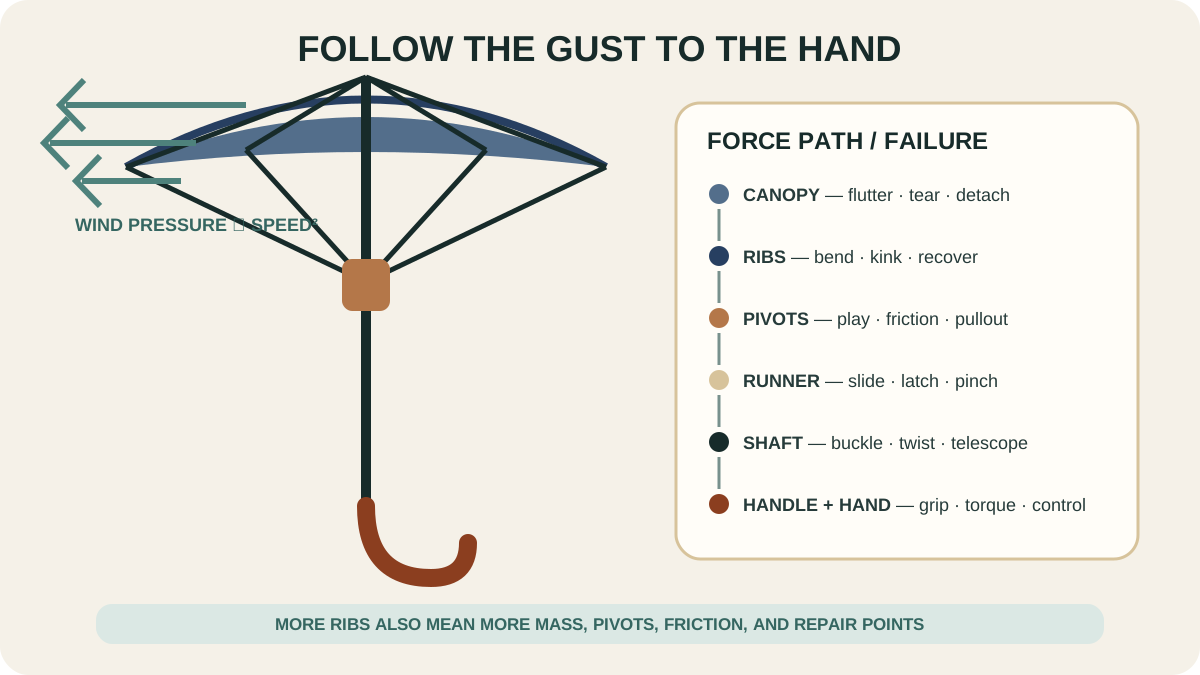
Umbrellas: Canopy, Ribs, Joints, and Wind
An umbrella as a one-handed tension structure: canopy, ribs, stretchers, runner, and shaft, how wind becomes bending and torsion, why more ribs isn't automatically better, stick, folding, and automatic designs, inversion as a fuse, and a hallway audit.
- 6 min
- 11 steps
- 3 questions
- Lesson 29 of 49
In this lesson
- Name the parts before judging them
- The canopy is a prestressed surface
- Wind becomes a chain of forces
- Why more ribs is not automatically better
- Stick, folding, and automatic architectures
- Inversion can be a fuse
- Fit and handling
- Three quality levels
- The hallway audit
- Rule of thumb
Open alongside this lesson
-
Wind-Resistant Umbrella (opens in a new tab)
Use the drawings to identify pole, runner, stretchers, ribs, joints, canopy, and anti-inversion features; treat the proposed solution as a design claim, not independent proof of performance.
Picking up where you left off.
An umbrella is a collapsible tension structure operated by one hand. It must deploy quickly, hold a curved textile surface, shed water, survive repeated folding, tolerate gusts, stay light enough to carry, and avoid turning its joints into finger traps.
Fineas Jackson’s umbrella episode asks why some versions cost so much 1. The answer is not one noble wood or a heroic rib count. It is the controlled movement of a linked mechanism.
Playback is optional. If the player is unavailable, open the video at its source.
Name the parts before judging them
A conventional handheld umbrella includes:
- canopy panels joined into a shaped surface;
- ribs extending from the top region toward the canopy edge;
- stretchers linking ribs to the sliding mechanism;
- runner that travels along the shaft;
- notches, cups, or hinges at central connections;
- shaft or telescoping tube set;
- spring, latch, or automatic opening components;
- tips, cap, handle, tie, and closure.
Patent drawings are useful because they strip away lifestyle photography. One wind-resistant umbrella patent identifies the canopy, pole, ribs, stretchers, runner, and anti-inversion relationships explicitly 2. A patent shows a proposed mechanism; it does not prove the retail object is durable.
The canopy is a prestressed surface
Panels are cut with curvature and joined so opening the ribs pulls them into tension. Too loose, and the fabric flaps, catches water, and transfers shock unpredictably. Too tight, and seams, tips, or ribs carry constant excess load.
Inspect:
- panel seams for straight feeding and complete coverage;
- attachment at each rib tip and intermediate tie;
- reinforcement at the top and high-stress points;
- fabric damage where folded against joints;
- edge shape and drip behavior;
- closure without forcing wet fabric into a tiny bundle.
Water repellency helps droplets bead, but the physical roof also needs overlap, seam control, and a crown that does not pool. A soaked canopy should open to dry.
Wind becomes a chain of forces
A gust creates pressure across the canopy. That pressure becomes bending and torsion in ribs, load at pivots, compression or tension in stretchers, sliding force at the runner, bending in the shaft, torque at the handle, and finally force in the user’s wrist.
A simplified relation is:
wind force ∝ air density × area × wind speed² × shape factor
Double wind speed and aerodynamic force can rise by roughly four times under comparable conditions. Real gusts and canopy shapes complicate the number, but the square relationship explains why a small change in weather overwhelms a mechanism that felt secure moments earlier.
Why more ribs is not automatically better
More ribs can reduce unsupported canopy span and distribute load. They also add:
- mass;
- drag and inertia during opening;
- pivots and attachments;
- friction;
- packaging bulk;
- repair complexity.
Rib material matters through section shape and connection. Thin spring steel may flex and recover; aluminum saves mass but can take a permanent bend; fiber-reinforced composite can flex without corrosion but needs sound joints. A strong rib attached to a weak plastic pivot merely moves the failure.
Stick, folding, and automatic architectures
Stick umbrella
A single long shaft and fewer telescoping interfaces can produce stiffness, broad coverage, and clean motion. The cost is carrying length.
Manual folding umbrella
Telescoping shafts and folding ribs reduce packed size. Each extra joint adds play, friction, alignment demands, and potential wear.
Automatic open or open-close
Springs and cords add convenience and a satisfying gesture. They also add force, parts, service risk, and the need to control closing safely. A mechanism that snaps open impressively in a shop may become unpleasant if reset force is too high.
Choose the architecture whose inconvenience you will actually tolerate. A perfect stick umbrella left at home has no rain performance.
Inversion can be a fuse
When wind gets under the canopy, ribs may flip upward. Inversion is not always catastrophic; a flexible or articulated system may release pressure and return without permanent damage. Judge:
- how easily inversion occurs;
- whether the canopy detaches;
- whether ribs kink or simply flex;
- whether pivots loosen;
- whether it can be restored safely;
- how it performs after multiple events.
“Windproof” without a stated procedure, wind speed, orientation, pass criterion, and after-test inspection is mostly an adjective.
Fit and handling
The user is part of the structure. Test:
- handle diameter with a wet hand or glove;
- balance when fully open;
- wrist torque when canopy is angled;
- runner pinch clearance;
- latch access;
- closing force;
- enough coverage for body, bag, or companion;
- tip behavior in crowds;
- wet storage and drying.
A sculpted hardwood handle may justify skilled material selection and finishing, but grip security and shaft attachment matter more than species prestige.
Three quality levels
| Level | Legitimate version | Common compromise | Evidence |
|---|---|---|---|
| Compact budget | low mass, simple manual operation, replaceable everyday object | high joint play, weak tips, tiny wet coverage | smooth deployment, reinforced attachments, honest limits |
| Serious commuter | controlled telescoping fit, recoverable ribs, useful canopy, grippy handle | added mass and cost | repeat-cycle claim, parts detail, warranty, dry-open behavior |
| Craft stick | shaped handle, carefully tensioned canopy, strong simple shaft, repairable assembly | inconvenient length; luxury materials may dominate | maker process, replaceable canopy or ribs, service, balanced handling |
The hallway audit
Without exposing yourself to a storm:
- open and close it ten times;
- listen for scraping and watch for asymmetric deployment;
- gently rock each joint and compare play;
- inspect every canopy tie and rib tip;
- hold it sideways and feel shaft/handle connection;
- mist the canopy, check shedding, then open it to dry;
- confirm you will carry its packed size.
Do not create dangerous improvised wind tests. A fan, vehicle, or rooftop can launch parts and conceal real gust behavior.
Rule of thumb
Buy an umbrella as a moving force path. The best one is not the object with the most ribs or finest handle; it is the mechanism you will carry, control, dry, and recover when weather stops behaving politely.
Practice
Adding ribs changes load distribution but also adds pivots, mass, drag, and possible failure points.
Practice
Some designs tolerate and recover from inversion, while others permanently bend, tear, or loosen.
Practice
Telescoping convenience and long-shaft simplicity solve different briefs.
Lesson complete
Nice work.
Sources for this lesson
- 1Fineas Jackson. Why cheap umbrellas fail…and the ugly $60 umbrella that beats a $500 masterpiece. Fineas Jackson on YouTube. 2026. verifiedChasing Beauty episode 39; 2:43. Used as a case or observation prompt, not as the sole authority for technical claims. Cited at: episode 39.
- 2Wind-Resistant Umbrella. World Intellectual Property Organization. 2017. verifiedPrimary patent drawings and description identifying canopy, pole, ribs, stretchers, runner, joints, and anti-inversion geometry in a handheld umbrella. Cited at: design document.