Expensive, Overpriced, or Worth It?
Deciding whether something is worth it: quality stated against a purpose, a five-part check of work, ownership horizon, risk, trouble, and human meaning, whole-life cost, how a product fails as part of its design, and writing two verdicts.
- 8 min
- 7 steps
- 3 questions
- Lesson 39 of 49
In this lesson
- Quality needs a sentence after it
- The WORTH horizon
- Compare the whole cost
- Failure behavior is part of design
- Practice: write two verdicts
- Rule of thumb
Open alongside this lesson
-
Why cheap umbrellas fail…and the ugly $60 umbrella that beats a $500 masterpiece (opens in a new tab)
Compare the inexpensive and luxury umbrellas by wind behavior, recovery, and intended use rather than appearance alone.
-
$700 for a pair of leather loafers…why? How is that even possible? #leather #loafers #education (opens in a new tab)
Use the loafer comparison to identify material, construction, repair, and brand claims that require separate evidence.
-
$600 for a…pen? Why? How is it different from a pen that cost $2? #pen #montblanc #education (opens in a new tab)
Ask where writing performance plateaus and where ritual, finish, service, and identity begin.
-
They've been lying to you about cookware #education #pan (opens in a new tab)
Translate the video's cookware comparison into explicit use cases and maintenance burdens.
-
$100 for Japanese nail clippers…why? How is that even possible? (opens in a new tab)
Observe how edge geometry, alignment, leverage, and finish can matter in a very small tool.
-
$2000 for Japanese kitchen knife…why? How is that even possible? (opens in a new tab)
Separate steel name from heat treatment, grind, geometry, balance, finishing, and maker labor.
Picking up where you left off.
Fineas Jackson’s umbrella comparison contains the central surprise of this course: the object with the highest price and most refined appearance need not be the one you should buy. His practical favorite is not presented as the most elegant. It earns attention because its structure responds usefully to wind and because a bad gust does not end its life 1.
That does not prove that the luxury umbrella is a scam. It proves that five questions commonly collapse into one:
| Question | What it actually asks |
|---|---|
| Is it expensive? | Is its price high relative to alternatives or to my budget? |
| Is it overpriced? | Does its asking price exceed a stated market benchmark after adjusting for comparable specifications, condition, service, and terms? |
| Is it costly to make? | Did materials, labor, tooling, testing, or low-volume production require substantial resources? |
| Is it high quality? | Does it perform its intended jobs reliably, with appropriate fit, finish, and durability? |
| Is it worth it? | Do those qualities, meanings, and ownership consequences justify the trade-off for this user? |
The tag gives only the asking price. Expensive requires a comparator; overpriced requires an explicit market or comparable-offer benchmark; the remaining claims require evidence about making, performance, and use. Whether the object serves this owner’s priorities and opportunity cost belongs under worth it, not overpriced.
Quality needs a sentence after it
Calling something “high quality” without naming a purpose is like calling a vehicle “fast” without saying whether it is a bicycle, forklift, or train. Quality is fitness for specified work.
A chef’s knife may be evaluated for geometry, edge stability, ease of sharpening, food release, balance, corrosion behavior, and handle comfort. Those qualities conflict. A very thin edge can slice beautifully but tolerate less abuse. A hard steel can retain an edge but demand more careful sharpening. Jackson’s knife episode is useful because it moves attention away from the steel name toward heat treatment, grind, taper, balance, and finishing 2. The label is an opening clue, not the verdict.
Standards make some quality claims testable. The Consumer Product Safety Commission describes voluntary standards as documents that can state performance requirements and repeatable test methods 3. A test result is powerful within its boundary: a chair survived a specified load cycle; a fabric met a stated abrasion method; an umbrella resisted a defined wind condition. It does not establish universal superiority. Ask for the method, specimen, threshold, and date.
Use this sentence frame:
For this user and task, the object is high quality because this observable feature or test result reduces this failure or burden over this period.
If you cannot fill the blanks, you have an impression—not yet an evaluation.
The WORTH horizon
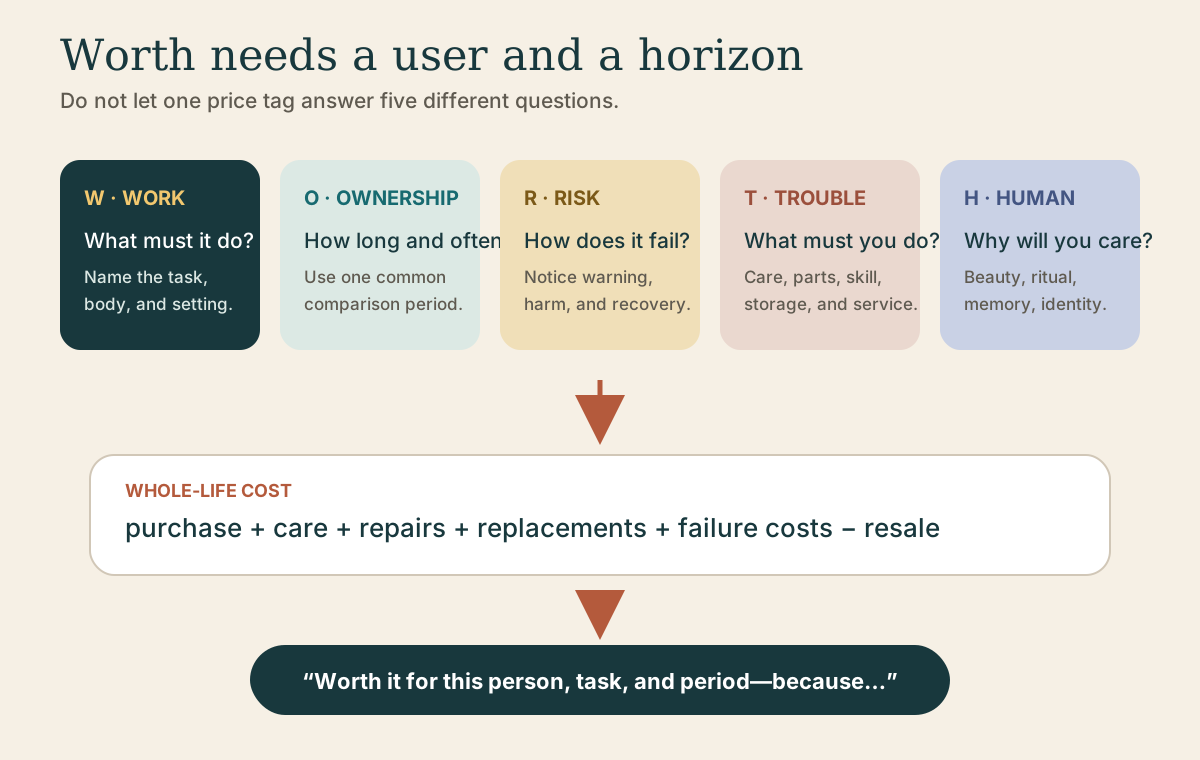
Use WORTH before comparing prices.
- W — Work: What jobs must the object perform? Rank the top three. “Carry rain off my shoulders during a windy walk” is more useful than “be a good umbrella.”
- O — Ownership horizon: How long and how often will you use it? A one-night costume and a ten-year coat should not be judged with the same weights.
- R — Risk and failure: What happens when it fails? Annoyance, ruined ingredients, injury, missed work, or only a scratch? How predictable is failure?
- T — Trouble: What cleaning, sharpening, storage, charging, specialist service, or learning does ownership require? Maintenance you will not perform should be counted as a design mismatch.
- H — Human meaning: Does beauty, ritual, memory, identity, provenance, or maker relationship matter to you? Treat this as real value, but name it instead of disguising it as technical performance.
The Design Council’s value framework is useful here because it treats design value as more than financial return: social and environmental effects can arise during production, use, and end of life 4. A repairable object can preserve material and economic value; NIST places repair, reuse, refurbishment, and recycling inside a circular-economy model 5. “Repairable” still needs specifics: available parts, accessible fasteners, documentation, willing repairers, and a repair cost that makes sense.
Compare the whole cost
For everyday decisions, use a simple ownership model:
Then divide by a common unit:
This is a decision estimate, not an accounting audit. Write a low, likely, and high lifespan instead of hiding uncertainty behind one precise number. The University of Maryland’s lifecycle-cost work similarly treats purchase as only one part of cost, alongside operation, maintenance, upgrading, residual value, and disposal 6. GSA’s lifecycle perspective includes acquisition, operation, maintenance, removal, and disposal while also asking about effects outside the use phase 7.
Worked example: two loafers
Suppose Pair A costs $90, cannot economically be resoled, and is likely to last 120–240 wears. Pair B costs $650, can be resoled for an estimated $180, and might last 500–900 wears with care. These are assumptions to verify, not promises supplied by price.
| Scenario | Likely whole-life cost | Likely wears | Cost per wear |
|---|---|---|---|
| A, one pair | $90 | 180 | $0.50 |
| A, four replacements | $360 | 720 | $0.50 |
| B, one resole | $830 | 720 | $1.15 |
The repairable pair does not automatically win the arithmetic. Its case may rest on fit, appearance, pleasure, lower waste, a reliable upper, or service—not a false claim that it must be cheaper per wear. Jackson’s loafer episode correctly focuses attention on upper material, construction, and resoling, but the buyer must verify the particular shoes and local repair reality 8.
Now test sensitivity. If Pair A fails at 100 wears, its cost becomes $0.90 per wear. If Pair B needs two resoles and reaches 1,200 wears, its cost is about $0.84 per wear. The choice changes because the uncertain variables changed. That is insight, not a defect in the method.
Failure behavior is part of design
Do not ask only, “Will it fail?” Everything eventually does. Ask:
- How does it warn me? A slowly loosening fastener is different from sudden fracture.
- How does it fail? Does it bend, jam, leak, crack, delaminate, or become unsafe?
- Can it recover? Can an umbrella invert and return, a pan be re-seasoned, a shoe be resoled, or a pen be cleaned?
- What becomes scrap? A replaceable blade can preserve the whole tool; an inaccessible battery can retire a sound enclosure.
- Who can restore it? “Serviceable” means little if parts, tools, knowledge, or authorized service are unavailable.
Jackson’s nail-clipper case makes this concrete. Alignment, edge geometry, and lever action may improve the cut, but the rational premium depends on how often you use the tool, whether it remains aligned, and whether that difference matters to your hands 9. A beautifully made specialist tool can be excellent and still unnecessary for you.
Playback is optional. If the player is unavailable, open the video at its source.
Practice: write two verdicts
Choose two versions of one object at meaningfully different prices. Do not start with “Which is better?” Start with a use case and complete WORTH.
Create a one-page comparison containing:
- three required jobs and one quality you do not need;
- the expected ownership horizon and uses per year;
- two likely failure modes for each object;
- purchase, consumable, repair, replacement, and resale estimates;
- one verified performance claim and its method;
- one emotional or aesthetic value stated plainly;
- a low, likely, and high cost-per-use result.
Then write two verdicts:
- Technical verdict: which object better fits the stated work and risk?
- Personal verdict: which would you choose after price, pleasure, maintenance, and opportunity cost?
They may disagree. That is the point.
Rule of thumb
Price is public; worth is conditional. Call an object expensive from a market or budget comparison, overpriced only against an explicit market or comparable-offer benchmark, costly from evidence about making, high quality from performance against a purpose, and worth it only after naming the user and ownership horizon.
Practice
Cost, performance, and personal value are separate. The commuter’s purpose gives wind behavior and repair more weight without proving anything dishonest about the other umbrella.
Practice
A common ownership horizon and cost per use expose replacement and maintenance while keeping the comparison tied to actual use.
Practice
Repeatable testing can support a bounded performance claim; it cannot decide taste, personal fit, or market value by itself.
Lesson complete
Nice work.
Sources for this lesson
- 1Fineas Jackson. Why cheap umbrellas fail…and the ugly $60 umbrella that beats a $500 masterpiece. Fineas Jackson on YouTube. 2026. verifiedChasing Beauty episode 39; 2:43. Used as a case or observation prompt, not as the sole authority for technical claims. Cited at: wind behavior and recovery comparison.
- 2Fineas Jackson. $2000 for Japanese kitchen knife…why? How is that even possible?. Fineas Jackson on YouTube. 2026. verifiedChasing Beauty episode 48; 2:57. Used as a case or observation prompt, not as the sole authority for technical claims. Cited at: knife construction factors.
- 3Voluntary Standards Development FAQ for Consumers. U.S. Consumer Product Safety Commission. verifiedExplains how product-safety standards define performance requirements and repeatable test methods. Cited at: performance requirements and test methods.
- 4The Design Value Framework. Design Council. verifiedFramework for financial, social, environmental, and democratic value across design, production, use, and end of life. Cited at: value dimensions and lifecycle stages.
- 5Circular Economy. National Institute of Standards and Technology. verifiedExplains how reuse, repair, refurbishment, and recycling can preserve resources and economic value. Cited at: value retention strategies.
- 6MCHESS Research: Life-Cycle Cost. University of Maryland Center for Advanced Life Cycle Engineering. verifiedLifecycle-cost framing that extends beyond purchase price to use, maintenance, upgrading, residual value, and disposal. Cited at: lifecycle cost components.
- 7Life cycle perspective (life cycle thinking). U.S. General Services Administration. verifiedGovernment overview of financial and environmental effects from extraction and purchase through operation, maintenance, removal, reuse, and disposal. Cited at: whole-lifecycle framing.
- 8Fineas Jackson. $700 for a pair of leather loafers…why? How is that even possible? #leather #loafers #education. Fineas Jackson on YouTube. 2026. verifiedChasing Beauty episode 13; 3:00. Used as a case or observation prompt, not as the sole authority for technical claims. Cited at: loafer material, construction, and repair claims.
- 9Fineas Jackson. $100 for Japanese nail clippers…why? How is that even possible?. Fineas Jackson on YouTube. 2026. verifiedChasing Beauty episode 41; 2:27. Used as a case or observation prompt, not as the sole authority for technical claims. Cited at: clipper geometry and tolerance case.