
How Icons Stay Recognizable
Why icons stay recognizable across versions: a stable core of contour and details with permitted change, the Porsche 911's engine and silhouette, four recognition tests, the 1936 Ray-Ban aviator, the T-shirt, the bikini's troubling name, and a continuity strip.
- 7 min
- 9 steps
- 3 questions
- Lesson 38 of 49
In this lesson
- Recognition needs a stable core and permitted change
- Constraint influences silhouette; it does not dictate it
- Run four recognition tests
- The aviator proves that use is only the first chapter
- Simple containers permit powerful variation
- An icon’s story can be ethically incoherent
- Titles are claims, not evidence
- Build an icon continuity strip
Open alongside this lesson
-
How one camera saved hundred of lives (opens in a new tab)
List the people, mechanism, institution, dates, and outcome implied by the title, then seek primary or museum evidence before repeating the causal claim.
-
The most iconic swimsuit in the world was named after…an atomic bomb?? #education (opens in a new tab)
Study naming as an icon-making device while keeping Bikini Atoll, nuclear testing, and Marshallese displacement in the story.
-
The t-shirt used to be shameful…now it’s everywhere. Behind the strange origin story of the white t (opens in a new tab)
Notice how a simple silhouette permits enormous variation in graphic, fit, fiber, status, subculture, and price.
-
How Pilots Created the World’s Most Iconic Sunglasses (opens in a new tab)
Compare the documented period claim of development for aviators with the much broader fashion meanings the frame later acquired.
-
The Porsche 911’s name is actually an accident…how did it happen? #porsche #education #design (opens in a new tab)
Separate the Peugeot naming-right objection from the engineering and design decisions that made later generations recognizable.
Picking up where you left off.
Draw a car as one continuous roofline, two raised front fenders, a low hood, round lamps, and a fast curve into the rear. Many people will say “911” before seeing a badge. That recognition was not present at birth. It accumulated through repetition, use, media, competition, ownership, and careful revision across generations.
Fineas Jackson begins with the number 1. Porsche introduced the new model as the 901, but Peugeot objected to Porsche using a three-digit designation with zero in the middle, asserting its naming rights. Porsche changed the center digit to make 911 2. Porsche Museum material says the first 82 examples carried the 901 designation 3. Calling the name an “accident” captures the surprise but not the whole icon. The rights dispute explains the label; it does not explain six decades of recognition.
Playback is optional. If the player is unavailable, open the video at its source.
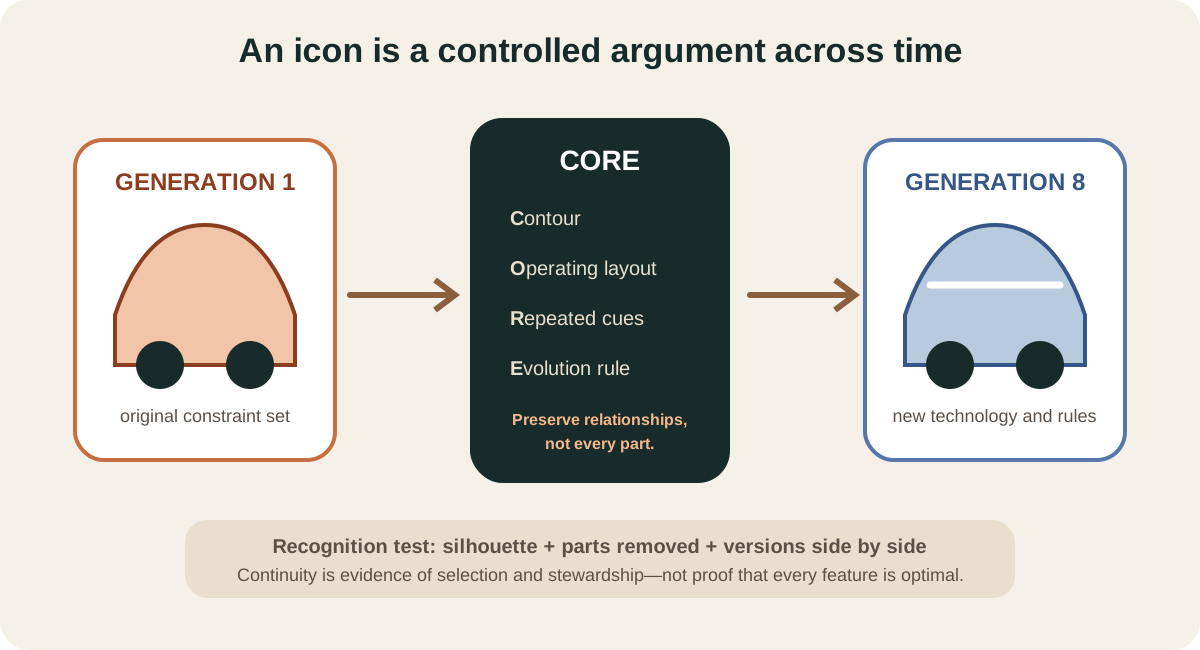
Recognition needs a stable core and permitted change
Use CORE to analyze an icon:
- C — Contour: Which outer silhouette survives at thumbnail distance?
- O — Operating layout: Which arrangement of body, mechanism, and interface shapes the type?
- R — Repeated cues: Which lights, openings, seams, colors, sounds, or details return?
- E — Evolution rule: What may change without breaking recognition?
The last question separates a living icon from a replica. Regulations, bodies, roads, materials, manufacturing, and technologies change. If nothing can move, the form becomes costume. If everything moves at once, the family loses memory.
Constraint influences silhouette; it does not dictate it
The 911’s rear-mounted flat engine strongly influenced packaging. It helped produce a low front without a conventional front radiator grille, placed mass over the driven rear axle, and shaped cooling and body relationships. Porsche traces that layout across eight generations 4.
But “the rear engine created the silhouette” becomes misleading if it sounds inevitable. Other rear-engine cars do not look identical. The designers still chose wheelbase, cabin position, glass angle, fender height, roof arc, overhang, lamp treatment, and how much each generation should resemble the last. Cooling changed from air to water. Dimensions, safety structure, aerodynamics, lighting, bumpers, interiors, tires, and manufacturing evolved.
The rear engine is therefore a persistent form-generating constraint, not a mechanical stencil. It also carries trade-offs and does not prove that rear placement is universally superior. The icon emerges from constraint plus repeated human selection.
Run four recognition tests
You can test icon claims without relying on a logo:
- Silhouette test: Fill the object as a solid black shape. Is the type still identifiable?
- Subtraction test: Remove badge, color, texture, and signature surface graphics. Which cues survive?
- Generation test: Put versions in chronological order. Can you point to both continuous relationships and genuine changes?
- Impostor test: Compare a lookalike. Which one or two relationships make it similar, and which differences reveal another system?
A strong result does not require universal recognition. Expertise, geography, age, advertising exposure, and culture affect what people know. Record the audience. “Recognizable to sports-car enthusiasts in this market” is better evidence than “timeless.”
The aviator proves that use is only the first chapter
The National Museum of American History documents Bausch & Lomb’s 1936 introduction of Ray-Ban eyewear and period advertisements describing it as developed for Army and Navy aviators 5. That supports a military-aviation association. It does not mean pilots personally designed every part, nor that every teardrop-lens fashion frame meets an aviation specification.
The recognizable core includes large lens coverage, a thin bridge structure, and a frame geometry that visually drops around the eyes. Later versions vary lens color, prescription, frame material, bridge count, scale, branding, and price 6. Cinema and celebrity shifted the social meaning from specialized equipment toward coolness, authority, anonymity, and nostalgia. Operating logic formed a memorable contour; culture multiplied its jobs.
Simple containers permit powerful variation
The T-shirt’s icon is almost aggressively generic: short sleeves, a T-like flat silhouette, pull-on neck, knit body, and broad chest field. The V&A traces its path from undergarment and work layer toward outerwear 7. Because the structural core is quiet, print, fit, fiber, color, distress, slogan, and context can change radically 8.
This is container coherence. The invariant form does not dictate one message; it supports thousands. A protest shirt and a luxury blank remain recognizable as the same product type while opposing each other in economics and social meaning.
The lesson transfers to interfaces and furniture. A stable navigation frame can hold changing content. A chair type can preserve seat, back, and load path while allowing different materials and cultural references. Iconic design is not always a rare sculpture. Sometimes it is a resilient grammar.
.jpg)
An icon’s story can be ethically incoherent
The bikini’s tiny silhouette and compact name are globally recognizable, but the name came from Bikini Atoll, where United States nuclear testing had begun. Smithsonian’s account explains that Louis Reard wanted the association with an explosive public reaction 9. Jackson uses the twist as an origin story 10.
An adequate lesson cannot stop at cleverness. A United Nations account records that the initial nuclear tests displaced communities from Bikini Atoll and its surroundings 11. Their home then became a metaphor sold elsewhere. The icon’s history contains unequal power. Coherence in visual form does not guarantee coherence in ethics. When an origin uses a person, community, or catastrophe as brand material, ask who gained recognition and who lost control of the story.
Titles are claims, not evidence
“How one camera saved hundreds of lives” is a powerful episode title 12. Before repeating it, unpack the causal chain. Which camera? What technical feature? Used by whom, where, and when? What counted as a life saved? Is there a report, archive, museum record, or contemporary documentation? Could training, policy, distribution, or another tool share the result?
This exercise matters because iconic objects attract compressed hero stories. A product may be important without acting alone. The more dramatic the causal verb—saved, invented, revolutionized, ended—the more links the evidence must support.
Build an icon continuity strip
Choose one object family with at least four dated versions: camera, sneaker, game controller, kettle, chair, car, pen, or software icon.
- Collect one comparable view of each generation.
- Trace only the outer contour.
- Mark five repeated cues and five changed variables.
- Complete CORE for the family, not just your favorite example.
- Identify one change forced by regulation or technology and one chosen mainly for identity.
- Design a next generation. Preserve only three cues and explain why those three carry recognition.
Finish with two sentences: “It remains recognizable because ___,” and “It remains alive because ___ was allowed to change.” If the same word fills both blanks, investigate further.
Three rules of thumb help:
- Recognition is cumulative. A first release can be distinctive; iconic status requires repetition among people.
- Preserve relationships before ornaments. Roof arc, operating layout, or control order often carries more identity than a badge.
- Continuity is not proof of optimality. A form may persist through compatibility, nostalgia, market power, or careful improvement.
An icon stays recognizable by remembering selectively. Its beauty lies in the tension between “I know this” and “I have not seen this version before.”
Practice
Porsche’s own history records the naming-right dispute. The name change should not be confused with the car’s engineering layout or silhouette development.
Practice
Layout is a powerful constraint, not a single-form machine or universal ranking. Iconic continuity results from repeated selection and adaptation.
Practice
An icon stays alive by knowing what can change. Without variation it becomes replica; without invariants it loses family resemblance.
Lesson complete
Nice work.
Sources for this lesson
- 1Fineas Jackson. The Porsche 911’s name is actually an accident…how did it happen? #porsche #education #design. Fineas Jackson on YouTube. 2026. verifiedChasing Beauty episode 14; 2:29. Used as a case or observation prompt, not as the sole authority for technical claims. Cited at: episode 14.
- 2I Am Legend. Porsche Newsroom. 2015. verifiedPorsche's account of the 901 debut, Peugeot's objection to the three-digit-with-zero naming pattern, the 911 rename, and the car's design brief and layout. Cited at: Porsche’s account.
- 3No. 57 Lives On. Porsche Newsroom. 2015. verifiedPorsche Museum account stating that the first 82 examples in the model's first year carried the 901 type designation before the change to 911. Cited at: production history.
- 4For Eternity. Porsche Newsroom. 2019. verifiedOfficial comparison of eight 911 generations linking the rear-engine layout to persistent proportions while documenting substantial technical and visual evolution. Cited at: generation comparison.
- 5Ray-Ban Sunlenses. National Museum of American History. verifiedMuseum record documenting Bausch & Lomb's 1936 introduction and period advertising that described the glasses as developed for Army and Navy aviators. Cited at: museum record.
- 6Fineas Jackson. How Pilots Created the World’s Most Iconic Sunglasses. Fineas Jackson on YouTube. 2026. verifiedChasing Beauty episode 69; 3:02. Used as a case or observation prompt, not as the sole authority for technical claims. Cited at: aviator episode.
- 7Kristian Volsing. T-Shirts 101. Victoria and Albert Museum. 2014. verifiedMuseum history tracing the T-shirt from washable undergarment and naval work layer toward widely accepted outerwear. Cited at: museum history.
- 8Fineas Jackson. The t-shirt used to be shameful…now it’s everywhere. Behind the strange origin story of the white t. Fineas Jackson on YouTube. 2026. verifiedChasing Beauty episode 47; 2:54. Used as a case or observation prompt, not as the sole authority for technical claims. Cited at: T-shirt episode.
- 9Rose Eveleth. The Bikini's Inventor Guessed How Much It Would Horrify the Public. Smithsonian Magazine. 2013. verifiedAccount of Louis Reard's naming of the modern bikini after Bikini Atoll, where United States nuclear testing had begun; a reminder that an icon's story can contain harm as well as novelty. Cited at: name history.
- 10Fineas Jackson. The most iconic swimsuit in the world was named after…an atomic bomb?? #education. Fineas Jackson on YouTube. 2026. verifiedChasing Beauty episode 35; 2:59. Used as a case or observation prompt, not as the sole authority for technical claims. Cited at: episode 35.
- 11The Unseen Battle: Addressing the Nuclear Legacy in Pacific Island Countries. United Nations in Micronesia. 2024. verifiedUnited Nations account of nuclear testing in the Marshall Islands, including displacement of communities from Bikini Atoll and its surroundings and the continuing human-rights, health, environmental, and livelihood effects. Cited at: displacement and continuing nuclear legacy.
- 12Fineas Jackson. How one camera saved hundred of lives. Fineas Jackson on YouTube. 2026. verifiedChasing Beauty episode 31; 2:43. Used as a case or observation prompt, not as the sole authority for technical claims. Cited at: episode 31.