The Lookalike Test
Comparing two objects that look the same: the job and load, observable differences, hidden construction, tagging each finding as documented, measured, or inferred, why quality today isn't reliability tomorrow, and a weighted score that still fails must-pass items.
- 7 min
- 9 steps
- 3 questions
- Lesson 3 of 49
In this lesson
- LOOK: a four-pass comparison
- Quality today is not reliability tomorrow
- A weighted score that does not hide failure
- Practical side-by-side lab
- Rule of thumb
Open alongside this lesson
-
Your glasses cost $15 to make...so why are they $300? The hidden company behind every pair (opens in a new tab)
Use the eyewear case to separate a factory-cost claim, market structure, construction evidence, service, and value to the wearer.
-
Quality versus reliability (opens in a new tab)
A sample can conform to its specification today while long-term reliability remains a separate evidence question.
-
Voluntary Standards Development FAQ for Consumers (opens in a new tab)
Look for a named performance requirement and repeatable method, not a floating “tested” badge.
Picking up where you left off.
On a product page, two objects may differ only in logo and price. The photographs can conceal wall thickness, fasteners, tolerances, internal reinforcement, finish preparation, inspection, replacement parts, and long-term service. “They look identical” is therefore an observation about visible geometry under limited conditions, not a conclusion about construction or value.
Fineas Jackson’s eyewear episode starts from an especially provocative gap between a quoted manufacturing figure and retail price 1. That gap can open questions about market structure and selling costs, but it cannot tell you whether a particular frame fits, resists fatigue, accepts new lenses, or can be repaired. Use the episode as a prompt to collect better evidence, not as permission to declare every high-priced frame equal or every inexpensive frame inferior.
Playback is optional. If the player is unavailable, open the video at its source.
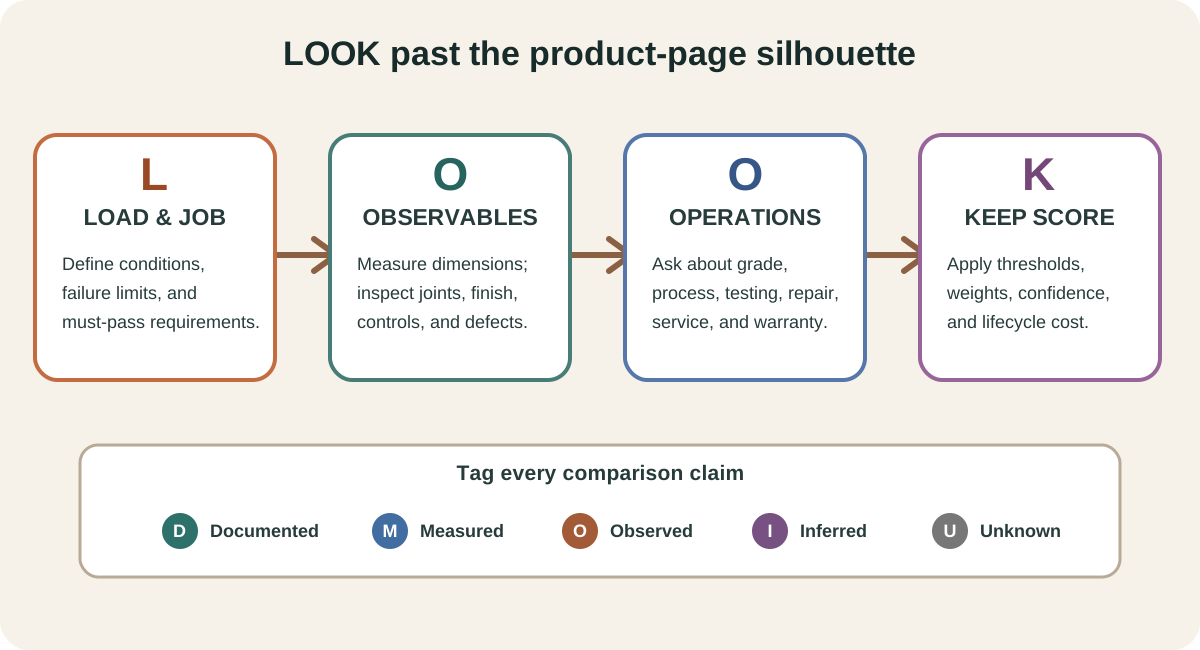
LOOK: a four-pass comparison
L — Load and job
Write one sentence before touching either object:
“The object must perform this task, for this user, under these conditions, without these failures.”
For glasses: maintain optical alignment on this face, remain comfortable for a full day, tolerate repeated opening, resist ordinary perspiration, and allow lens or component service. For a chair: support a stated user range, fit under a particular desk, remain stable, and tolerate repeated loading. Requirements should be specific enough to disprove.
Divide them into:
- must pass: safety, fit, compatibility, legal or task-critical performance;
- weighted: comfort, finish, repair access, appearance, weight, delivery, price;
- preference only: color, history, rarity, or symbolic association.
This prevents a beautiful minor feature from averaging away a critical failure.
O — Observables
Compare the samples under the same conditions, preferably before focusing on brand and price. Observe without destructive testing:
- measured dimensions, mass, symmetry, and range of adjustment;
- gaps, flash, frayed edges, finish pooling, sharp transitions, and color mismatch;
- motion at joints, hinge play, fastener access, control force, and unwanted sound;
- contact comfort after a realistic trial, not a five-second squeeze;
- labels, model numbers, care instructions, warranty terms, and parts diagrams.
Record what happened, not the theory. “The left hinge moved laterally about one millimeter under gentle hand pressure” is an observation. “The hinge is cheap” is an interpretation. Never improvise a load test that could hurt you or damage store property; use published reports for safety-critical performance.
O — Operations and hidden construction
Ask what the silhouette cannot reveal:
- What is the exact material and grade, not only the family name?
- Which process made it, and which dimensions or properties are controlled?
- Are junctions molded, bonded, welded, sewn, screwed, riveted, or merely hidden?
- What inspection or performance test applies? Under what load, duration, environment, and pass criterion?
- Which components wear first? Are replacements sold to the owner?
- Who performs service, at what price, and for how many years?
- What does the warranty exclude, and who pays shipping or labor?
A standard is useful only when it connects a requirement to a repeatable method. The U.S. Consumer Product Safety Commission explains that voluntary standards can specify performance requirements and test methods 2. A badge saying “tested” without a method, sample, threshold, and result is weak evidence.
K — Keep score and confidence
Tag each entry:
- D — documented: a specification, test report, manual, or written term;
- M — measured: your measurement with method and reasonable precision;
- O — observed: a repeatable sensory or functional observation;
- I — inferred: a conclusion that fits evidence but is not confirmed;
- U — unknown: information you do not have.
Do not convert unknowns into zeros. “No published cycle test found” is not proof of low durability. It is lower confidence, which may itself matter if you need assurance.
Quality today is not reliability tomorrow
ISO’s quality framing asks whether characteristics fulfill requirements 3. NIST adds a useful engineering separation: conformance to specifications in shipped units can be measured as a quality level, while reliability concerns performance over time 4.
A showroom zipper may operate smoothly on both bags. That is current function. Evidence about ten thousand cycles, contamination, repair, or field failures addresses reliability. A long warranty may transfer some financial risk, but warranty length alone does not prove low failure probability; exclusions, inconvenience, and seller survival matter.
A weighted score that does not hide failure
After must-pass screening, assign weights totaling 100. Score each remaining object 1–5 on every criterion using recorded evidence.
Weighted score = Σ(weight × score) ÷ 5
The result runs from 20 to 100 when weights total 100 and scores run 1–5. Add an evidence-confidence column rather than dressing guesses as measurements.
Example for prescription glasses, after both frames have passed the required lens-compatibility gate:
| Criterion | Weight | Frame A | Frame B | Evidence needed |
|---|---|---|---|---|
| all-day fit | 30 | 4 | 3 | timed wear trial and adjustment |
| hinge/service | 20 | 2 | 5 | inspection, parts, written service |
| ordering and fit support | 20 | 3 | 5 | measurements, remake terms, and optician quote |
| finish and appearance | 15 | 5 | 3 | controlled side-by-side observation |
| lifecycle cost | 15 | 4 | 2 | price, expected service, repair, resale |
The numbers do not discover truth; they expose priorities. Change the weights and see whether the decision changes. If a one-point guess reverses the winner, collect more evidence or admit that the choice is close.
For lifecycle cost, include purchase, fitting or installation, operation, maintenance, repair, replacement, disposal, and resale where relevant 5. Calculate cost per successful day, wear, or use only with an explicit service-life range.
Practical side-by-side lab
Select two lookalikes you can safely handle: mugs, T-shirts, lamps, hand tools, notebooks, or bags.
- Photograph both from the same angles and lighting. Hide logos and prices if possible.
- Write one job sentence, three must-pass requirements, and five weighted criteria.
- Inspect for ten minutes each using the same sequence. Weigh and measure with the same tools.
- Enter every claim with a D/M/O/I/U tag. Photograph evidence; do not alter or overload the product.
- Research exact model numbers. Capture specifications, manuals, warranty, repair, and named test information.
- Reveal price and calculate low/middle/high cost-per-use scenarios.
- Score, then write a two-sentence verdict: which better meets the job, and how confident you are.
Avoid country, brand, weight, handwork, and price as automatic quality proxies. Each can correlate with relevant characteristics in a particular case; none replaces inspection or testing.
Rule of thumb
Compare requirements, not silhouettes. Lookalikes deserve neither automatic suspicion nor automatic equivalence. Define the job, observe the samples, investigate the hidden system, keep evidence labels, and allow “not enough information” to survive as an honest result.
Practice
A comparison has no useful quality target until the intended job and unacceptable failures are stated.
Practice
Testing becomes interpretable when conditions, method, threshold, and result are available and relevant to the job.
Practice
A high appearance score should not offset unsafe edges, incompatible dimensions, or failure under the required load.
Lesson complete
Nice work.
Sources for this lesson
- 1Fineas Jackson. Your glasses cost $15 to make...so why are they $300? The hidden company behind every pair. Fineas Jackson on YouTube. 2026. verifiedChasing Beauty episode 46; 2:55. Used as a case or observation prompt, not as the sole authority for technical claims. Cited at: episode 46.
- 2Voluntary Standards Development FAQ for Consumers. U.S. Consumer Product Safety Commission. verifiedExplains how product-safety standards define performance requirements and repeatable test methods. Cited at: standards overview.
- 3ISO 9000:2026 — Quality management — Fundamentals and vocabulary. International Organization for Standardization. 2026. verifiedOfficial overview of the quality-management vocabulary, emphasizing consistent fulfillment of customer and regulatory requirements. Cited at: quality vocabulary.
- 4Quality versus reliability. National Institute of Standards and Technology. verifiedEngineering-statistics explanation distinguishing conformance to specifications at shipment from reliability over time. Cited at: quality versus reliability.
- 5Life-Cycle Analysis. U.S. Department of Energy Building Science Education. verifiedPublic teaching resource showing that lifecycle cost can include purchase, operation, maintenance, replacement, disposal, and financing costs. Cited at: lifecycle categories.