Brand, Scarcity, and Story
Why prices keep rising after performance levels off: a map of price drivers, four kinds of scarcity, what a brand genuinely does, a seven-part premium audit, natural versus lab-grown diamonds, eyewear markups and distribution, and stripping the logo.
- 8 min
- 9 steps
- 3 questions
- Lesson 40 of 49
In this lesson
- The market price driver map
- Four kinds of scarcity
- What a brand can genuinely do
- The PREMIUM audit
- Case: diamonds and the word “same”
- Case: eyewear and the channel
- Practice: strip the logo, then restore it
- Rule of thumb
Open alongside this lesson
-
Why I walked out of Ralph Lauren #story #education #ralphlauren (opens in a new tab)
Use Jackson's Ralph Lauren experience to separate brand expectation, service, fit, construction, and personal response.
-
From Antarctica to Banned in Schools: The Canada Goose Story #education #story (opens in a new tab)
Follow the movement from difficult-use clothing through celebrity adoption, school rules, and public identity.
-
They look identical, but one costs $5,000 more. Where the money actually goes might surprise you... (opens in a new tab)
Inventory movement, adjustment, finish, bracelet, service, volume, scarcity, and brand claims separately.
-
This coffee variety was ignored for decades. Now it's worth more than gold...why? #education (opens in a new tab)
Ask how cultivar, terroir, sensory judging, low supply, competitions, and buyers interact.
-
$800 for sneakers copied from a 1970s army shoe…why? How is that even possible? (opens in a new tab)
Separate inherited construction logic from material upgrades, finish, exclusivity, and label value.
-
$3,000 for perfume...why? How is that even possible? (opens in a new tab)
Sort ingredient, bottle, packaging, distribution, scarcity, experience, and brand claims before accepting the final price story.
-
Your glasses cost $15 to make...so why are they $300? The hidden company behind every pair (opens in a new tab)
Treat the video's unit-cost claim cautiously; investigate licensing, lenses, fitting, retail service, warranty, and market structure.
-
This hoodie looks ruined…so why is it $1,800? (opens in a new tab)
Compare real patina with factory distressing as labor, visual effect, cultural reference, and scarcity.
-
Gold is expensive…but it’s not the rarest precious metal. Why? (opens in a new tab)
Notice how workability, stability, recognition, liquidity, and inherited cultural demand can matter alongside abundance.
-
All diamonds are 'real'...right? So how can the same diamond be $1,400 and $8,000? (opens in a new tab)
Use the comparison to ask which properties are shared and which origin, supply, grading, disclosure, and resale expectations differ.
Picking up where you left off.
A price can keep rising after practical performance has nearly stopped improving. This is not an error in the market equation. It is evidence that people buy more than physical output.
A watch tells time, but it can also preserve a manufacturing tradition, reward minute finishing, provide long-term service, signal membership, mark an event, and remain scarce because a maker limits production. A perfume carries scent, but it also arrives through a bottle, presentation, boutique, name, launch story, and promise of exclusivity. A distressed hoodie covers the body while selling controlled irregularity and a particular cultural reference. The challenge is not to sneer at these meanings or accept them whole. It is to name what the premium buys.
The market price driver map
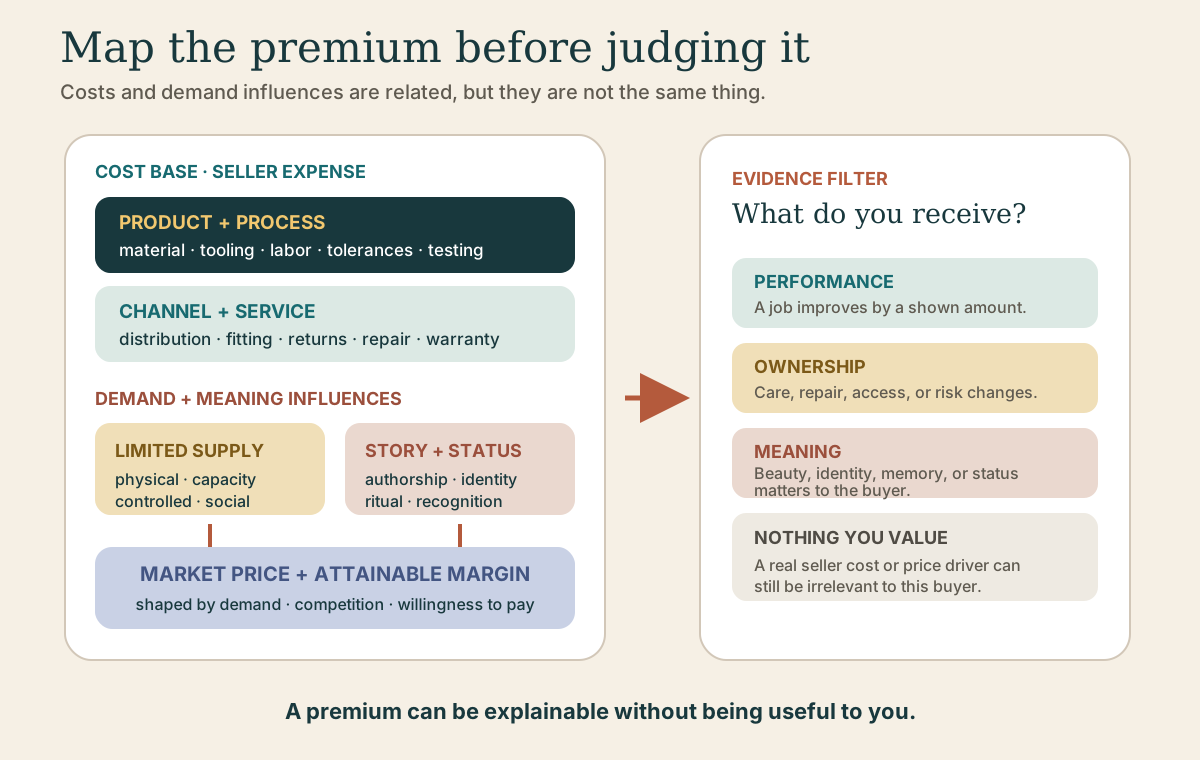
Start with a map, not a verdict:
Market price and attainable margin are then shaped by demand, competition, scarcity, story, status, and willingness to pay. Those influences are not extra costs stacked onto margin. They affect the price a market may sustain and therefore how much margin remains above the cost base.
This is a thinking model, not a manufacturer’s accounting statement. The drivers interact. A low-volume process can raise unit cost while also limiting supply. A prestigious store can add costly service while making the object more visible as a status good. A brand can fund industrial design, warranty systems, and quality control while also increasing recognition and willingness to pay.
WIPO’s reporting on intangible investment treats brands, design, software, and other nonphysical assets as economically consequential—not imaginary leftovers after “real” material 1. Industrial-design protection likewise concerns the ornamental appearance of products, a reminder that visual authorship can be a created and legally recognized asset even when it is not a functional invention 2.
The practical question is: which layers matter to your ownership?
Four kinds of scarcity
“Rare” sounds explanatory, but it hides different mechanisms.
- Physical scarcity: the input exists in limited accessible quantity. Supply can still change with exploration, technology, recycling, or substitution.
- Capacity scarcity: few people, tools, or facilities can perform the process to the required standard. Training and investment may expand it, but not immediately.
- Controlled scarcity: a firm limits production, distribution, colorways, invitations, or release timing. The limit may protect quality—or manufacture urgency.
- Social scarcity: the object is valuable partly because not everyone can or does own it. If access becomes common, some of its signaling power disappears.
Scarcity raises price only when it meets demand. A unique pebble from your driveway is scarce as an individual object but normally commands no luxury market. Conversely, a widely available material can become expensive through limited production, famous authorship, controlled retail access, or intense cultural demand.
Jackson’s Gesha coffee case shows several layers arriving together: a cultivar and growing conditions, sensory distinction, competition scores, small lots, and auction buyers who publicize the result 3. Do not reduce that to either “the taste explains everything” or “it is all hype.” Run separate tests: blind sensory preference, production evidence, lot traceability, supply, and what the auction story means to the buyer.
What a brand can genuinely do
A useful brand can lower search and ownership costs. It can coordinate:
- a recognizable design language across products;
- documented specifications and more consistent quality control;
- distribution that lets you inspect or try the item;
- warranties, spare parts, repairs, returns, and trained service;
- provenance and accountability when something fails;
- a community of knowledge, compatible accessories, or resale demand.
None is guaranteed by fame. Jackson’s account of walking out of Ralph Lauren is instructive because the brand expectation did not override his response to the particular product and purchase experience 4. The correct level of analysis is this model, this specimen, this seller, these terms—not a halo around every object carrying the name.
Brand also performs social work. An experiment archived by Chapman University found that public visibility affected demand under status-linked conditions 5. That does not mean every logo purchase is shallow. Clothing and objects communicate group, taste, memory, work, aspiration, and humor. It means some value depends on an audience. Ask whether you would choose the same object if its brand were invisible and resale impossible. The answer reveals a component; it does not morally grade you.
The PREMIUM audit
Use PREMIUM to interrogate an added charge:
- P — Performance: Which measured or observable job improves, and by how much?
- R — Repair and service: Are parts, warranty, fitting, maintenance, and competent service actually available?
- E — Evidence: Is the claim supported by a test, specification, provenance record, or only an adjective?
- M — Making constraint: Does skilled labor, low yield, tight tolerance, difficult material, or slow process plausibly raise cost?
- I — Identity and experience: What pleasure, ritual, authorship, history, or social meaning are you buying?
- U — Unavailability: Is supply physically limited, capacity-bound, deliberately restricted, or merely presented as urgent?
- M — Market channel: What do wholesale, licensing, retail, returns, fitting, financing, and margin contribute?
Mark each layer useful to me, meaningful to me, real but irrelevant, or unsupported. This prevents two common mistakes: treating every nonfunctional value as fake, and treating every compelling story as proof.
Case: diamonds and the word “same”
Playback is optional. If the player is unavailable, open the video at its source.
Jackson uses a natural-versus-laboratory-grown diamond comparison to ask why large price differences can remain when visible and physical properties are closely matched 6. The question is valuable. The phrase “the same diamond” is too loose for a buying decision.
GIA explains that laboratory-grown diamonds possess essentially the same chemical, physical, and optical properties as natural counterparts, while growing under different conditions and requiring specialized testing for reliable identification 7. The FTC requires clear disclosure that a laboratory-created diamond is not mined and distinguishes it from a simulated stone 8. Its Jewelry Guides also cover representations about grade, quality, treatment, origin, price, and value 9.
A defensible comparison therefore holds constant:
- carat weight and dimensions;
- cut proportions and finish;
- color and clarity grades;
- fluorescence and treatments where relevant;
- grading laboratory and report details;
- setting and metal;
- seller, warranty, return, upgrade, and buyback terms.
Then name what differs: origin, production path, supply, traceability, cultural meaning, and expected resale market. A person may rationally prefer either origin. They should not pretend the preference is a laboratory measurement.
Case: eyewear and the channel
Jackson’s eyewear episode makes a sharp market claim by contrasting an estimated frame production cost with retail price 10. Treat the number as a prompt, not a universal bill of materials. A complete purchase may contain frame design, lens material and coatings, prescription fabrication, measurement, fitting, adjustment, breakage allowance, returns, rent, staff, licensing, warranty, and profit. Compare like with like.
Market structure still matters. The FTC’s Eyeglass Rule requires eye doctors to provide a complete prescription after a refractive exam and before offering to sell glasses, giving the patient the ability to compare sellers 11. Portability is a design-value lesson in institutional form: if information is locked inside one channel, the buyer cannot test the premium.
Ask every seller for an itemized comparison: frame, lenses, options, fitting, warranty, remake policy, and delivery. A low frame cost does not prove the complete service is overpriced; refusal to make the comparison legible is meaningful evidence.
Practice: strip the logo, then restore it
Choose one branded object with a large price spread. Make two passes.
Pass 1 — blind specification. Hide the name and price. Record function, material, construction, tolerances, finish, serviceability, and likely failures. State which claims you can verify.
Pass 2 — market meaning. Restore brand and price. Add warranty, repair network, availability, designer or maker, provenance, release strategy, resale, community, and what ownership communicates.
Run PREMIUM. Then finish these sentences:
- “The performance premium is supported by…”
- “The service premium matters only if…”
- “The scarcity is primarily physical / capacity / controlled / social because…”
- “The story has personal value to me because…”
- “The least supported claim is…”
- “I would pay up to ___ because ; beyond that, I would be buying .”
Rule of thumb
Story can create value, but it cannot substitute for evidence about performance. Let material and testing explain what the object does; let market structure explain access and price; let the buyer state honestly what identity, provenance, or pleasure is worth.
Practice
Brands can create practical and social value, but the logo alone does not demonstrate performance or make every premium useful to every buyer.
Practice
A scarce item without demand or a trusted market may have little price power; controlled access and cultural desire can also raise prices for things that are not geologically rare.
Practice
Laboratory-grown diamonds can share essentially the same optical, physical, and chemical properties as mined diamonds, but origin and market conditions differ and must be disclosed and compared.
Lesson complete
Nice work.
Sources for this lesson
- 1World Intangible Investment Highlights 2026. World Intellectual Property Organization. 2026. verifiedEvidence that brands and other intangible assets carry economic value beyond a product's measurable physical attributes. Cited at: brands and other intangible investment.
- 2Industrial Designs. World Intellectual Property Organization. verifiedOfficial overview of protection for the ornamental or aesthetic appearance of useful products. Cited at: scope of industrial design.
- 3Fineas Jackson. This coffee variety was ignored for decades. Now it's worth more than gold...why? #education. Fineas Jackson on YouTube. 2026. verifiedChasing Beauty episode 36; 2:07. Used as a case or observation prompt, not as the sole authority for technical claims. Cited at: coffee cultivar and auction-value case.
- 4Fineas Jackson. Why I walked out of Ralph Lauren #story #education #ralphlauren. Fineas Jackson on YouTube. 2026. verifiedChasing Beauty episode 26; 2:27. Used as a case or observation prompt, not as the sole authority for technical claims. Cited at: personal purchasing case.
- 5David Clingingsmith, Roman M. Sheremeta. Status and the Demand for Visible Goods: Experimental Evidence on Conspicuous Consumption. Chapman University Economic Science Institute. 2015. verifiedExperimental study of how public visibility and status conditions can affect demand for goods. Cited at: visible-goods experiment.
- 6Fineas Jackson. All diamonds are 'real'...right? So how can the same diamond be $1,400 and $8,000?. Fineas Jackson on YouTube. 2026. verifiedChasing Beauty episode 65; 3:00. Used as a case or observation prompt, not as the sole authority for technical claims. Cited at: diamond pricing case.
- 7Is There a Difference Between Natural and Laboratory-Grown Diamonds?. Gemological Institute of America. verifiedGemological overview of shared properties, different growth conditions, and the testing needed to distinguish natural and laboratory-grown diamonds. Cited at: properties, growth, and identification.
- 8In the Loupe: Advertising Diamonds, Gemstones and Pearls. U.S. Federal Trade Commission. verifiedOfficial guidance distinguishing mined, laboratory-created, and simulated stones and explaining required origin disclosures. Cited at: origin and simulation disclosures.
- 9Jewelry Guides. U.S. Federal Trade Commission. verifiedOfficial guidance requiring truthful description of gemstone origin, composition, grade, treatment, durability, price, and value. Cited at: covered claims.
- 10Fineas Jackson. Your glasses cost $15 to make...so why are they $300? The hidden company behind every pair. Fineas Jackson on YouTube. 2026. verifiedChasing Beauty episode 46; 2:55. Used as a case or observation prompt, not as the sole authority for technical claims. Cited at: eyewear price and market-structure argument.
- 11Complying with the Eyeglass Rule. U.S. Federal Trade Commission. 2024. verifiedOfficial guidance requiring release of a complete eyeglass prescription so patients can compare sellers rather than being tied to the examiner's retail channel. Cited at: prescription release and consumer choice.
Further reading
- Fineas Jackson. $3,000 for perfume...why? How is that even possible?. Fineas Jackson on YouTube. 2026. verifiedChasing Beauty episode 44; 2:58. Used as a case or observation prompt, not as the sole authority for technical claims.
- Fineas Jackson. Gold is expensive…but it’s not the rarest precious metal. Why?. Fineas Jackson on YouTube. 2026. verifiedChasing Beauty episode 53; 2:54. Used as a case or observation prompt, not as the sole authority for technical claims.