Leather: Hide, Tan, Surface, and Cut
Leather as a transformed hide: why the full grain, top grain, genuine, bonded ladder misleads, chrome and vegetable tanning, retanning and fatliquoring, aniline and pigmented finishes, clicking at the cutting table, and inspecting shoes or a jacket.
- 6 min
- 8 steps
- 3 questions
- Lesson 11 of 49
In this lesson
- Retire the four-step grade ladder
- Tanning creates different leathers
- Finish is part of the material
- Clicking: value can disappear at the cutting table
- Read a leather object with HIDE
- Shoe or jacket inspection
- Rule of thumb
Open alongside this lesson
-
$700 for a pair of leather loafers…why? How is that even possible? #leather #loafers #education (opens in a new tab)
Use the shoe as a system: hide selection, tanning, finishing, clicking, lining, lasting, construction, edge work, fit, and repair.
-
74 Essential Leather Industry Terms (opens in a new tab)
Distinguish full grain, corrected grain, grain split, flesh split, coating, and tanning without pretending those terms rank the whole product.
-
Environmental, Health, and Safety Guidelines for Tanning and Leather Finishing (opens in a new tab)
See how tanning chemistry, splitting, shaving, retanning, dyeing, fatliquoring, and finishing create different properties and impacts.
Picking up where you left off.
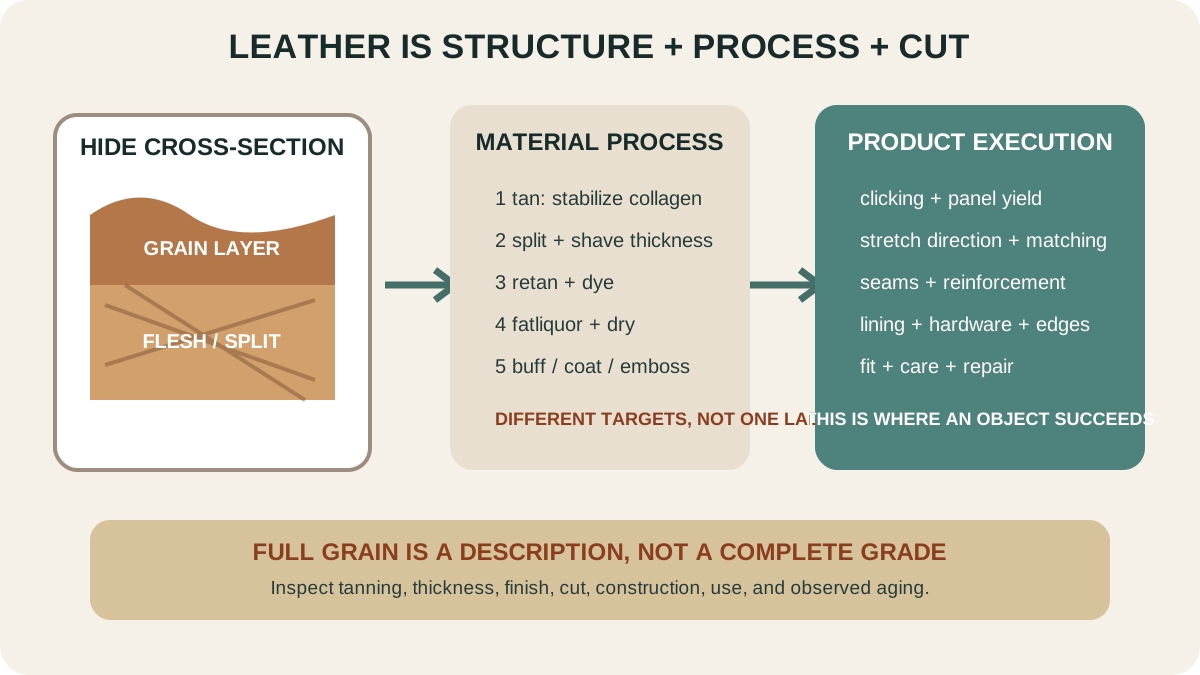
Leather is a preserved collagen structure, not a uniform sheet extruded to specification. Thickness, fibre density, stretch, scars, wrinkles, grain, and usable area vary across a hide. Tanning stabilizes that structure; splitting, shaving, retanning, dyeing, lubrication, drying, staking, buffing, coating, embossing, cutting, and assembly transform it again.
Fineas Jackson’s loafer episode asks why one pair can cost hundreds of dollars 1. His leather-jacket episode makes the visual side equally clear: pattern, panel choice, drape, wear, and surface can make jackets with the same generic material read very differently 2. The useful answer is never merely “full grain.”
Playback is optional. If the player is unavailable, open the video at its source.
Retire the four-step grade ladder
Online guides often present full grain > top grain > genuine > bonded as though these were USDA-style grades. They are not a complete grading system.
The Leather Working Group’s terminology distinguishes several structural and treatment descriptions 3:
- Full grain leather retains the grain surface without corrective mechanical removal.
- Corrected grain leather has some grain removed or modified by buffing and is enhanced through finishing.
- Grain split is the upper portion created when a hide is divided horizontally.
- Flesh split is a lower layer; it can be processed as suede or finished in other ways.
- Coated leather includes a surface coating within defined thickness conventions.
These distinctions matter. They do not tell you whether the raw hide was sound, tanning was well controlled, thickness is appropriate, finish adheres, panels were cut intelligently, seams are strong, or the product fits its use.
A clean corrected surface can be a rational choice for colour consistency, stain resistance, price, or high-volume matching. An exposed full-grain surface can show natural variation and age attractively, but it can also come from mediocre tanning or be poorly assembled. Structure is not destiny.
Tanning creates different leathers
Tanning cross-links and stabilizes collagen so the hide resists putrefaction and gains usable thermal and mechanical properties. The IFC process guide distinguishes mineral tanning—commonly chromium(III)—from vegetable and alternative systems 4.
Chrome tanning
Chrome tanning can produce soft, flexible leather with high hydrothermal stability and broad colour possibilities. “Chrome” does not establish irresponsible processing by itself; tannery chemistry control, chromium form, capture, wastewater, worker protection, traceability, and auditing matter. It also does not guarantee quality.
Vegetable tanning
Plant polyphenols can produce denser, firmer leather that often darkens with light and use. The IFC notes common use in soles, belts, and leather goods, along with limited water resistance unless further treated 4. Vegetable tanning is not simply the same leather made “naturally.” It targets different material behaviour and still requires water, chemicals, energy, time, and control.
Retanning, dyeing, and fatliquoring
After primary tanning, retanning can alter fullness, firmness, dye response, and other properties. Dye adds colour through the section or surface depending on the system. Fatliquoring distributes lubricating materials among fibre bundles so the leather can flex rather than dry into a board. Drying and mechanical softening then shape hand and area.
Finish is part of the material
Aniline finishing uses transparent dyes and light surface protection so natural grain remains visible. Semi-aniline systems add more protective pigment or coating while retaining some variation. Pigmented finishes can improve uniformity, stain resistance, colour consistency, and yield. Buffing creates nubuck-like nap or prepares a corrected surface; embossing presses a texture.
Do not use visibility of scars as a purity test. A transparent finish requires selecting around certain defects and can reduce usable yield. A protective finish can better serve a restaurant banquette, child’s shoe, or frequently cleaned bag. The question is whether the finish is disclosed, controlled, repairable, and suited to the exposure.
Clicking: value can disappear at the cutting table
Clicking is the selection and cutting of pattern pieces from a hide. The craft lies in mapping each component to a region with suitable firmness, stretch, appearance, and thickness while avoiding or deliberately placing defects. Matching left and right shoe vamps or jacket fronts can consume more area than simply filling every gap.
Yield is not just hide area divided by pattern area. Irregular perimeter, defects, direction, paired pieces, colour variation, and stretch zones constrain nesting. A higher price may fund lower-yield selection; it may also fund brand, distribution, or margin. Inspect the result before accepting the story.
Read a leather object with HIDE
- H — Hide and layer: Species if documented, grain or split, thickness, panel location clues, natural variation, and unknowns.
- I — Intervention: Tanning family, retan, dye, fatliquor, buffing, embossing, coating, waterproof treatment, and repair implications.
- D — Design and deployment: Panel layout, stretch direction, lining, seams, reinforcement, edge finish, hardware, fit, bending zones, water and abrasion exposure.
- E — Evidence over time: Finish cracking or delamination, grain break, deep creases, colour transfer, abrasion, conditioning response, stitch failure, resoling or panel repair.
Shoe or jacket inspection
On an owned object:
- Record every material statement exactly; do not translate “genuine” into a grade.
- Map panels and count seams. Note whether paired parts match reasonably in colour, grain, and stretch.
- Flex the object normally and observe where creases form. Do not sharply fold leather to “test” it.
- Inspect a protected edge or seam allowance for coating thickness, through-dye, fibre structure, and backing—but do not cut or peel it.
- Check lining, thread, stitch distance from edge, skipped stitches, reinforcement, and hardware attachment.
- Photograph the same high-wear zone every month. Separate patina from coating failure and structural cracking.
Durability and repairability are separate design choices; Textile Exchange likewise treats longevity, care, disassembly, repair, and end-of-life as distinct considerations 5.
Rule of thumb
Leather names a transformed hide, not a quality tier. Ask which layer, which tanning and finish, which thickness, which cut, which construction, and which job. The best leather is not the least processed; it is the best-specified and best-executed material for the life the object will lead.
Practice
Grain and split vocabulary is useful, but it does not collapse the full material and product system into a single rank.
Practice
Tanning stabilizes collagen. Different tanning and post-tanning systems produce different colour, firmness, heat and water response, dyeing, finishing, and end-use possibilities.
Practice
Cutting layout and hide selection affect yield, symmetry, stretch direction, appearance, and cost before sewing begins.
Lesson complete
Nice work.
Sources for this lesson
- 1Fineas Jackson. $700 for a pair of leather loafers…why? How is that even possible? #leather #loafers #education. Fineas Jackson on YouTube. 2026. verifiedChasing Beauty episode 13; 3:00. Used as a case or observation prompt, not as the sole authority for technical claims. Cited at: episode 13.
- 2Fineas Jackson. Why do some leather jackets look so much better? #education #leather. Fineas Jackson on YouTube. 2026. verifiedChasing Beauty episode 27; 2:40. Used as a case or observation prompt, not as the sole authority for technical claims. Cited at: episode 27.
- 374 Essential Leather Industry Terms. Leather Working Group. 2025. verifiedDefinitions compiled with leather-sector bodies for leather, full grain, corrected grain, grain split, flesh split, tanning, coating, and traceability vocabulary. Cited at: industry definitions.
- 4Environmental, Health, and Safety Guidelines for Tanning and Leather Finishing. International Finance Corporation, World Bank Group. 2007. verifiedProcess and environmental reference describing collagen stabilization, mineral and vegetable tanning, splitting, shaving, retanning, dyeing, fatliquoring, finishing, and different end-use properties. Cited at: tanning section; vegetable-tan properties.
- 5Materials Benchmark Survey Guide 2025. Textile Exchange. 2025. verifiedIndustry framework that treats durability, longevity, disassembly, care information, and recyclability as separate design considerations. Cited at: durability framework.
Further reading
- Modern Cow Leather Processing. Leather Working Group. 2022. verifiedConcise process guide following hide preservation, beamhouse preparation, tanning, splitting, shaving, retanning, dyeing, fatliquoring, drying, and finishing.