Pens: Ink, Balls, Feeds, Nibs, and Tolerances
How pens make a line: the ballpoint as a precision valve, gel and rollerball inks, the fountain pen's feed balancing ink and air, why the tipping matters more than a gold nib, the cap as a seal, where expensive pens spend money, and a one-page test.
- 6 min
- 9 steps
- 3 questions
- Lesson 31 of 49
In this lesson
- The ballpoint is a precision valve
- Gel and rollerball are not merely “better ballpoints”
- The fountain pen regulates ink and air
- The writing point is made after the prestige material
- The cap is a climate chamber
- Where expensive pens spend money
- A one-page pen test
- Rule of thumb
Open alongside this lesson
-
Born in the Earth, Completed by Human Hands (opens in a new tab)
Follow forming, tipping attachment, welding, polishing, slit cutting, shaping, and human checks; notice that gold content alone does not create the writing interface.
-
ISO 12757-1:2017: Ball Point Pens and Refills for General Use (opens in a new tab)
General-use ballpoint pens and refills have defined minimum requirements and tests, a reminder that low price and controlled performance can coexist.
Picking up where you left off.
A pen turns stored fluid into a controlled line while moving through many angles and speeds. The humble version can do this for cents. The exceptional version may offer a tuned contact, reliable sealing, repair, material pleasure, and an emotional ritual. Price can also purchase little more than decoration.
Fineas Jackson’s pen episode invites the right separation: writing performance, durable mechanism, body craft, and status are related but not identical 1.
Playback is optional. If the player is unavailable, open the video at its source.
The ballpoint is a precision valve
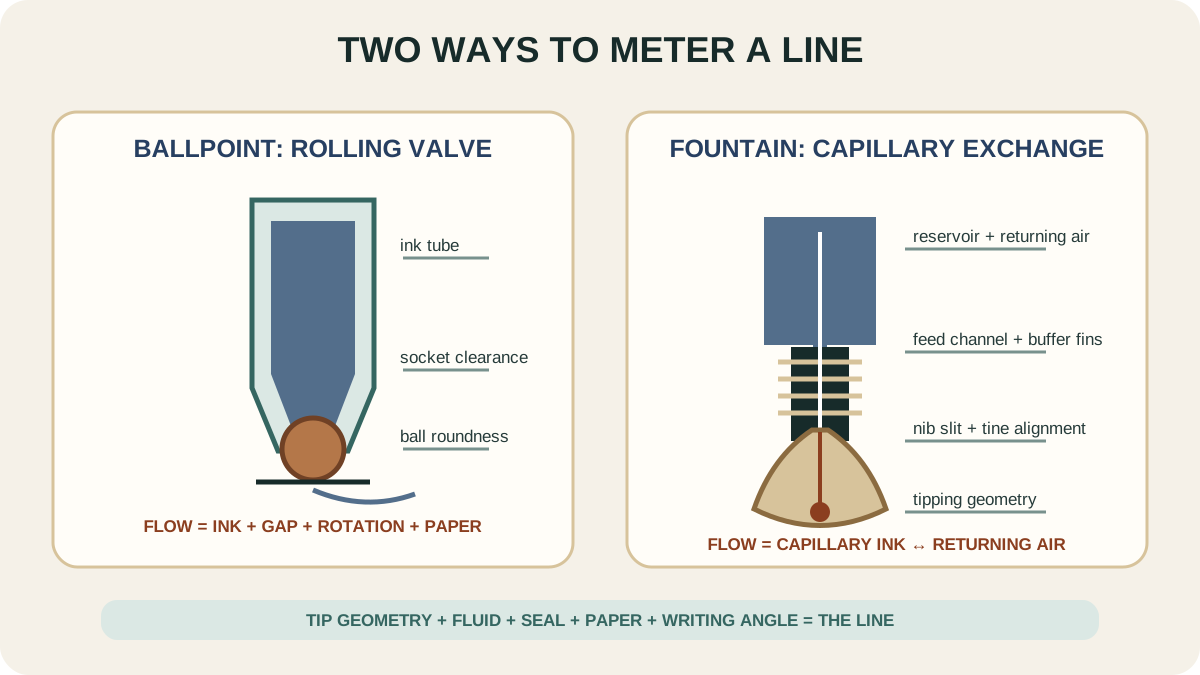
A ballpoint refill contains ink, a tube or reservoir, and a tip with a small ball captured in a socket. As the ball rolls:
- its inner surface contacts ink;
- rotation carries a thin film around the exposed side;
- paper receives the ink;
- the ball continues to meter flow while partly sealing the reservoir.
The system depends on:
- ball diameter, roundness, hardness, and finish;
- socket geometry and clearance;
- ink viscosity, thixotropy, lubrication, and pigment;
- cap or retract seal;
- tip cleanliness;
- paper roughness and absorbency;
- storage temperature and orientation.
Too much clearance can leak. Too little can seize when ink dries or particles lodge. A hard ball can resist wear while a badly finished socket scratches. Smoothness that feels luxurious may lay a wetter, broader line and reduce page yield.
ISO 12757-1 defines minimum quality requirements and test methods for general-use ballpoint pens and refills 2. An inexpensive standardized refill can be excellent engineering. Low unit cost reflects automation and scale, not the absence of precision.
Gel and rollerball are not merely “better ballpoints”
Oil-based ballpoint ink is usually viscous and resistant to drying in the tip. Water-based rollerball ink can flow more freely and create a saturated line, but cap sealing and paper compatibility become more important. Gel suspends pigment in a water-based gel system, enabling opaque or vivid colors with its own start, smudge, and shelf-life tradeoffs.
Compare:
- starting after uncapped storage;
- line continuity at slow and fast strokes;
- pressure required;
- show-through and bleed-through;
- drying time;
- waterproofness and lightfastness if needed;
- refill availability;
- line length per refill.
The best signing pen may be wrong for field notes in rain or a left-handed student moving across fresh ink.
The fountain pen regulates ink and air
A fountain pen typically includes:

- reservoir, cartridge, converter, piston, or other filling system;
- section and ink interface;
- feed with ink channel, air path, and buffering fins;
- nib with slit, shoulders, tines, breather geometry, and tipping;
- cap and inner seal.
Capillary action draws ink through narrow paths toward the nib. As ink leaves the reservoir, air must return. The feed moderates this exchange and stores transient excess when temperature or hand warmth changes pressure.
If flow is too dry, causes can include closed tines, contamination, a dry ink, poor feed contact, or capillary interruption. If too wet, large gaps, air leaks, heat, or unsuitable ink may be involved. “Flex” greatly increases flow demand and mechanical stress.
The writing point is made after the prestige material
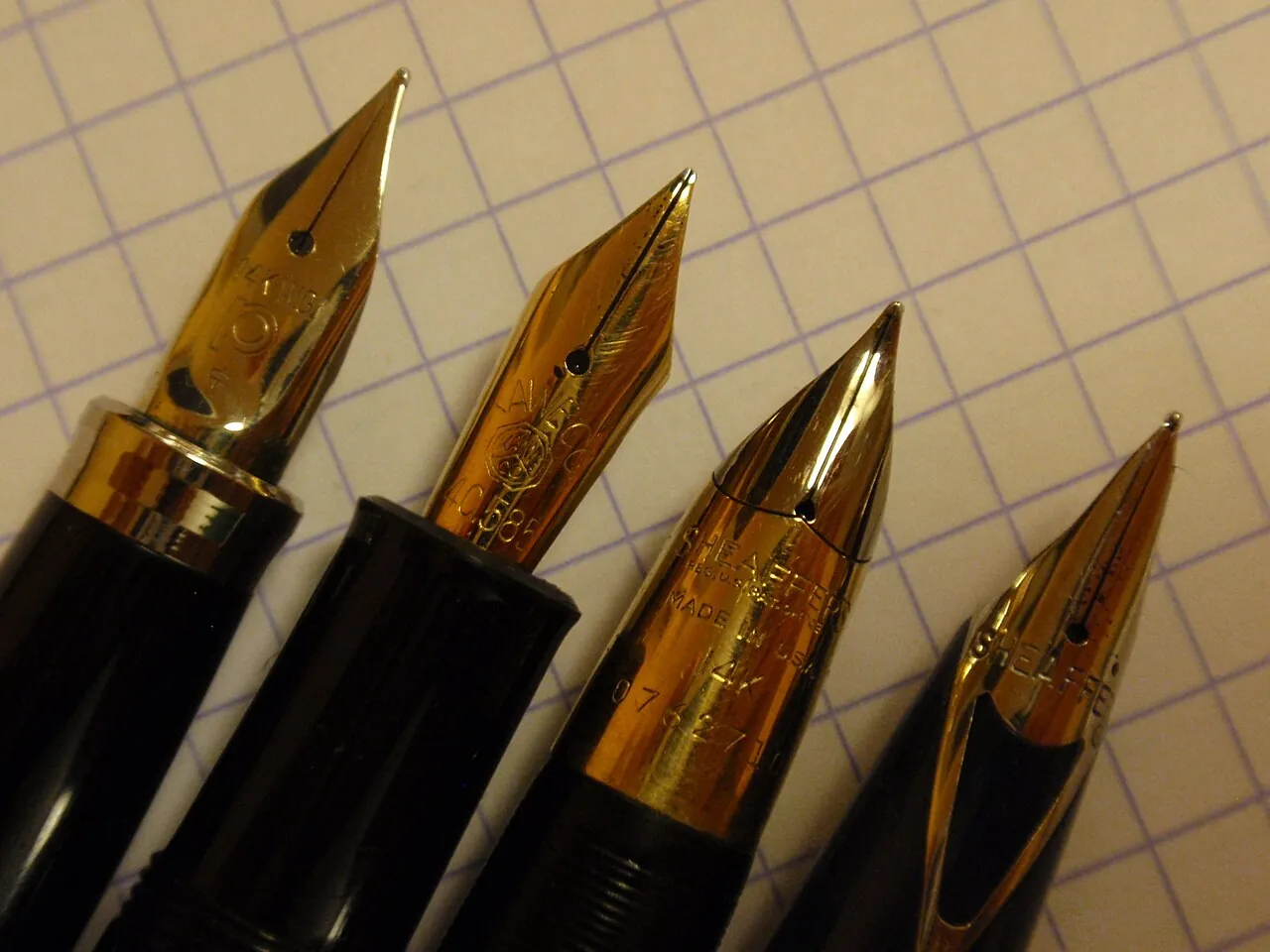
Gold nib alloys resist corrosion and provide workable elasticity, but gold does not usually contact paper directly. A hard tipping alloy is attached, shaped, slit, ground, and polished.
PILOT’s process account follows gold nib material through forming, tipping attachment, welding, polishing, slit cutting, shaping, and repeated checks by skilled workers 3. This sequence explains why two nibs stamped with the same gold content can write differently.
Critical variables include:
- tine alignment;
- slit width and taper;
- contact patch geometry;
- tipping symmetry;
- edge rounding;
- nib-to-feed contact;
- elastic range and return;
- intended writing angle and rotation.
A broad rounded nib can feel smooth but obscure small handwriting. A crisp italic creates line variation but has a narrower sweet spot. Smoothness is not the only quality.
The cap is a climate chamber
Ink dries when water or solvent escapes. A cap’s inner seal, thread fit, snap geometry, and exposed air volume influence starting after storage. A beautiful body with a poor seal creates hard starts and concentrated ink.
For retractable fountain pens, an internal door must seal while clearing the nib reliably. Complexity is legitimate when it creates one-handed convenience; it also creates more surfaces to contaminate and service.
Test a pen after one day and one week, not only immediately after filling.
Where expensive pens spend money
price = writing system + body production + decoration + low-volume setup + inspection/tuning + distribution + service + brand/scarcity
Body work can include turning resin or hard rubber, machining metal, deep drawing, lacquering, urushi work, engraving, stone setting, clip forming, polishing, and repeated finishing. Those may be real crafts independent of writing performance.
Separate four offers:
| Offer | Evidence |
|---|---|
| Reliable tool | consistent start and line, ergonomic grip, protected tip, affordable available refill |
| Tuned writing instrument | inspected nib, coherent feed, useful filling system, cap seal, parts and service |
| Crafted object | named material and maker, documented surface process, finish suited to handling and aging |
| Collectible signal | edition, provenance, historical relevance, transparent scarcity and resale—not invented performance |
A one-page pen test
Use the paper and posture that matter:
- write slowly, then rapidly;
- draw horizontal, vertical, diagonal, and circular strokes;
- begin at your natural rotation and angle;
- pause uncapped for one minute, then restart;
- shade or write a dense block to test flow recovery;
- cap or retract ten times;
- leave the pen overnight and test the first stroke;
- estimate refill cost per month.
Do not press a fountain nib to prove flexibility. Excess force can permanently spread tines or break the feed relationship.
Rule of thumb
Buy the line first, the seal second, the body third, and the story deliberately. A costly pen can contain remarkable craft—but a standardized refill may still be the more precise writing tool for your job.
Practice
Ball size, roundness, socket clearance, finish, ink rheology, and contamination must cooperate.
Practice
The feed regulates a two-way exchange and buffers excess ink in fins or collectors.
Practice
Diagnosis protects a precise, easy-to-damage component and preserves service options.
Lesson complete
Nice work.
Sources for this lesson
- 1Fineas Jackson. $600 for a…pen? Why? How is it different from a pen that cost $2? #pen #montblanc #education. Fineas Jackson on YouTube. 2026. verifiedChasing Beauty episode 15; 2:57. Used as a case or observation prompt, not as the sole authority for technical claims. Cited at: episode 15.
- 2ISO 12757-1:2017: Ball Point Pens and Refills for General Use. International Organization for Standardization. 2017. verifiedOfficial standard page defining minimum quality requirements and test methods for general-use ballpoint pens and refills. Cited at: standard scope.
- 3Born in the Earth, Completed by Human Hands. PILOT Corporation. verifiedPrimary manufacturer account of gold nib forming, tipping attachment, welding, polishing, slit cutting, finishing, and repeated human inspection. Cited at: manufacturer process.