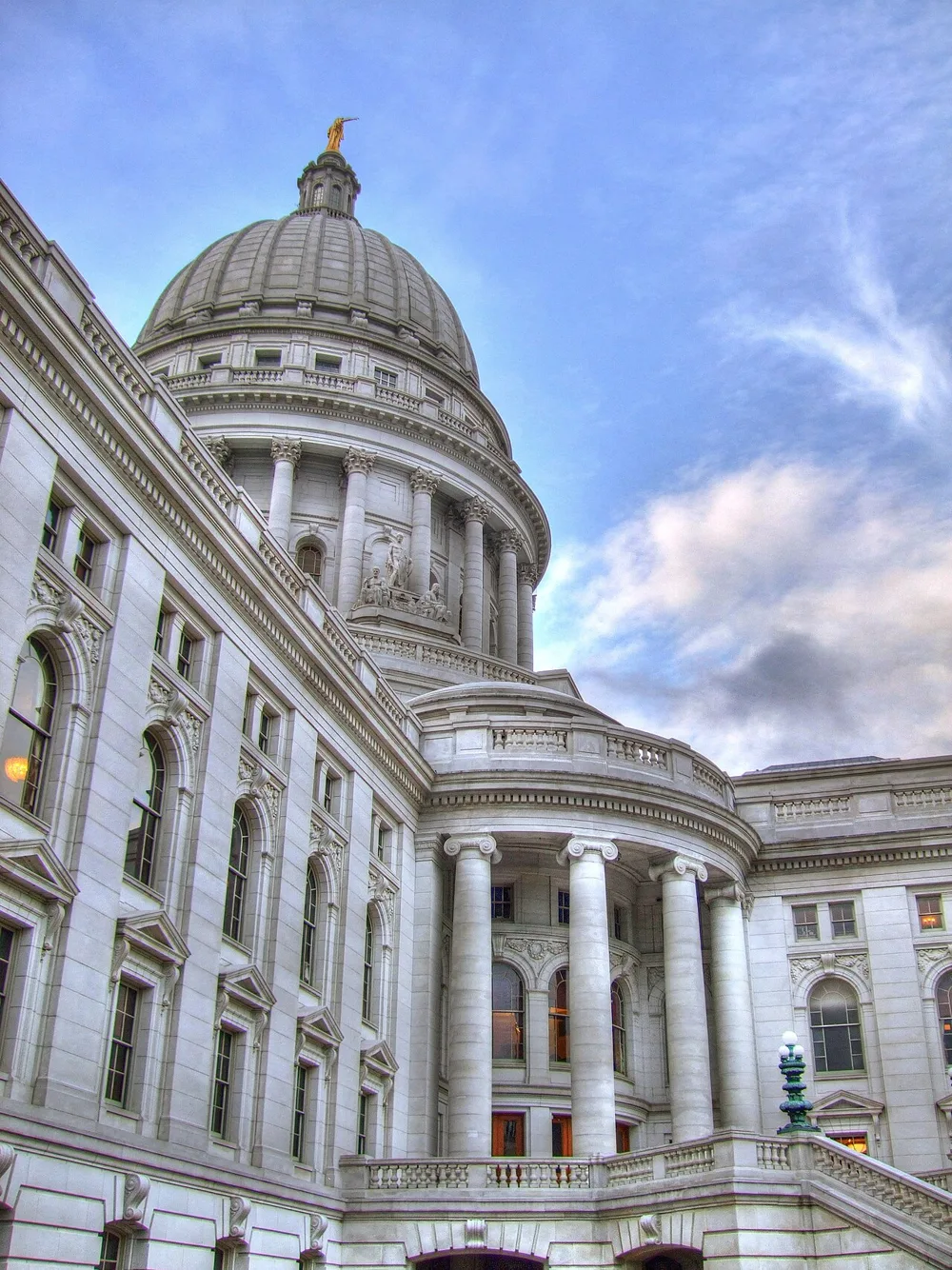
The Wisconsin State Capitol
Madison's third capitol rose after the second burned in 1904: built one wing at a time from 1906 to 1917 so government could keep working inside, in white Vermont granite, to a Beaux-Arts design by George B. Post. A Greek cross on the highest point of the isthmus, the only granite dome in the country, 284.4 feet to the top of the gilded statue 'Wisconsin,' and the state law that keeps every building within a mile below the base of its columns.
- 5 min
- 6 steps
- 2 questions
- Lesson 49 of 49
In this lesson
- Three capitols in Madison
- Built one wing at a time
- Beaux-Arts on the isthmus
- The dome
- Keeping the view
- Try it
Picking up where you left off.
From almost anywhere in Madison you can see the dome. That’s by design, and by law.
Three capitols in Madison
Wisconsin’s first territorial legislature met in 1836 in a rented building at Belmont. The next year the legislature chose Madison, then “merely a town on paper,” as the permanent capital 1. The first Madison capitol, of local stone and oak, cost $60,000; it was soon too small, and a second, larger capitol went up from 1857, with its dome finished in 1869 and two wings added in the 1880s 1.
In 1903 the legislature appointed a commission to plan a third. Before it got far, on February 27, 1904, fire gutted much of the old building 1.
Built one wing at a time
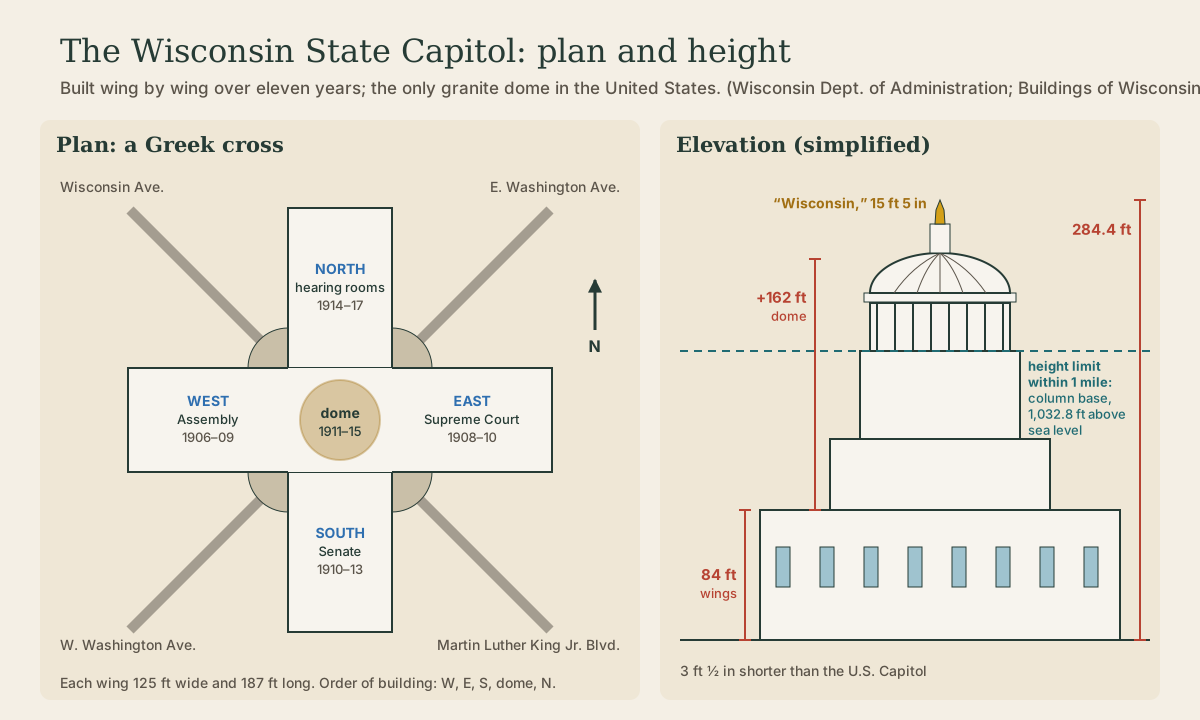
In 1906 the commission chose George B. Post of New York, an engineer-architect who had helped pioneer steel-framed tall buildings in Manhattan 1. Money was limited and government had to keep working somewhere, so the new building rose one wing at a time, replacing the old one piece by piece 1:
| Part | Built | Houses |
|---|---|---|
| West wing (worst burned) | 1906–1909 | State Assembly |
| East wing | 1908–1910 | Supreme Court, Governor’s Conference Room |
| South wing | 1910–1913 | State Senate |
| Rotunda and dome | 1911–1915 | |
| North wing | 1914–1917 | Hearing rooms |
Post died in 1913, and his sons finished the job 1. The building and its power plant cost about $7.25 million; when it was finished in 1917 it housed all of state government 2 3. With World War I under way, the dedication was put off, and it didn’t happen until July 7, 1965, forty-eight years later 1.
Quick check
The fire-damaged west wing came first, and the old building’s remaining parts housed government while the rest went up.
Beaux-Arts on the isthmus
The Capitol sits on the highest point of the isthmus between Lake Mendota and Lake Monona, at the center of Madison’s original street plan, so all roads seem to lead to it 3. It went up during the great age of American capitol building, 1893 to 1920, in the spirit of the City Beautiful movement launched by Chicago’s 1893 World’s Columbian Exposition, which Post had worked on 3 1.
Post’s plan is a Greek cross: four equal wings pointing to the compass directions, with semicircular pavilions in the angles between them. Madison’s four diagonal avenues end at the pavilions, each with a grand staircase and a curved row of Ionic columns 3. The wings end in porticoes of Corinthian columns with sculpture groups by the leading American sculptors of the day.
The whole exterior is white Bethel granite from Vermont, as white as marble but far harder 2. The rusticated ground story (stone cut with deep horizontal grooves), giant columns, rich moldings, framed windows, and statuary are the hallmarks of Beaux-Arts classicism, the grand style taught at the École des Beaux-Arts in Paris 3.

The dome
The dome, finished in 1915, rises 162 feet above the 84-foot wings. The state calls it the only granite dome in the United States and the largest by volume 2. It is really two domes: an outer shell of granite blocks eight inches thick, and an inner, shallow coffered dome seen from the rotunda, with Edwin Blashfield’s mural The Resources of Wisconsin around the opening at its center 3.
On top stands “Wisconsin,” a gilded bronze figure by Daniel Chester French, the sculptor of the Lincoln Memorial’s Lincoln: 15 feet 5 inches tall, over 3 tons, with a badger on her helmet and a globe and eagle in her hand 2. From the ground floor to the top of her head the building measures 284.4 feet, just three feet and half an inch shorter than the U.S. Capitol 2.
Keeping the view
In 1966 the 14-story Van Hise Hall on the UW campus stood out against the skyline, and the outrage led to a height limit 4. Today state law says no building within one mile of the center of the Capitol may rise above 1,032.8 feet above sea level, which matches the city’s rule that nothing may top the base of the dome’s columns 4. That’s why downtown Madison’s towers all stop below the same line, leaving the dome on top.
Playback is optional. If the player is unavailable, open the video at its source.
Quick check
State law sets the limit at 1,032.8 feet above sea level within a mile of the center of the Capitol.
Try it
Guided tours have run since 1915 1, and in summer the lowest observation deck around the dome is open to the public 2. Walk around the outside first and find the parts of the plan: a wing ending in its Corinthian portico, a curved pavilion facing an avenue, and the dome over the center. Then from the observation deck, notice how the surrounding buildings all stop short of you.
Lesson complete
Nice work.
Sources for this lesson
- 1Wisconsin State Capitol History. Wisconsin Department of Administration. verifiedFirst territorial legislature at Belmont, 1836; Madison chosen 1837; first Madison capitol $60,000; second begun 1857, dome 1869, wings 1882; fire of February 27, 1904. Post & Sons chosen 1906; built one wing at a time: west 1906-09, east 1908-10, south 1910-13, rotunda and dome 1911-15, north 1914-17. Post died in 1913 and his sons finished. Completed 1917 for $7.2 million; dedication deferred by World War I until July 7, 1965.
- 2Wisconsin State Capitol Exterior. Wisconsin Department of Administration. verified284.4 feet from ground floor to the top of the statue, three feet and one-half inch shorter than the U.S. Capitol. White Bethel, Vermont, granite. Wings 125 feet wide, 84 high, 187 long; Assembly west, Supreme Court and Governor's Conference Room east, Senate south, hearing rooms north. Dome completed 1915, rises 162 feet above the wings; largest by volume in the U.S. and the only granite dome in the U.S.; three observation decks, lowest open in summer. Statue 'Wisconsin' by Daniel Chester French, 15 ft 5 in, over 3 tons, badger on her helmet.
- 3Marsha Weisiger et al.. Wisconsin State Capitol. SAH Archipedia / Buildings of Wisconsin (University of Virginia Press, 2017). verifiedHighest point of the isthmus between Lakes Mendota and Monona; built in the great age of capitol building, 1893-1920, in the City Beautiful spirit of the 1893 Columbian Exposition. Third capitol on the site; predecessor (1856-83) burned 1904. George B. Post's last work: Greek cross of four equal wings facing the compass points, semicircular pavilions in the angles where the four avenues end, Ionic colonnades on the pavilions, Corinthian porticoes with sculpture by Karl Bitter, Adolph Weinman, and Attilio Piccirilli. White Bethel granite from Vermont; Beaux-Arts classicism. Outer dome of eight-inch granite blocks; statue by Daniel Chester French; inner coffered dome with Edwin Blashfield's mural; rotunda about 80 feet across.
- 4Why do Madison's buildings all seem shorter than the Capitol?. Wisconsin Public Radio. verifiedCity Capitol View Preservation Limit: within 1 mile of the center of the Capitol, buildings may not exceed the base of the Capitol's columns. State statute: no building within 1 mile above 1,032.8 feet above sea level. Prompted by outrage over the 14-story Van Hise Hall in 1966.