Grade, Yield, and Finish
Three words that get blurred: grade as selected input properties, yield as the share of input that becomes usable output, and finish as treatment that changes look and performance, with a rule to ask 'premium what?'
- 7 min
- 7 steps
- 3 questions
- Lesson 5 of 49
In this lesson
- Three words, three different jobs
- Grade is a vector, not a halo
- Yield turns waste into a number
- Finish can dominate first impression
- Side-by-side exercise: investigate two same-label textiles
- Rule of thumb
Open alongside this lesson
-
All linen is the same right? Then how can two linen products be priced so differently...? (opens in a new tab)
Use the linen comparison to ask which input properties, losses, yarn and cloth choices, and finishing operations are actually evidenced.
-
Cotton Classing Services (opens in a new tab)
Cotton classing demonstrates that one fiber family can be described across several independently measured properties.
-
Quality Assurance Basics (opens in a new tab)
Match claims such as water repellency, stretch, drying, or stain release to conditions and repeatable methods.
-
What’s so special about linen? How is it made? Episode 2 of “Chasing Beauty” #linen #fashion #style (opens in a new tab)
Use retting, scutching, and hackling as major process stages, then remember that yarn, weaving, finishing, and garment construction still shape the result.
-
Cashmere isn’t the softest wool. So what is? Hint: the softest wool fiber is actually illegal #wool (opens in a new tab)
Fiber diameter strongly affects prickle, but diameter distribution, coarse fibers, yarn, fabric, and finish matter too; a ring test is not authentication, and wildlife-trade claims need jurisdiction and provenance.
-
The softest wool is not cashmere...? So what is it? #cashmere #soft #education (opens in a new tab)
Compare this later version with episode 3 and mark which claims describe a specimen, a trade label, a controlled record, or a regulated animal fiber.
-
The Real Truth About Expensive Matcha #matcha #cafe #education (opens in a new tab)
Track shading, tencha processing, refinement, grinding, cultivar, origin, and freshness; “ceremonial grade” is not an official ISO or Japanese-government quality grade.
-
$400 for a pair of jeans…why? How is that possible? Part 1 #denim #jeans #education (opens in a new tab)
Inventory cotton, yarn, dyeing, denim construction, cutting, sewing, hardware, finishing, labor, volume, and brand instead of treating “denim” as a complete specification.
-
Why is Japanese denim so expensive? #denim #selvedge #education (opens in a new tab)
Ask for mill, yarn, loom and cloth specification, dye process, sanforization or other finishing, garment construction, and traceability; country of origin alone is not a performance grade.
-
The shocking science behind the different levels of steak #steak #education (opens in a new tab)
Separate the named grading system and its measured criteria from breed, cut, aging, handling, cooking, preference, and price; a grade is designed for stated questions, not every eating outcome.
Picking up where you left off.
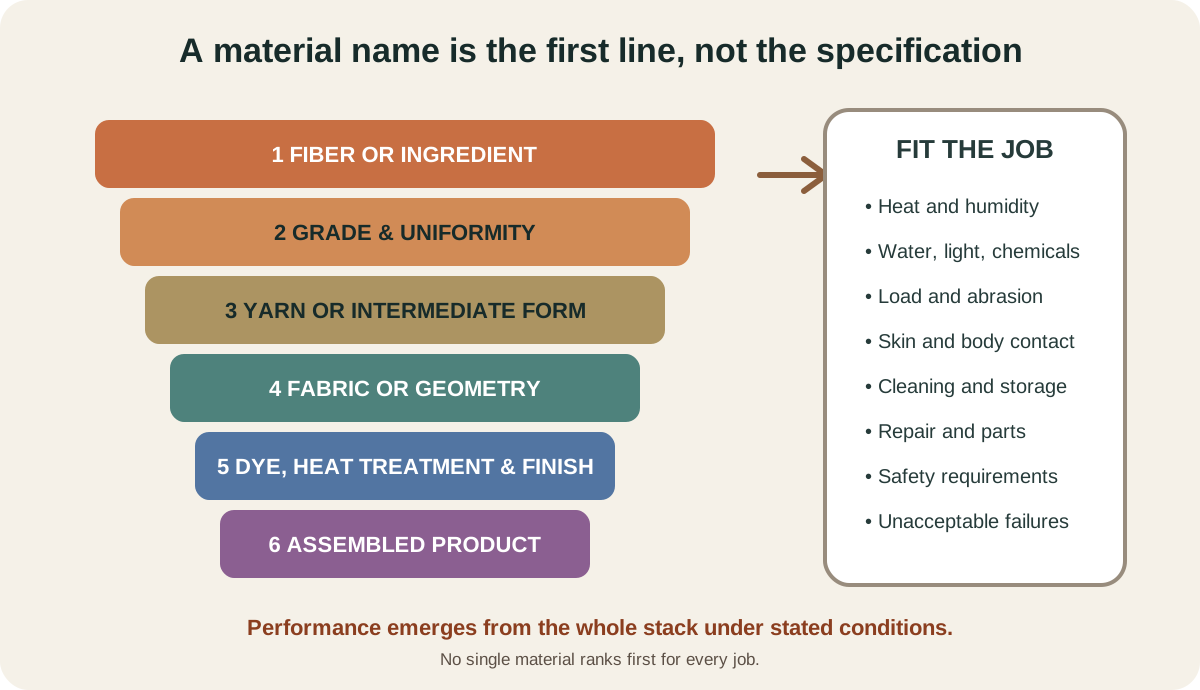
Two products can truthfully carry the same fiber label and still differ in raw input, usable yield, spinning, weaving, coloration, finishing, assembly, and quality control. Those differences may raise cost. They may also produce no benefit for your job.
Fineas Jackson uses linen to challenge the phrase “all linen is the same” 1. Keep the challenge but sharpen the method. When a seller says “premium grade,” ask which properties were measured. When a story emphasizes laborious loss, calculate yield. When a sample feels unusually smooth, ask what finishing created that hand and whether it survives care.
Playback is optional. If the player is unavailable, open the video at its source.
Three words, three different jobs
Use this compact rule:
Grade describes selected input properties. Yield describes usable output. Finish describes transformation after formation.
They interact, but they should not be collapsed into “quality.”
Grade is a vector, not a halo
A useful grade places material into a class according to stated properties and procedures. It is not necessarily one ladder from worthless to perfect. A property that improves one process can hinder another, and a seller’s proprietary “Grade A” may not match an independent standard.
USDA cotton classing is a concrete example. The Agricultural Marketing Service reports bale-level measurements including color, trash, micronaire, fiber length, length uniformity, and strength 2. Notice what this list teaches:
- one fiber name contains variation; “cotton” does not erase measurable differences;
- grade uses several axes; one attractive number does not summarize the material;
- the axes serve a process and market; fiber length and strength can affect spinning decisions, while trash and color affect other handling and appearance concerns;
- measurement names must be read precisely; USDA describes micronaire as a combination of fineness and maturity, not a universal softness score.
That last point is a general warning. Fiber diameter may contribute to tactile behavior in some materials, but softness also emerges from yarn twist, surface fibers, fabric geometry, finishing, and skin contact. Never let one metric impersonate the whole hand.
When evaluating a claimed grade, ask G-M-J:
- G — Grading system: Who defined the classes?
- M — Measurement: Which property, sampling method, tolerance, and result?
- J — Job connection: How should that property improve this process or use?
If the seller cannot name the system, “grade” may be a house description rather than comparable evidence. That does not make it false; it makes its scope narrow.
Yield turns waste into a number
Yield is the share of input that becomes usable output within a defined boundary:
Yield % = usable output ÷ total input × 100
Input needed = required usable output ÷ yield fraction
Suppose a garment requires 2.2 meters of fabric inside accepted pieces.
- Fabric A costs $24 per meter and achieves 88% cutting yield. Input needed is
2.2 ÷ 0.88 = 2.50 m; incorporated-fabric cost is$60. - Fabric B costs $36 per meter and achieves 96% cutting yield. Input needed is
2.2 ÷ 0.96 ≈ 2.29 m; incorporated-fabric cost is about$82.50.
Higher yield narrows B’s material-cost gap but does not erase it. The example also ignores matching stripes, defect zones, size mix, minimum order, and remnants reused elsewhere. State the boundary.
For sequential stages, multiply yields rather than averaging them. If preparation yields 96%, weaving 92%, and inspection/cutting 90%:
0.96 × 0.92 × 0.90 = 0.79488, or about 79.5% overall yield.
To obtain 100 usable units at that overall yield, plan roughly 100 ÷ 0.79488 ≈ 126 input units. Yield loss may represent trimming, short fibers, knots, color mismatch, breakage, rejected cloth, or conservative inspection. Some loss improves consistency; some reveals poor control; some material may be recovered. “Wasteful” and “selective” are interpretations that require destination and cause.
Low yield can raise production cost, but it does not prove a better output. Deliberately destroying usable goods to create scarcity would also lower yield. Ask what defect or mismatch was removed and whether that threshold matters to the job.
Finish can dominate first impression
A finish is a mechanical or chemical treatment used to change appearance, hand, performance, or serviceability. CottonWorks notes that chemical finishing can affect all four 3. Mechanical relaxation or compaction can alter dimensional stability; other processes may change luster, surface texture, stiffness, water behavior, or wrinkle response.
This creates two opposite errors:
- “Finish is fake.” A stable, well-specified finish can be the engineering that lets a fabric meet its job.
- “The showroom hand proves the material.” A softener, pressing, or surface treatment can dominate first touch without revealing long-term behavior.
Ask four finish questions:
- Function: Which property is the finish meant to change?
- Method: Is the treatment named, or only described with an adjective?
- Durability: What happens after abrasion, cleaning, light, heat, or time?
- Tradeoff: Did improving wrinkle resistance, repellency, or hand affect strength, breathability, repair, or care?
Textile performance claims become stronger when attached to standard conditions. CottonWorks’ quality-assurance materials discuss tests for airflow, moisture behavior, stretch, water response, and stain release 4. “Water resistant” without a method, pressure or spray condition, preconditioning, number of washes, and result remains underspecified.
Shrinkage is a useful case because cause crosses layers. Construction settings and forces during dyeing and finishing affect residual dimensional change; relaxation, compaction, and chemical approaches may manage it 5. A fiber name cannot predict the final number.
Side-by-side exercise: investigate two same-label textiles
Use two owned linen, cotton, wool, or synthetic products with the same declared fiber content.
- Record claims: photograph labels and product descriptions. Underline every grade, origin, process, finish, and performance term.
- Classify: mark each term
standard grade,supplier specification,process,finish,marketing adjective, orunknown. - Measure initial state: mass, key dimensions, opacity over one background, drape over one form, and surface under the same light. Do not mistake heavier for automatically better.
- Inspect consistency: look for yarn thick places, slubs, skew, pulled floats, color variation, seam puckering, and finish variation. Decide whether each is intentional, acceptable, defective, or unknown.
- Run care trials: only on owned items, follow each care label, measure after 1, 5, and 10 cycles, and record surface and color change. Do not change care methods to force a winner.
- Estimate yield effect: if pattern matching, flaws, or shrink allowance appears relevant, calculate a transparent range instead of repeating “much more waste.”
- Write the verdict: one sentence each for grade evidence, yield evidence, finish evidence, and fitness for your use.
Rule of thumb
Demand a noun after “premium.” Premium what—length, uniformity, strength, colorfastness, finish durability, inspection tolerance, service? A complete design explanation names the property, method, result, and job. Price may reflect grade, loss, and finishing, but only evidence connects that spending to a better object.
Practice
Grades depend on specified characteristics and methods. Their relevance must be connected to processing and the intended job.
Practice
Sequential yields multiply: 0.96 × 0.92 × 0.90 = 0.79488, or about 79.5% usable output.
Practice
Initial hand is an observation. Cause, durability, and fitness for a particular use require further documentation or testing.
Lesson complete
Nice work.
Sources for this lesson
- 1Fineas Jackson. All linen is the same right? Then how can two linen products be priced so differently...?. Fineas Jackson on YouTube. 2026. verifiedChasing Beauty episode 60; 2:57. Used as a case or observation prompt, not as the sole authority for technical claims. Cited at: episode 60.
- 2Cotton Classing Services. U.S. Department of Agriculture Agricultural Marketing Service. verifiedOfficial description of bale-level cotton measurements including color, trash, micronaire, length, length uniformity, and strength. Cited at: classing measurements.
- 3Chemical Finishing. CottonWorks by Cotton Incorporated. verifiedTextile-industry training defining finishing and explaining how it changes appearance, hand, performance, and serviceability. Cited at: finishing scope.
- 4Quality Assurance Basics. CottonWorks by Cotton Incorporated. verifiedOverview of measurable textile attributes and standardized approaches to stretch, comfort, water behavior, stain release, and other performance claims. Cited at: quality-assurance categories.
- 5Shrinkage and Skewing. CottonWorks by Cotton Incorporated. verifiedTechnical training on how construction, wet processing, tension, relaxation, compaction, and finishing affect dimensional stability. Cited at: shrinkage factors.