Handmade, Artisan, and the Economics of Lost Skills
What 'handmade' can and can't mean: a continuum from hand tools to automation, what hand labor legitimately buys, the price floor for small production, skill as fast correction, lost skills as broken ecosystems, four kinds of handmade claim, and a maker dossier.
- 6 min
- 10 steps
- 3 questions
- Lesson 23 of 49
In this lesson
- A hand–machine continuum
- What legitimate hand labor can buy
- The real price of small production
- Skill is compressed correction
- A lost skill is a broken ecosystem
- Four kinds of “handmade”
- How to compare an artisan object fairly
- A five-part maker dossier
- Rule of thumb
Open alongside this lesson
-
Traditional Craftsmanship (opens in a new tab)
Preservation is not freezing one object. It means sustaining the skills, knowledge, materials, meanings, and transmission that let communities keep practicing.
-
Red List of Endangered Crafts 2025 (opens in a new tab)
Practitioner numbers, trainee numbers, training routes, market trends, tools, materials, and business conditions reveal more than nostalgia.
Picking up where you left off.
“Handmade” is one of the least complete descriptions in the marketplace.
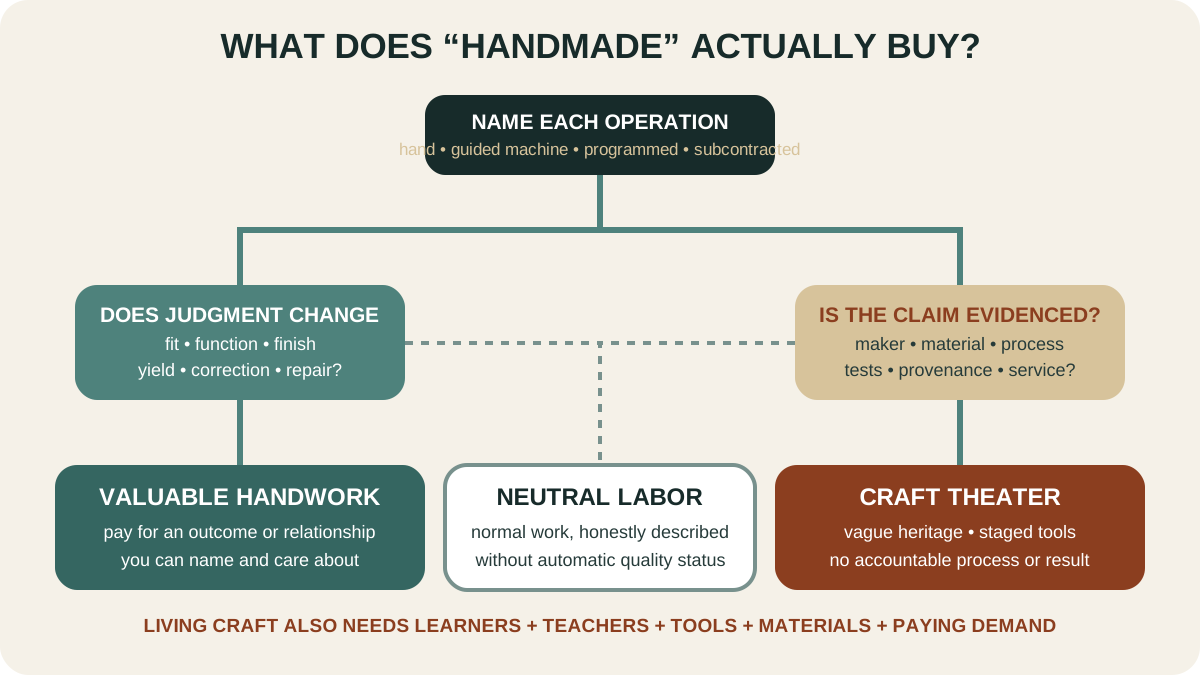
It might mean one maker performed every operation with hand tools. It might mean operators guided material through specialized machines. It might mean a factory worker attached one component by hand. It might describe a valuable adjustment—or a slower way to make an imprecise object.
Fineas Jackson’s knife episode offers a useful prompt 1. A high-priced knife can contain steelmaking, forging, heat treatment, grinding, straightening, polishing, sharpening, handle fitting, inspection, distribution, and reputation. “Forged by hand” cannot stand in for that whole chain.
Playback is optional. If the player is unavailable, open the video at its source.
A hand–machine continuum
Most serious objects mix methods:
- hand tool: knife, chisel, plane, needle, hammer, brush;
- hand-guided machine: sewing machine, bandsaw, grinder, wheel, press;
- jigged or templated process: human loads and judges; fixture controls repeatability;
- programmed machine: knitting, cutting, milling, or forming follows stored instructions;
- automated cell: sensing and control reduce direct intervention;
- inspection and correction: people or instruments accept, reject, rework, and learn.
A seamless computerized knitting machine can reduce cutting waste and seams while encoding deep knitting knowledge 2. A hand-cut garment can waste cloth or fit poorly. The ethical and quality question is not which side touched the object more.
Ask:
- Where does material variation require judgment?
- Which operation benefits from repeatable machine control?
- Where can a skilled person detect and correct drift?
- Is the process documented well enough to teach, repair, or reproduce?
- Who is accountable for the final result?
What legitimate hand labor can buy
Selection
A cutter feels temper, sees grain direction, finds flaws, and assigns each piece to a role. The result may be higher yield, better matching, or strategically accepted variation.
Adaptation
A tailor changes balance for a body. An upholsterer changes tension around a curve. A smith corrects a warp after heat treatment. A chairmaker responds to grain runout.
Access
Some internal corners, repairs, short runs, and compound forms are difficult or wasteful to automate.
Finish and correction
Edges can be leveled, surfaces blended, mechanisms tuned, and defects caught late in the process.
Relationship and traceability
A named maker can explain decisions, maintain the object, and accept feedback. That continuity has value beyond measurable performance if the owner wants it.
None of these excuses weak design. Labor hours spent correcting a preventable process problem are cost, not necessarily value.
The real price of small production
A simplified maker price is:
price floor = materials ÷ yield + direct hours × sustainable labor rate + tools/space + development + rejects + selling/admin + warranty
Imagine a maker spends:
- $120 on purchased material;
- achieves 75% usable yield;
- 9 direct hours at a sustainable loaded rate of $40/hour;
- $70 on hardware, finish, packaging, and tool wear;
- $90 allocated to development, selling time, overhead, rejects, and warranty.
Then:
$120 ÷ 0.75 + 9 × $40 + $70 + $90 = $680
This is not a retail rule. It simply explains why comparing an independent maker’s price with a mass-produced object by raw material cost is misleading. Factories can spread design, tooling, purchasing, and inspection across thousands of units. A craft shop cannot.
Skill is compressed correction
Experts are not only faster. They notice deviations earlier.
A novice may sand past a line, misread leather stretch, overheat a blade edge, distort a seam, or discover bad upholstery tension after closing the chair. An expert sequences work so errors remain reversible, senses when a material has changed, and knows when to stop.
That knowledge is difficult to capture in a product photograph. Look for indirect evidence:
- consistent work across multiple examples;
- clear explanation of material and process;
- realistic tolerances rather than “perfect” claims;
- jigs, samples, patterns, and records;
- repair services and spare components;
- willingness to name tradeoffs;
- apprentices or a documented teaching route.
A lost skill is a broken ecosystem
UNESCO treats traditional craftsmanship as intangible heritage because the crucial asset is the knowledge and skill transmitted among people—not only finished artifacts 3.
A craft needs:
practitioners
  + learners with enough paid time
  + teachers
  + specialized tools and repair knowledge
  + suitable raw materials
  + workspace
  + customers who understand the result
  + prices that sustain all of the above
Remove one link and a living practice can become demonstration-only. Heritage Crafts’ Red List assesses practitioner and trainee numbers, training opportunities, market trends, and other viability risks 4. Its saddlery entry also shows how sub-skills can differ: general work may continue while a specialist practice such as traditional collar making becomes endangered 5.
“Lost” does not mean every historical method should return unchanged. Some methods were dangerous, exploitative, environmentally harmful, or surpassed for the job. Preservation should keep knowledge available for study, adaptation, repair, and meaningful practice—not demand that every buyer reenact the past.
Four kinds of “handmade”
| Claim | What it may contain | What to ask |
|---|---|---|
| Valuable handwork | selection, adaptation, difficult assembly, tuning, repair | What result depends on the hand operation? |
| Neutral handwork | loading, trimming, moving, or simple assembly | Is it simply normal labor honestly described? |
| Craft theater | staged tools, vague heritage, artificial irregularity, hidden subcontracting | Who did which operation, where, and with what evidence? |
| Living craft | accumulated local or occupational knowledge with active transmission | Are people learning, earning, maintaining tools, and advancing the practice? |
How to compare an artisan object fairly
Compare it three ways:
- Against its own claim. Does the named process actually appear in construction?
- Against the best industrial alternative. Does it fit, perform, age, or repair differently?
- Against the maker’s ecosystem. Does the price plausibly sustain skilled labor, training, tools, rejects, and service?
Then decide which benefits you value. Supporting a practice can be a legitimate reason to pay more. Say so clearly instead of inventing a durability claim.
A five-part maker dossier
For one object, record:
- material: source, grade, dimensions, variation, and usable yield;
- operations: hand, guided machine, programmed machine, subcontracted, and finished;
- critical judgment: where selection or correction changes the outcome;
- evidence: measurements, tests, process images, provenance, and repeat work;
- continuity: care, repair, warranty, training, and what happens when the maker retires.
Rule of thumb
Pay for handwork when you can trace it to judgment, adaptation, finish, repair, or the survival of useful knowledge. “Made by hand” describes motion; craftsmanship describes controlled decisions over time.
Practice
Inspectable process and outcome are stronger than an undefined label.
Practice
A craft survives through transmission and viable practice, not merely through preserved objects.
Practice
Hand and machine are not moral opposites. The allocation of judgment and control matters.
Lesson complete
Nice work.
Sources for this lesson
- 1Fineas Jackson. $2000 for Japanese kitchen knife…why? How is that even possible?. Fineas Jackson on YouTube. 2026. verifiedChasing Beauty episode 48; 2:57. Used as a case or observation prompt, not as the sole authority for technical claims. Cited at: episode 48.
- 2WHOLEGARMENT Business. SHIMA SEIKI. verifiedPrimary manufacturer explanation of cut-and-sew, shaped-panel, and three-dimensional seam-free knitwear production, including labor, fit, and cutting-loss tradeoffs. Cited at: production system.
- 3Traditional Craftsmanship. UNESCO Intangible Cultural Heritage. verifiedFramework treating transmitted knowledge and skills—not only surviving objects—as cultural heritage, with discussion of apprenticeship and pressure from cheaper mass production. Cited at: heritage framework.
- 4Red List of Endangered Crafts 2025. Heritage Crafts. 2025. verifiedResearch-based assessment using practitioner numbers, trainee numbers, training opportunities, market trends, and other viability risks across UK heritage crafts. Cited at: 2025 assessment.
- 5Saddlery. Heritage Crafts. verifiedCraft inventory describing cutting, edging, creasing, stitch marking, stitching, punching, blocking, polishing, dedicated tools, apprenticeship, and endangered sub-crafts such as traditional collar making. Cited at: craft inventory.
Further reading
- The Oak-Bark Tanning Process. J&FJ Baker & Co.. verifiedPrimary tannery process account documenting three months suspended in tanning liquor followed by nine months layered with bark for a twelve-month tannage.
Previous: Upholstery Inside Out: Frame, Springs, Foam, and Cover