Leather Cost Anatomy: Animal, Hide, Yield, and Time
Why leather costs what it does: species and age, hide quality set before tanning, hides, sides, and splits, tanning as chemistry plus time, cutting yield on an irregular sheet, a fuller cost model, three levels of leather goods, and a field audit.
- 7 min
- 10 steps
- 3 questions
- Lesson 20 of 49
In this lesson
- The animal sets a starting structure
- Quality starts before tanning
- Hide, side, split, and surface
- Tanning is chemistry plus time
- Cutting yield: where invisible leather goes
- A fuller cost model
- Three levels in practice
- Field audit
- Rule of thumb
Open alongside this lesson
-
Importers' Requirements of Hides and Skins and Derived Products (opens in a new tab)
See how husbandry, parasites, brands, transport, slaughter, flaying, curing, grading, and lot consistency affect usable hide.
-
The Oak-Bark Tanning Process (opens in a new tab)
Use this as one documented slow process, not as proof that all vegetable-tanned leather takes a year.
Picking up where you left off.
Leather begins as a variable biological sheet, not a uniform roll. That single fact explains a surprising amount of price.
A jacket makes the constraint obvious. Fineas Jackson uses leather jackets to ask why similar silhouettes can look radically different 1. The answer is not one ranking such as “full grain is best.” It is a chain: animal, life history, preservation, tanning, grading, thickness, finish, pattern size, cutting, matching, assembly, and wear.
Playback is optional. If the player is unavailable, open the video at its source.
The animal sets a starting structure
Different species and ages produce different combinations of fiber structure, grain pattern, thickness, size, softness, and strength. The Canadian Conservation Institute’s guide shows why conservators identify species and processing together 2.
Broadly:
- calf and young bovine hides can offer a fine, relatively even grain for shoes, bags, and garments;
- adult cattle hides provide large areas and can be made into anything from soft upholstery leather to firm belting and sole leather;
- goatskin can combine a pronounced grain with useful strength at relatively low thickness;
- sheepskin or lambskin can be light and supple for garments, but breed, age, and structure affect tear and abrasion behavior;
- pigskin has a recognizable follicle pattern and can be tough and breathable;
- horsehide can be dense and abrasion resistant in some constructions, with limited panel geometry compared with large cattle hides.
None of these is a universal ladder. A soft lambskin can be wonderful for a draping jacket and wrong for an unlined tool belt. A firm cattle side can be excellent for a structured case and miserable for gloves.
Ask four questions:
- What property does the species and age make possible?
- Which part of the hide supplied this panel?
- How did tanning and finishing alter the starting structure?
- Is the seller naming a useful property or merely an exotic animal?
Quality starts before tanning
The FAO traces commercial hide quality through the animal’s life and the first hours after slaughter 3. Scars, parasites, disease, brands, manure damage, scratches, transport, flay cuts, delayed curing, heat, and bacterial damage can all reduce usable area.
Some marks are visually appealing evidence of a life. Others interrupt the fiber network, weaken a flex point, or make a large clean panel impossible. “Natural character” is therefore neither defect nor virtue by itself. Placement decides:
- a healed scar on a wallet back may be harmless and expressive;
- the same scar across a shoe flex line may crack;
- loose belly can work as a soft lining but distort a structured strap;
- the dense butt region can be valuable where dimensional stability matters.
A buyer who accepts visible variation may let a maker use more of the hide. A buyer demanding perfectly matched, unmarked, pale panels forces stricter selection and lower yield.
Hide, side, split, and surface
A tannery may work with a whole hide, a side, a bend, a shoulder, or another cut. Thick hides may be split horizontally. The upper layer retains the natural grain surface; lower splits do not. A split can be useful and durable when engineered honestly. It is not the same material structure as unsplit grain leather.
Surface categories describe interventions:
- full grain retains the grain surface without sanding away its natural topography;
- corrected grain is buffed to reduce surface variation, then coated or embossed;
- nubuck is abraded on the grain side for a fine nap;
- suede exposes a split or flesh surface as a nap;
- aniline color leaves more natural variation visible;
- pigmented finishes add greater surface coverage, consistency, and often stain resistance.
These are tradeoffs. A heavily pigmented upholstery leather can be exactly right for a busy restaurant. A lightly finished aniline leather may show depth and age beautifully in a private chair while demanding more care.
Tanning is chemistry plus time
Tanning stabilizes skin against putrefaction and changes its response to water, heat, flex, and aging. Chrome, vegetable, aldehyde, oil, and combination processes can be tuned for very different outcomes.
Time can be a real input. J&FJ Baker describes one oak-bark process with roughly three months suspended in tanning liquors and another nine months layered with bark 4. That does not mean every vegetable-tanned leather requires twelve months, or that the slowest leather wins.
Slow processing can add:
- longer use of pits, drums, racks, and floor space;
- inventory and cash tied up before sale;
- more handling and inspection;
- risk that a batch misses color, temper, or physical targets;
- smaller throughput and fewer chances to spread overhead.
It earns its keep when the resulting firmness, density, color, edge behavior, aging, or authenticity serves the object.
Environmental quality also needs evidence. The Leather Working Group manufacturer audit covers traceability, water, energy, emissions, effluent, waste, chemicals, and worker safety 5. A romantic tannery photograph is not an environmental report.
Cutting yield: where invisible leather goes
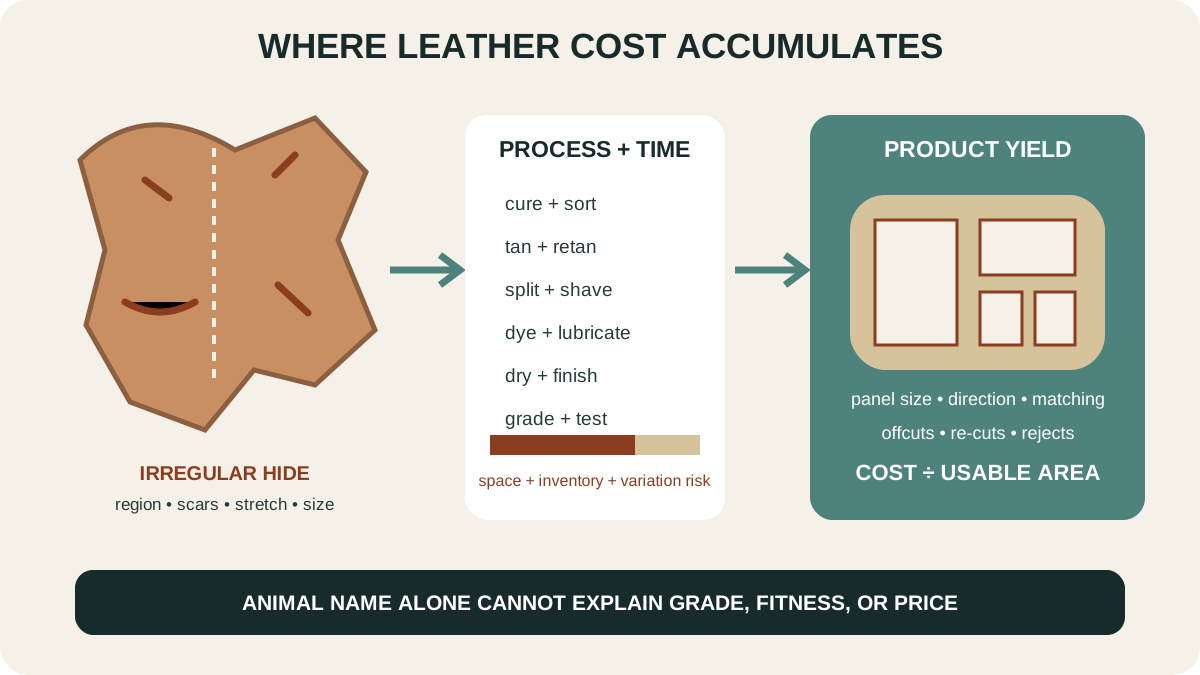
Leather is irregular. A cutter has to nest pattern pieces inside the boundary while considering spine direction, belly stretch, defects, grain, color, pair matching, nap, and the final location of each panel.
Use a rough comparison:
usable yield = acceptable pattern-piece area ÷ purchased hide area
If a maker buys 50 square feet and can place only 32 square feet of acceptable panels, the usable yield is 64%. The remaining 36% is not automatically trash: small-goods makers may use it for tabs, keepers, reinforcements, samples, or repairs. But the jacket still has to carry the cost.
Large uninterrupted panels are expensive because they demand large clean zones. Small wallets can fit between defects. A pair of shoes also demands visual and mechanical pairing: left and right should flex, color, and age together.
A fuller cost model
finished cost ≈ hide purchase ÷ usable yield + tanning/finishing + cutting/matching + assembly + components + rejects/rework + overhead
Two implications follow:
- expensive hides can be economical when grading is consistent and yield is predictable;
- cheaper hides can become expensive if every one needs slow inspection, heavy correction, re-cutting, and color sorting.
Three levels in practice
| Level | Typical choices | Honest strengths | Common compromises |
|---|---|---|---|
| Budget | splits or lower selections, strong pigments, smaller panels, simple lining, rapid cutting | consistent color, stain resistance, attainable price | plastic-like surface, weak flex zones, little matching, hard-to-repair coatings |
| Competent | leather specified for use, sensible finish, graded panels, reinforced stress points, replaceable hardware | balanced durability, appearance, yield, and care | some visible scars or joins; not every edge hand finished |
| Exceptional | rare combination of suitable grain, temper, panel size, matching, controlled tannage, exact cutting, skilled assembly | coherent drape or structure, clean aging, repairable construction, traceable process | high cost, maintenance, variability, long lead time |
The exceptional tier is not “most natural” in every product. It is the hardest appropriate specification executed consistently.
Field audit
- Name the product’s job: drape, abrasion, support, polish, water resistance, or soft hand.
- Record species, tannage, finish, thickness, and lining if disclosed.
- Map panel size and grain direction.
- Find scars, belly stretch, wrinkles, sanding, embossing, and finish pooling.
- Compare paired pieces in color, thickness, and flex.
- Inspect high-stress holes, folds, seam allowances, and edges.
- Ask what can be refinished, re-heeled, re-lined, or re-stitched.
- Separate documented traceability from evocative origin language.
Rule of thumb
Leather becomes expensive when a variable hide is asked to deliver large, matched, purpose-specific pieces through a controlled process. Pay for the constraint you can name—not for the animal name alone.
Practice
Irregular boundaries, defects, directional properties, matching, and panel geometry create cutting loss.
Practice
Species changes the starting structure, but the intended use and subsequent processing determine whether it is a good choice.
Practice
Calendar time ties up inventory and capacity. It can create a valued result, but duration alone is not proof of superiority.
Lesson complete
Nice work.
Sources for this lesson
- 1Fineas Jackson. Why do some leather jackets look so much better? #education #leather. Fineas Jackson on YouTube. 2026. verifiedChasing Beauty episode 27; 2:40. Used as a case or observation prompt, not as the sole authority for technical claims. Cited at: episode 27.
- 2Caring for Leather, Skin and Fur. Canadian Conservation Institute. 2018. verifiedGovernment conservation reference explaining species differences in grain, thickness, strength, processing, and aging. Cited at: conservation guide.
- 3Importers' Requirements of Hides and Skins and Derived Products. Food and Agriculture Organization of the United Nations. 2001. verifiedTechnical commodity report linking animal husbandry, transport, slaughter, curing, scars, brands, flay damage, grading, and homogeneity to hide quality and price. Cited at: technical report.
- 4The Oak-Bark Tanning Process. J&FJ Baker & Co.. verifiedPrimary tannery process account documenting three months suspended in tanning liquor followed by nine months layered with bark for a twelve-month tannage. Cited at: tannery process.
- 5Leather Manufacturer Standard. Leather Working Group. verifiedAudit scope covering production data, traceability, energy, water, emissions, waste, effluent, chemical management, health and safety, and operations. Cited at: audit scope.
Previous: Straps: Webbing, Buckles, Stitching, and Load Paths