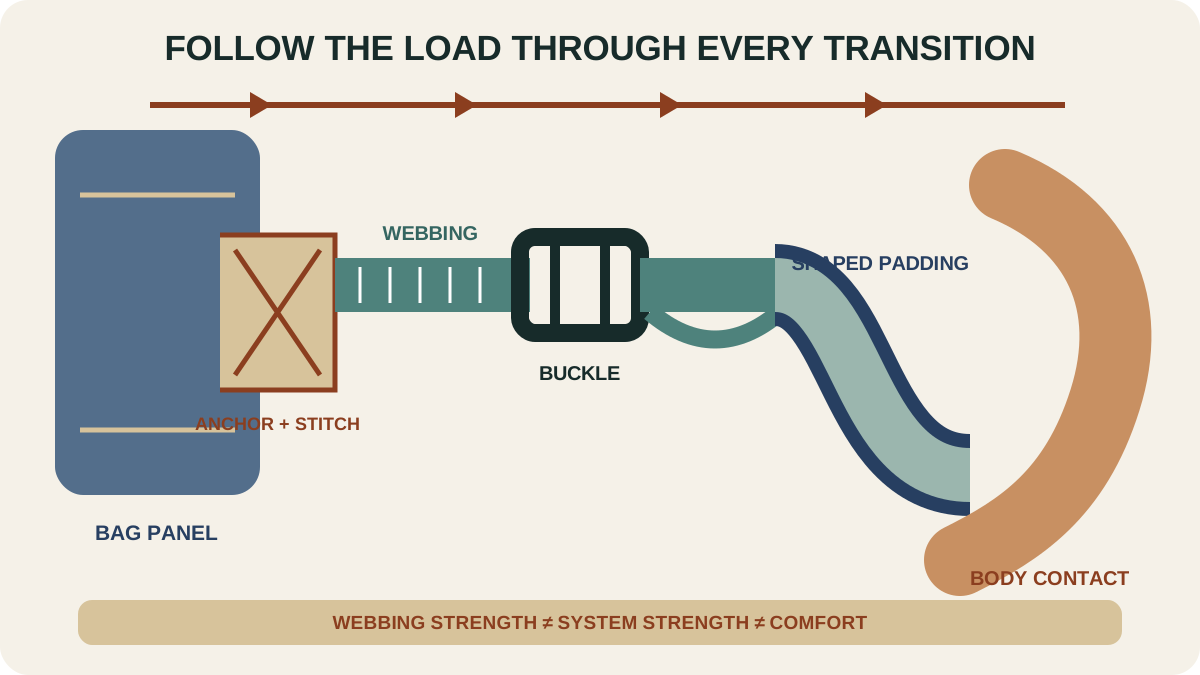
Straps: Webbing, Buckles, Stitching, and Load Paths
Following load from a pack to your body: the jobs different straps do, webbing fibers, weaves, and edges, ladder locks and cam buckles, stitch patterns as designed junctions, a contact-pressure calculation, three levels of execution, and a field audit.
- 6 min
- 9 steps
- 3 questions
- Lesson 19 of 49
In this lesson
- Name the strap’s job
- Fiber is only the first decision
- Weave and edges change behavior
- Hardware controls and concentrates load
- Stitching is a designed junction
- A simple pressure calculation
- Three levels of strap execution
- Field audit
- Rule of thumb
Open alongside this lesson
-
Parachute Rigger Handbook (opens in a new tab)
Use the handbook to see why stitch pattern, needle, thread, webbing condition, repeated sewing, and too many perforations all matter at a junction.
-
MIL-DTL-4088L — Webbing, Textile, Woven Nylon (opens in a new tab)
Compare type, class, fiber, loom, width, thickness, weight, and breaking strength instead of treating “nylon strap” as complete.
Picking up where you left off.
A strap is a flexible beam, an adjustment mechanism, a pressure distributor, and a set of junctions. Calling it “ballistic nylon” tells you less than most product pages imply.
Name the strap’s job
Different straps should not be judged by the same feel:
- shoulder straps distribute a carried load across body contact;
- hip belts transfer load toward the pelvis when the bag and body geometry allow it;
- load lifters change the upper harness angle and stabilize the bag;
- sternum straps control shoulder-strap spread;
- compression straps limit load movement and volume;
- watch straps retain a small object through flex, sweat, and spring-bar failure;
- luggage straps contain a case;
- tool or camera straps balance access, security, and localized pressure;
- safety harness webbing belongs to regulated, tested systems and must never be inferred from casual pack construction.
The intended load, consequences of failure, range of bodies, wet exposure, UV, chemicals, abrasion, and adjustment frequency should set the specification.
Fiber is only the first decision
Engineered narrow fabrics use nylon, polyester, polypropylene, aramids, high-modulus polyethylene, and other fibers. Bally Ribbon Mills describes selecting for strength, limited elongation, thickness, flammability, weight, and special conditions 1.
Broad tendencies:
- nylon can combine toughness and high strength, with useful energy absorption; it can absorb more moisture and may stretch when wet;
- polyester offers good UV and moisture stability and often lower stretch;
- polypropylene is light, low-cost, and does not absorb much water, but lower heat tolerance and long-term abrasion or UV requirements can limit it;
- high-performance fibers can deliver exceptional strength or heat resistance while raising cost and creating new bend, creep, sewing, and cutting constraints.
These are starting points. Finish, yarn size, weave, heat setting, edge construction, and test condition can overturn a generic comparison.
The U.S. military’s active webbing specification divides woven nylon by type and class and sets measurable requirements 2. That is how a strap stops being an adjective.
Weave and edges change behavior
Plain or twill webbing can trade surface texture, flexibility, thickness, and yarn exposure. Tubular webbing forms a flattened tube; it can spread around hardware, accept internal components, or double in layers. Jacquard webbing weaves graphics or varying structures in rather than printing them.
Inspect:
- edge yarns protected from abrasion;
- no picks, cuts, melted damage, or severe fuzzing;
- thickness compatible with the buckle slot;
- enough friction to hold adjustment without making it impossible;
- bend radius around bars that does not sharply crease stiff fibers.
Hardware controls and concentrates load
A ladder lock routes webbing around bars so friction holds an adjusted length. A cam buckle adds a toothed or smooth moving cam. A side-release buckle combines a quick connection with separate adjustment. A triglide or slide holds and redirects a tail. A traditional frame buckle places a pin through a hole or bears on the strap.
The buckle must match webbing width and thickness. Too thin and it creeps; too thick and it jams. A sharp mold parting line or stamped-metal edge can cut fibers. A tiny radius concentrates bending.
Adjustment range is part of quality. The correct strap should:
- reach the smallest and largest intended user or load;
- retain a usable tail;
- avoid the buckle landing on a collarbone or pressure point;
- remain adjustable with gloves if that is the use;
- resist accidental loosening but release deliberately.
Stitching is a designed junction
Common visible patterns include bar tacks, box-X, W-W, rows, and combinations. Do not rank them by graphic complexity.
The FAA Parachute Rigger Handbook explains that ultimate junction strength changes with stitch pattern and length, fabric weight and weave, thread, needle condition, rows, webbing treatment, and re-sewing 3. It warns that excessive stitch density can perforate and weaken material; more holes are not free.
For ordinary goods, inspect:
- generous overlap rather than stitches close to a raw end;
- reinforcement spreading load into the bag panel or leather body;
- stitches crossing enough webbing yarns;
- no skipped stitches or cut fibers;
- thread protected from direct abrasion;
- pattern aligned with load direction;
- repair access.
For life-safety equipment, visual inspection is not certification. Use rated, traceable products and the manufacturer’s retirement and inspection rules.
A simple pressure calculation
Comfort depends partly on pressure:
average contact pressure = carried force ÷ effective contact area
A wider strap can lower average pressure only if its padding and shape keep the width in contact. A stiff straight strap on a curved shoulder may touch at two narrow edges. Thick soft foam can feel plush for five minutes and collapse under a heavy load.
Look for graduated stiffness: firmer foam or structure to spread load, softer surface layers for local comfort, edges that do not cut, and a curve that follows the body.
Three levels of strap execution
Budget
- generic polypropylene or nylon;
- thin one-piece foam;
- basic side-release hardware;
- short overlap and simple stitching;
- limited range or no keepers;
- good enough for light, low-consequence use.
Competent
- fiber and width suited to exposure and load;
- compatible branded or specified hardware;
- reinforced anchor panel;
- multiple foam densities or shaped padding;
- clean bar tacks or designed junctions;
- replaceable components where wear is expected.
Exceptional
- traceable webbing and hardware test data;
- controlled elongation and abrasion;
- body-contoured pattern and pressure mapping;
- low-friction or high-friction surfaces placed deliberately;
- load path carried into the product’s structure;
- prototypes tested wet, cold, dirty, and cycled;
- junctions designed for inspection and repair.
Field audit
Load a bag with a known mass. Photograph and mark:
- where the strap enters the bag;
- every fold and hardware bar;
- stitch pattern and overlap length;
- the smallest and largest adjustment;
- contact zones after 20 minutes;
- any slip, squeak, edge curl, or numbness;
- whether a worn buckle or strap can be replaced.
Rule of thumb
Follow the load from object to body. The quality of a strap is the quality of the weakest transition along that path—not the strength number of the webbing alone.
Practice
Material name and marketing adjective leave the performance system unspecified.
Practice
The FAA handbook warns that stitch security and perforation damage must be balanced.
Practice
Strap roles differ. Shoulder, hip, stabilizer, compression, and sternum straps manage different loads and geometries.
Lesson complete
Nice work.
Sources for this lesson
- 1Commercial and Recreational Webbing. Bally Ribbon Mills. verifiedNarrow-fabric manufacturer overview of nylon, polyester, polypropylene, and high-performance fibers engineered for strength, elongation, thickness, weight, and end use. Cited at: manufacturer overview.
- 2MIL-DTL-4088L — Webbing, Textile, Woven Nylon. U.S. Defense Logistics Agency. 2021. verifiedActive detail specification showing that webbing is purchased by defined type, class, fiber, weave, width, thickness, weight, and breaking-strength requirements. Cited at: MIL-DTL-4088.
- 3Parachute Rigger Handbook. U.S. Federal Aviation Administration. 2015. verifiedSafety-critical construction handbook explaining webbing junctions, stitch patterns, thread and needle variables, overstitching, re-sewing damage, and load-path design. Cited at: junction guidance.
Previous: Hiking Shells: Waterproof, Breathable, and Built to Move