Wisconsin Barns and Round Barns
The classic Wisconsin dairy barn is a long bank barn: cows in a stone basement with a window for each animal, hay in a huge gambrel-roofed loft above, and a ramp so wagons drive straight into the mow. Then the experiment: in 1889 UW professor Franklin King built a 90-foot round barn around a round silo for 80 cows and 10 horses. Why round seemed smarter, why Vernon County still has the most, and why milking pipelines and square bales finished them.
- 5 min
- 6 steps
- 2 questions
- Lesson 48 of 49
In this lesson
- The Wisconsin dairy barn
- King’s round barn
- Vernon County
- Why they faded
- Try it
Picking up where you left off.
Drive any back road in Wisconsin and you’ll pass more barns than houses. Most follow one design that the state’s agricultural scientists helped settle a century ago. A few are round.
The Wisconsin dairy barn
As dairying took over Wisconsin farming, the University of Wisconsin’s Agricultural Experiment Station gave farmers barn advice built around two things: fresh air and sunshine, for healthy cows and clean milk. That meant dormers, rooftop ventilators, and a window for each animal 1.
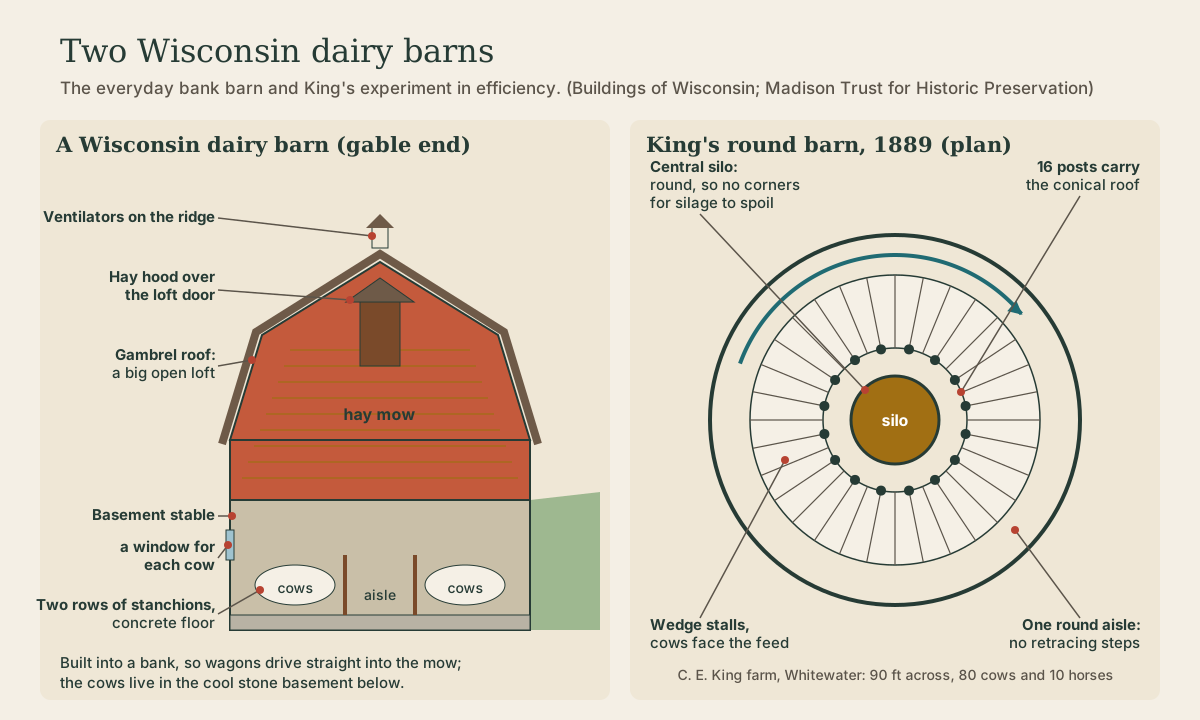
The result, the typical Wisconsin dairy barn, is a long, two-story bank barn 1:
- Downstairs, a stone or concrete basement stable with two rows of cattle stanchions and a central aisle running from one gable end to the other. The floors were concrete for cleanliness, often covered with cork or wooden bricks to be easier on the cows.
- Upstairs, the hay loft under a gambrel roof, the roof with two slopes on each side, which leaves a tall, open mow with no low corners.
- At the peak, a small gabled hay hood juts out over the loft door.
“Bank” means the barn is built into a slope, so one side of the loft is at ground level and a wagon can drive straight into the mow while the cows live in the basement below 2.
King’s round barn
Franklin H. King, professor of agricultural physics at the Experiment Station in Madison, started with silos. Farmers were losing silage to spoilage in the corners of square silos; King concluded round was the only way to build them, and his all-wood round silo became known as the King or Wisconsin silo 2.
In January 1889 his brother Charles asked him for a barn to shelter eighty cows and ten horses on his farm near Whitewater. Franklin designed a round barn 90 feet across with a round silo at the center and a conical roof carried on sixteen posts around the silo 2. His “Plan of a Barn for a Dairy Farm,” published in 1890, was reprinted in books and farm journals across the country 3. King’s case for the circle 3:
- Less material. A circle encloses more space for its wall length than any other shape.
- Strength. More stable than a rectangle, and curved walls stand up to wind better.
- Feeding from the center. Cows faced inward to a single feed trough around the silo, and the barn around the silo kept the silage from freezing.
- One aisle, one direction. Wedge-shaped stalls fit cows well, and the farmer worked around a single circular aisle, cow to cow, without retracing steps.
That obsession with efficiency was typical of the Progressive Era, when the same thinking was being applied to forests, factories, and city government 3.
Quick check
The cows faced inward toward the feed; the silo was the barn’s center in every sense.
Vernon County
Round barns caught on. Balloon-frame round barns were once more common in Wisconsin than anywhere else in the country, except perhaps Indiana, and the state may have had up to 215 of them 3 4. Most went up between the 1880s and the 1930s 4.
Vernon County probably has more than any other county. As of 2019, ten were still standing there, plus one newly built 4. The leading local builder was Alga Shivers, a farmer-carpenter from Cheyenne Valley, probably Wisconsin’s largest rural Black community, settled by free Black families from the South beginning in 1855. In 1921 he built a round barn for Joe and Mary Dank, children of Bohemian immigrants, from boards cut from their own woodlot, with a ramp so a wagon could drive right into the haymow 3.

Why they faded
The circle had problems. Central silos were hard to fill, and curved fittings were expensive to install and maintain 3. From the 1930s, as farms got electricity, the new milking pipelines and barn cleaners were built to run in straight lines, and machines began packing hay into square bales, which stack best in a rectangle 4. After World War II, mechanization made the round barn’s efficiency claims obsolete 3. Today most of Vernon County’s survivors store hay or house horses, calves, and heifers; some Amish farmers, who don’t use the machinery, still milk in them 4.
Playback is optional. If the player is unavailable, open the video at its source.
Quick check
Mechanization made their efficiency claims obsolete.
Try it
On your next country drive, read the barns as you pass: gambrel or plain gable roof? Is there a hay hood at the peak, ventilators on the ridge, a row of small basement windows? Is it built into a bank? For round barns, the back roads of eastern Vernon County, around Hillsboro and Cheyenne Valley, are the place to look.
Lesson complete
Nice work.
Sources for this lesson
- 1Marsha Weisiger et al.. Horseshoe Bay Farms (Murphy Farms Barns). SAH Archipedia / Buildings of Wisconsin (University of Virginia Press, 2017). verifiedThe typical Wisconsin dairy barn: a long two-story bank barn with a gambrel roof and a gabled hay hood over the loft doors; in the basement two rows of stanchions with a central aisle, gable to gable; concrete floors, often covered with cork or wood bricks. UW Agricultural Experiment Station advice: ventilation and sunshine, with dormers, rooftop ventilators, and a window for each animal.
- 2John T. Hanou. The Odd Experiment: The Circular Thinking of Franklin H. King. Madison Trust for Historic Preservation. 2020. verifiedKing studied silos and saw silage spoiling in the corners of square ones. In January 1889 his brother Charles asked for a barn for eighty cows and ten horses; Franklin designed a 90-foot round barn with his all-wood round silo at the center, balloon frame, conical roof on sixteen posts around the silo; near Whitewater, Walworth County; burned 1924.
- 3Marsha Weisiger et al.. Round Barns of Vernon County. SAH Archipedia / Buildings of Wisconsin (University of Virginia Press, 2017). verifiedVernon County may have more round barns than any other Wisconsin county; balloon-frame round barns were once more numerous in Wisconsin than anywhere but perhaps Indiana. F. H. King's 'Plan of a Barn for a Dairy Farm' (1890) reprinted nationally. Advantages: less material for the volume, stability, wind resistance, a single circular aisle, wedge-shaped stalls, a central feeding trough, silage protected from freezing. Faded because central silos were hard to fill and circular fittings costly; mechanization after WWII. Alga Shivers, African American farmer-carpenter of Cheyenne Valley, the leading local builder; Dank Barn 1921.
- 4Round Barns of Vernon County. Vernon County Historical Society. verifiedWisconsin may once have had up to 215 round barns; as of 2019, 10 stood in Vernon County plus one newly built. First U.S. round barn: the Shakers' stone barn at Hancock, Massachusetts, 1826. Most built 1880s-1930s. Cows faced the center where feed and silage were kept. King's 1889 barn for his brother in Walworth County. From the 1930s, milking pipelines, barn cleaners, and square bales suited rectangular barns.