Hiking Shells: Waterproof, Breathable, and Built to Move
Reading a rain shell: face fabric, membrane, and backer, what ISO 811 waterproof ratings measure, the several meanings of breathability, DWR versus the membrane, seams and tape as the expensive inches, three quality levels, and a shell dossier.
- 6 min
- 8 steps
- 3 questions
- Lesson 18 of 49
In this lesson
- Read the laminate first
- Waterproof is a test claim with a boundary
- Breathability has several meanings
- DWR is not the membrane
- Seams, tape, and pattern are expensive inches
- Three quality levels
- A practical shell dossier
Open alongside this lesson
-
ISO 811:2018 — Textiles: Hydrostatic Pressure Test (opens in a new tab)
Use a water-head claim as one controlled material test, not as a complete prediction of comfort or garment durability.
-
H2No Performance Standard (opens in a new tab)
Notice the sequence of initial tests, simulated wear, re-testing, field use, and whole-product judgment.
Picking up where you left off.
A hiking shell is a portable environmental-control system. Its job is not simply to “be waterproof.” It must resist outside water, move sweat vapor, block wind, survive abrasion, seal holes made by sewing, allow motion, interface with layers and a pack, and remain maintainable.
Playback is optional. If the player is unavailable, open the video at its source.
Read the laminate first
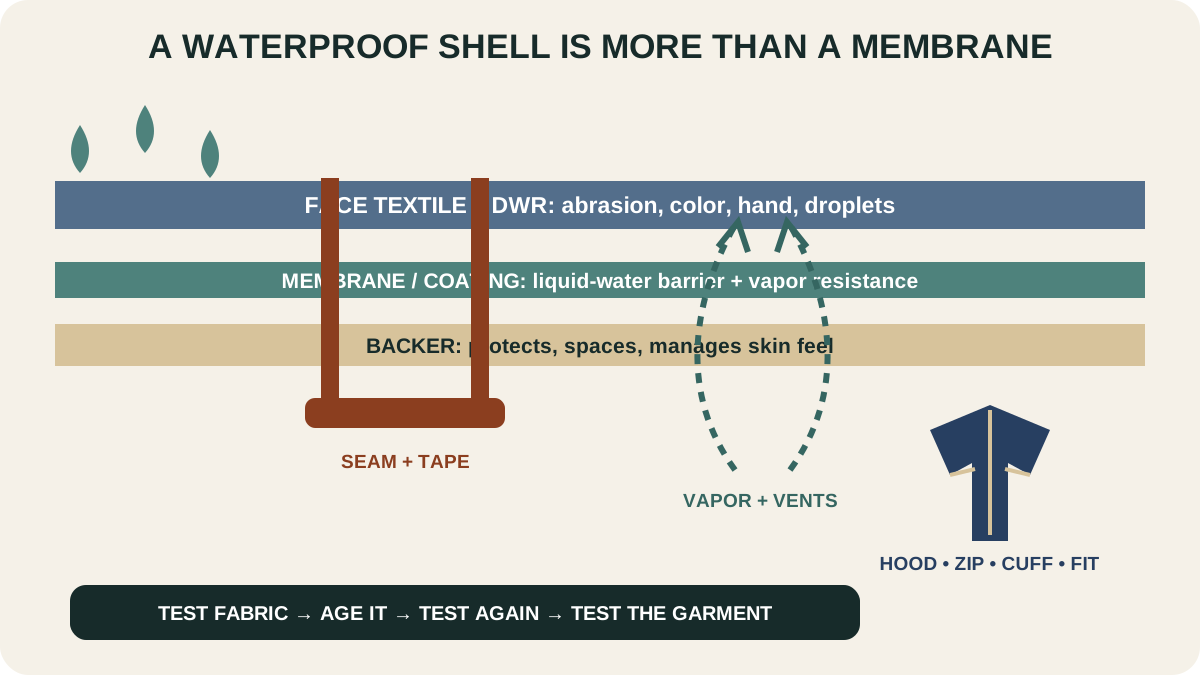
A typical waterproof-breathable shell combines:
- a face textile that takes abrasion, color, and surface treatment;
- a membrane or coating that creates the principal liquid-water barrier;
- sometimes a backer that protects the barrier from skin, oil, dirt, and wear.
Common shorthand:
- 2-layer: face and membrane are laminated; a separate loose lining protects the inside.
- 2.5-layer: face and membrane plus a printed or raised protective inner treatment.
- 3-layer: face, membrane, and backer are laminated into one fabric.
These are architectures, not a universal podium. A light 2.5-layer shell may be right for occasional rain and packing small. A robust 3-layer shell may better tolerate pack straps and sustained use. A heavy face can protect a membrane but feel noisy and stiff.
Gore describes the membrane as one component bonded to face and, in many products, backer textiles; seam tape and approved garment construction complete the barrier 1.
Waterproof is a test claim with a boundary
ISO 811 measures resistance to water penetration under hydrostatic pressure 2. A fabric supports an increasing water column until penetration criteria are reached.
A millimeter rating expresses pressure equivalence, not “millimeters of rain.” Higher can create margin for kneeling, pack pressure, or aging, but only under the cited test. It does not tell you whether:
- the seams are taped correctly;
- the zipper leaks;
- the hood drains onto the neck;
- the laminate delaminates after flexing;
- the face wets out;
- the garment fits over insulating layers.
The best claim includes test method, initial result, after-wear result, and whole-garment checks.
Patagonia’s H2No program is one disclosed example: it separates waterproofness, vapor transfer, surface repellency, and long-term durability, then re-tests after a simulated wear or “Killer Wash” sequence 3. Treat this as evidence about that program, not proof that one logo wins every use.
Breathability has several meanings
Sweat must evaporate from skin, pass through base and insulation layers, then cross the shell. A laboratory can measure water-vapor transmission or resistance under controlled temperature, humidity, and airflow.
ISO 11092 uses a sweating guarded hotplate to measure thermal and water-vapor resistance in fabrics and multilayer assemblies 4. Lower water-vapor resistance means vapor encounters less resistance under that method.
Other methods report MVTR, often in mass per area per time. A larger MVTR can indicate more transfer under that test. Do not compare an RET number with an MVTR number as if they share a scale, or compare two MVTR results without methods and conditions.
In the field, pit zips, pocket mesh, cuffs, front zipper, hem, wind, temperature gradient, activity, and layers can matter as much as a small material difference.
DWR is not the membrane
Durable water repellent lowers the surface energy of the face so droplets bead and roll. When it wears or becomes contaminated, the face can wet out. The membrane may still block liquid water, yet the dark saturated face feels cold and clammy and reduces useful vapor movement.
Gore explicitly separates DWR maintenance from membrane waterproofness 5. Cleaning and heat reactivation or reapplication—following the garment’s instructions—are part of ownership. A shell that needs care is not necessarily defective; a shell with no understandable care path is harder to value.
Seams, tape, and pattern are expensive inches
Every needle hole through a waterproof laminate is a possible leak. Seam tape uses controlled heat, pressure, width, and dwell to cover the seam without damaging the laminate.
Narrow tape can reduce weight and stiffness, but requires precise sewing and application. Wide tape offers placement margin but covers more breathable area and adds bulk. Curves, intersections, zipper ends, hood brims, and drawcord exits are hard.
Fewer seams can reduce leak paths, yet seam placement also creates shape. An articulated elbow, gusseted underarm, shaped hood, and rotated shoulder seam may cost more pattern pieces and taping while improving motion and moving pressure away from pack straps.
Three quality levels
Budget rain shell
- coated or laminated fabric selected for price;
- simple pattern and generous fit;
- limited seam sealing or bulkier tape;
- basic hood and zipper storm flap;
- few published test details;
- acceptable for short exposure if fit and care are honest.
Competent hiking shell
- face weight matched to use;
- full critical seam sealing;
- hood that turns with the head;
- hem and cuff control;
- reachable pockets above a hip belt;
- articulated sleeves;
- test method or standard disclosed;
- repair patches and clear care.
Exceptional technical shell
- laminate selected as part of an intended use system;
- precise micro-seams and tape;
- low-bulk intersections;
- validated movement with layers and equipment;
- water management at hood, zips, and openings;
- durability testing after contamination, flex, and abrasion;
- factory process control and whole-garment rain testing;
- design for cleaning, reproofing, and repair.
The exceptional shell can still be wrong for a warm drizzle or casual walk. Capability you never use becomes carried weight and cost.
A practical shell dossier
Record:
- garment mass and packed volume;
- layer architecture and face denier if disclosed;
- hydrostatic and vapor claim with test method;
- seam-tape coverage and intersections;
- hood field of view while turning;
- overhead reach and hem lift;
- pocket access with pack hip belt;
- ventilation paths;
- wet-out locations after a controlled shower;
- care, patch, zipper, and warranty options.
Then write the use case: temperature, duration, pack weight, abrasion, activity, and consequences of failure.
Rule of thumb
Pay for the weakest link to be managed. A spectacular membrane in a poorly taped, badly vented, restrictive jacket is not a spectacular shell.
Practice
ISO 811 is a controlled fabric test. Seams, wet-out, fit, ventilation, wear, and garment design remain.
Practice
DWR supports comfort and surface repellency. Its decline does not necessarily mean the membrane has begun leaking.
Practice
Always ask for the method, conditions, specimen, and direction of the scale before comparing claims.
Lesson complete
Nice work.
Sources for this lesson
- 1Get to Know the GORE-TEX Membrane. GORE-TEX. verifiedPrimary manufacturer explanation of membrane, face and backer textiles, laminates, seam tape, style approval, and final-garment quality control. Cited at: manufacturer system.
- 2ISO 811:2018 — Textiles: Hydrostatic Pressure Test. International Organization for Standardization. 2018. verifiedOfficial abstract defining the hydrostatic-pressure method for resistance of fabrics to water penetration. Cited at: standard abstract.
- 3H2No Performance Standard. Patagonia. verifiedMaker-published example of evaluating waterproofness, breathability, surface repellency, and durability before and after simulated wear; useful as a disclosed test system, not a universal ranking. Cited at: test program.
- 4ISO 11092:2026 — Thermal and Water-Vapour Resistance. International Organization for Standardization. 2026. verifiedOfficial abstract for guarded-hotplate measurement of thermal and water-vapour resistance in textiles, films, coatings, foams, leather, and multilayer assemblies. Cited at: standard abstract.
- 5Durable Water Repellent in GORE-TEX Products. GORE-TEX. verifiedPrimary explanation of DWR as a face-fabric treatment, why wet-out affects comfort, and why maintenance differs from membrane waterproofness. Cited at: care guidance.
Further reading
- Fineas Jackson. From Antarctica to Banned in Schools: The Canada Goose Story #education #story. Fineas Jackson on YouTube. 2026. verifiedChasing Beauty episode 28; 2:09. Used as a case or observation prompt, not as the sole authority for technical claims.
Previous: Cut & Shape: Ease, Sleeves, Gussets, and Silhouette