Dress Shirts: Cloth, Collar, Seams, and Fit
Judging a dress shirt: thread count as one coordinate, the pattern as the hidden product, collar interlinings, seam types as load-bearing joints, buttons and finishing as minor evidence, three quality levels, and a two-wash measurement audit.
- 7 min
- 8 steps
- 3 questions
- Lesson 24 of 49
In this lesson
- Thread count is a coordinate, not a verdict
- The pattern is the invisible product
- A collar is a small piece of architecture
- Seams are load-bearing interfaces
- Buttons and finishing: small evidence, modest weight
- Three realistic quality levels
- The two-wash audit
Open alongside this lesson
-
What Makes a Quality Garment? (opens in a new tab)
Use the photographs and checklist to inspect seam allowances, interfacing, sleeve setting, hems, grain, and secure attachment.
-
Seam Types (opens in a new tab)
Match a seam to its load, bulk, edge protection, appearance, and production constraints instead of assuming more stitches are always better.
Picking up where you left off.
A dress shirt looks simple because the successful version hides its negotiations. A flat textile must become a moving volume around neck, shoulders, arms, and torso. The collar must keep a controlled shape without feeling like cardboard. Seams must hold while remaining thin. The front must hang straight even though the body beneath it is asymmetric and mobile.
Fineas Jackson’s shirt episodes make a useful opening move: stop treating price as a property of “cotton” and ask what happened between fiber and finished fit 1 2.
Playback is optional. If the player is unavailable, open the video at its source.
Thread count is a coordinate, not a verdict
CottonWorks defines thread count as the number of warp and filling yarns in a square inch; a plied yarn is counted as one yarn under the conventional method 3. That makes the number useful when the yarns and method are comparable. It does not tell you:
- staple length, cleanliness, or fiber maturity;
- yarn fineness, twist, evenness, or whether it is single or plied;
- weave structure and cover;
- finishing, resin treatment, shrinkage, or abrasion resistance;
- opacity, air movement, hand, drape, or recovery;
- how well the shirt was cut and sewn.
A very high count can require fine yarns that feel smooth but are not ideal for every hard-wearing use. A lower-count oxford can be thicker, more open in character, and more durable. “Higher” answers only one narrow question.
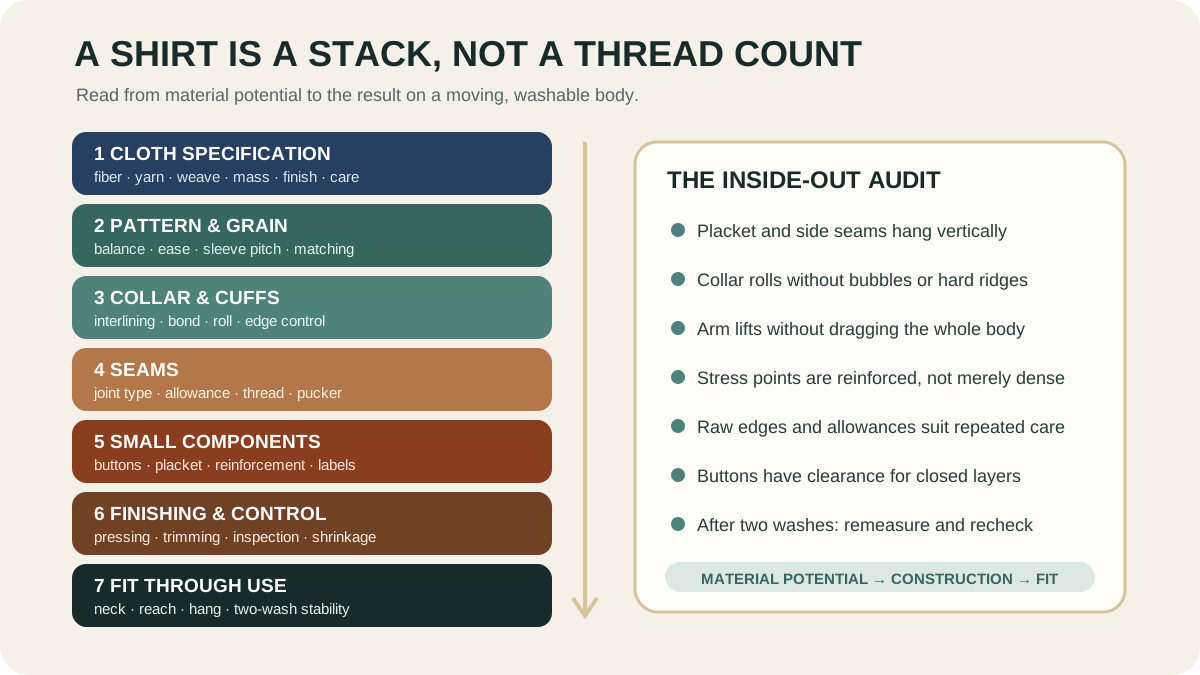
Use a cloth specification stack:
fiber → yarn → weave → mass/thickness → finish → care → intended use
For a warm-office shirt you might value an open, dry hand and easy laundering. For formal wear you may accept delicacy for a cleaner surface. Quality begins with fitness for the job.
The pattern is the invisible product
Lay the shirt flat, but judge it on a body. Look at:
- neck and collar: enough room to close without a gap large enough to collapse;
- shoulder point: near the body’s shoulder break unless the intended cut is dropped;
- chest and back ease: enough for breathing and reaching without a sail of surplus;
- armhole: high enough for mobility, shaped without cutting the underarm;
- sleeve pitch: aligned with the arm’s resting direction;
- cuff and sleeve length: stable when the elbow bends;
- body balance: fronts and back hang without pulling to one side;
- grain: placket and major vertical lines do not spiral after washing.
Two shirts can use identical cloth and machinery yet feel entirely different because the block, grading, and sleeve pitch differ. Extra fabric is not automatically comfort. Poorly placed ease shifts, balloons, or binds.
A collar is a small piece of architecture
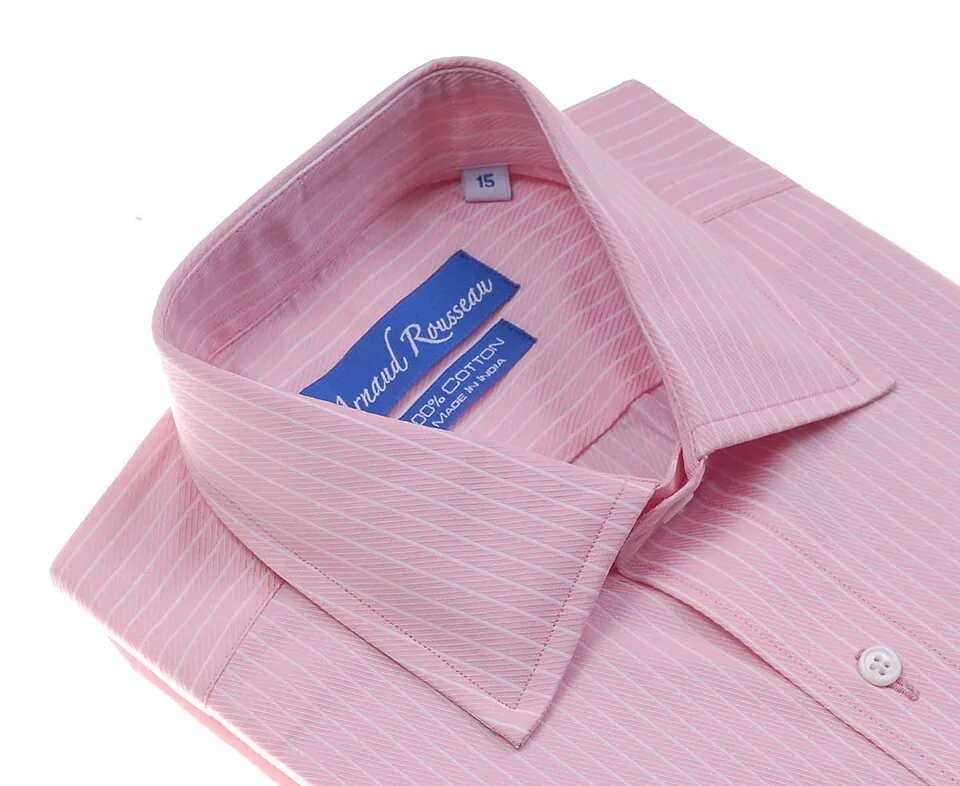
The visible collar cloth often encloses one or more interlining layers. They add body, stabilize the roll, and resist collapse. Depending on the design, layers may be fused with adhesive, sewn in, or combined.

The important question is compatibility:
outer cloth movement ≈ interlining movement ≈ stitch and fuse behavior through care
If shrinkage or stiffness differs too much, the collar can bubble, curl, delaminate, or feel dead. ASTM D2724 exists because bonded and fused apparel assemblies need their bond and dimensional behavior evaluated before and after cleaning 4. That does not make all fusing cheap. A controlled fuse can be light, stable, and consistent; a badly selected sewn interlining can be bulky. Technique must serve the intended roll.
Fineas’s collar episode is a reminder that tiny visible differences can emerge from pattern shape, interlining, pressing, and hand finishing rather than one magical component 5.
Seams are load-bearing interfaces
Coats classifies seams by how plies and edges are arranged because a lapped seam, superimposed seam, bound edge, and flat construction solve different problems 6. Inspect:
- stitch line straightness and even feeding;
- puckering along the thread path;
- skipped or damaged stitches;
- raw edges that can fray;
- enough allowance to resist pullout;
- dense areas where many layers meet;
- reinforcement at side vents, pockets, cuffs, and placket ends.
More stitches per inch can create a refined appearance and distribute a load, but too many needle holes can weaken delicate cloth. Thick thread can overpower fine fabric. ASTM D1683 distinguishes modes such as thread breakage, fabric rupture, and yarn slippage because a seam is only as strong as the combined system 7.
Pattern matching at a pocket, yoke, or placket costs cloth and cutting time. It is visible evidence of planning, but it is not worth sacrificing grain or fit merely to align a stripe.
Buttons and finishing: small evidence, modest weight
Buttons should fit the placket’s scale, pass without excessive force, and remain secure. Spare buttons and a shank of thread for thick cloth are practical. A beautiful hand-worked buttonhole can show rare skill, but the shirt still needs a sound pattern and washable assembly.
Inspect the inside:
- smooth collar and cuff edges without hard ridges;
- clean placket ends;
- symmetrical collar points where symmetry is intended;
- sleeve plackets that close flat;
- tails and hems without roping;
- no loose thread trapped into seams;
- labels and care instructions that do not irritate.
The University of Tennessee guide treats interfacing, seam balance, smooth sleeve setting, secure fasteners, and absence of puckering as observable quality evidence 8.
Three realistic quality levels
| Level | What may be good | Common compromise | Evidence to seek |
|---|---|---|---|
| Budget, honest | serviceable cloth, efficient fused collar, automated seams, few sizes | generic block, limited pattern matching, narrow allowances, little aftercare | even sewing, compatible collar, stable wash result, useful fit |
| Competent | better-specified cloth, thoughtful block, controlled fusing or interlining, reinforced stress points | industrial construction remains visible; alterations limited | published measurements, consistent collar roll, tidy inside, spare component, return/alteration path |
| Exceptional | cloth and pattern selected for a person or precise use, fine balance, skilled cutting/pressing, extensive matching and finishing | high labor and low volume; delicate cloth may still wear faster | fittings, named construction choices, allowances, repair, demonstrable comfort and longevity |
Exceptional does not mean “everything by hand.” A computer-cut component and automated buttonhole can be more repeatable. Pay for the decisions and outcomes you can trace.
The two-wash audit
Record the shirt before wear:
- chest, waist, body, sleeve, cuff, and collar measurements;
- collar lay and buttoning comfort;
- placket and side-seam verticality;
- seam puckering and loose threads;
- arm lift and reach.
Wash twice according to the care label, then repeat. A shirt may shrink slightly and still be excellent if shrinkage was anticipated. Watch for asymmetric twist, collar bubbles, cuff distortion, button loss, color change, and a fit that crossed from ease into strain.
Rule of thumb
Buy the shirt as a moving, washable system. Cloth creates potential; pattern, collar compatibility, seams, pressing, and fit decide whether you receive it.
Practice
Thread count is one fabric construction measure. It cannot rank complete shirts without the rest of the specification.
Practice
The collar is a small engineered laminate or assembly whose parts must move and age together.
Practice
Wear and care expose pattern balance, shrinkage, incompatible layers, and construction control that launch-day appearance can hide.
Lesson complete
Nice work.
Sources for this lesson
- 1Fineas Jackson. $345 for a basic white dress shirt…why? Is it different from one that costs $40?. Fineas Jackson on YouTube. 2026. verifiedChasing Beauty episode 67; 2:56. Used as a case or observation prompt, not as the sole authority for technical claims. Cited at: episode 67.
- 2Fineas Jackson. All cotton is the same right? Then how can two cotton shirts feel so different...?. Fineas Jackson on YouTube. 2026. verifiedChasing Beauty episode 63; 2:59. Used as a case or observation prompt, not as the sole authority for technical claims. Cited at: episode 63.
- 3Thread Count. CottonWorks. verifiedTextile-industry definition of thread count as warp plus filling yarns per square inch, with plied yarn counted as one yarn rather than multiplied into a marketing number. Cited at: industry definition.
- 4ASTM D2724: Bond Strength of Bonded, Fused, and Laminated Apparel Fabrics. ASTM International. verifiedStandard methods for measuring bond strength and dimensional behavior before and after cleaning, relevant to fused interlinings and laminated components. Cited at: bond test.
- 5Fineas Jackson. They look like decoration, but there’s a reason...behind the collar on your shirt. Fineas Jackson on YouTube. 2026. verifiedChasing Beauty episode 66; 2:58. Used as a case or observation prompt, not as the sole authority for technical claims. Cited at: episode 66.
- 6Seam Types. Coats Group. verifiedIndustrial sewing reference classifying seam architectures and explaining how strength, slippage, bulk, appearance, and production method change with the joint. Cited at: seam guide.
- 7ASTM D1683/D1683M-17e1: Failure in Sewn Seams of Woven Fabrics. ASTM International. 2017. verifiedStandard test method evaluating the force at which a sewn seam fails through thread breakage, fabric rupture, yarn slippage, or another defined mode. Cited at: test boundary.
- 8What Makes a Quality Garment?. University of Tennessee Institute of Agriculture. 2023. verifiedExtension guide identifying construction evidence such as interfacing, balanced seams, smooth sleeve setting, adequate allowances, secure fasteners, and absence of puckering. Cited at: garment audit.
Previous: Handmade, Artisan, and the Economics of Lost Skills