Cost, Price, and Value Are Different
Why price doesn't settle quality: four separate ledgers (cost to produce, market price, quality against a requirement, and value to the owner), lifecycle cost instead of purchase price, and a side-by-side comparison of two objects that do the same job.
- 7 min
- 8 steps
- 3 questions
- Lesson 1 of 49
In this lesson
- The four ledgers
- Calculate ownership, not just admission
- Side-by-side exercise: four columns, two objects
- Three rules of thumb
Open alongside this lesson
-
Why cheap umbrellas fail…and the ugly $60 umbrella that beats a $500 masterpiece (opens in a new tab)
Use Jackson's comparison to notice when price, appearance, and performance point in different directions.
-
ISO 9000:2026 — Quality management — Fundamentals and vocabulary (opens in a new tab)
Quality becomes discussable when the object's characteristics are compared with stated requirements.
-
Life-Cycle Analysis (opens in a new tab)
Adapt the lifecycle-cost categories to ordinary objects: purchase, use, maintenance, replacement, and disposal.
Picking up where you left off.
An expensive object can be excellent, mediocre, or actively wrong for you. A cheap object can be disposable, astonishingly efficient, or simply cheap. The price alone cannot choose among those possibilities.
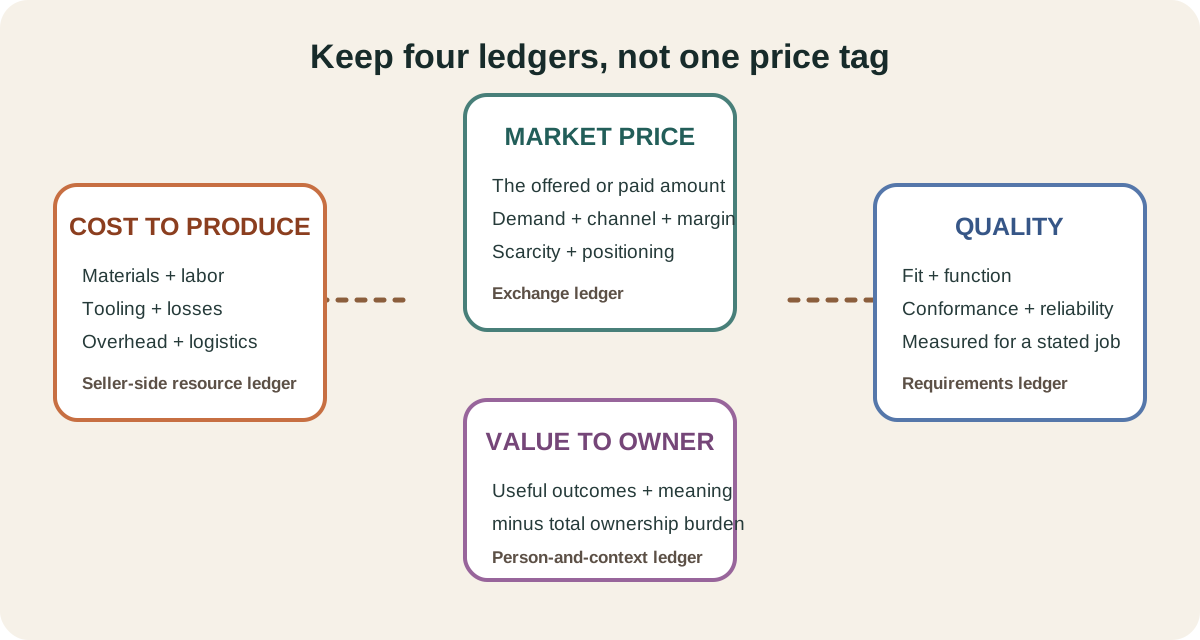
Fineas Jackson’s umbrella comparison makes that separation visible: an object with less visual prestige may perform the actual umbrella job better than both a bargain option and a far more expensive showpiece 1. The useful lesson is not “buy the middle one.” It is that cost to produce, market price, quality, and value to the owner are four different ledgers. They influence one another, but none is a synonym for another.
Playback is optional. If the player is unavailable, open the video at its source.
The four ledgers
Use the mnemonic CPQV—Cost, Price, Quality, Value—whenever a design story begins with “Why does this cost so much?”
1. Cost to produce
Cost to produce is the seller-side resource burden of making an object ready for sale. It can include material, direct labor, rejected parts, tooling, development, testing, factory overhead, packaging, and inbound logistics. The exact boundary matters. “Factory cost” may exclude design salaries, warranty reserves, retail rent, and the cost of unsold inventory.
Cost is not visible on the price tag. A material that costs $12 is not evidence that the entire object cost $12 to make, and a creator’s long development process does not guarantee the resulting object works well. Production cost answers: What resources did this offering consume within the chosen accounting boundary?
2. Market price
Market price is the amount offered, asked, or paid in an exchange. It may reflect production cost, but also demand, competition, distribution, taxes, retailer margin, scarcity, intellectual property, brand position, convenience, and the seller’s judgment about willingness to pay.
A $500 price proves one narrow fact: someone has offered the object at $500. If a sale occurs, it proves that at least one buyer accepted that amount under those conditions. It does not prove a $500 production cost or universal worth. A sale price is likewise not an objective value meter; list prices and discounts are part of market presentation.
3. Quality
Quality needs a requirement. ISO’s quality vocabulary centers on the degree to which characteristics fulfill requirements 2. For an umbrella, requirements might include opening reliably, resisting inversion in a stated wind condition, shedding water, covering the user’s body and bag, avoiding sharp edges, and remaining comfortable to carry.
This definition blocks a common trick: replacing performance with generalized “niceness.” A hand-polished handle may show workmanship, but it cannot compensate for a frame that fails the required load. Conversely, a rough industrial finish may be a quality defect on a formal accessory and irrelevant on an emergency umbrella. Quality is not always perfectly objective, because requirements and thresholds must be chosen; once chosen, many characteristics can be inspected or tested.
4. Value to the owner
Value to the owner is the object’s contribution to a particular person’s goals and experience relative to the burdens of owning it. Those contributions may include reliable function, time saved, repairability, comfort, beauty, delight, memory, or status. Burdens may include price, care, storage, anxiety about damage, incompatibility, and disposal.
Value can be personal without being vague. The Design Council’s value framework deliberately includes financial, social, and environmental dimensions across production, use, and end of life 3. You can state your priorities, record evidence, and explain why one tradeoff matters more to you than another. “I love it” is real evidence about your preference, not proof that the object is well made.
Calculate ownership, not just admission
For a first-pass comparison, write a simple lifecycle cost:
Lifecycle cost = purchase + setup + operation + maintenance + repair + replacement + disposal − resale
The U.S. Department of Energy uses comparable categories in lifecycle analysis, including purchase, operation, maintenance, replacement, and disposal 4. For a shirt, “operation” might mean special cleaning. For a chair, it might be replacement casters and the time to obtain them. Do not invent false precision: write unknown or a range when evidence is weak.
Then calculate:
Cost per successful use = lifecycle cost ÷ successful uses
Suppose these are planning assumptions, not tested facts:
| Umbrella | Purchase | Repair | Expected successful trips | Cost per trip |
|---|---|---|---|---|
| A | $25 | $0 | 20 | $1.25 |
| B | $60 | $10 | 150 | $0.47 |
| C | $500 | $20, less $200 resale | 100 | $3.20 |
The table does not crown B forever. If C gives its owner intense aesthetic pleasure, serves a ceremonial role, or resells for more, C’s owner-value could be high. If B cannot fit in your bag, its favorable cost per use may be irrelevant. The calculation exposes assumptions so that the disagreement becomes specific.
Repairability can extend useful life and retain material and economic value; NIST includes repair, refurbishment, reuse, and recycling among circular-economy strategies 5. Still, “repairable” must be evidenced by accessible fasteners, available parts, instructions, or a real service—not just a hopeful adjective.
Side-by-side exercise: four columns, two objects
Choose two objects that perform the same basic job: two kettles, backpacks, desk lamps, or rain jackets. Hide their prices initially if possible.
- Write the job. Complete: “This object must ___ under ___ conditions for ___ years or uses.” Add three must-pass requirements.
- Inspect quality. Record only observable or documented characteristics: dimensions, weight, joint movement, control feel, seams, finish consistency, repair access, test results, and warranty terms.
- Reveal price. Record actual transaction price, not only the crossed-out list price.
- Sketch cost drivers. List plausible material, process, labor, testing, channel, and service costs. Mark each
documented,inferred, orunknown. Do not pretend to reconstruct a private invoice. - Estimate ownership. Use low, middle, and high service-life scenarios. Calculate lifecycle cost and cost per successful use for each.
- Name personal value. Give 100 importance points across function, comfort, appearance, repair, emotional meaning, and any other criterion. Score only after assigning the weights.
Finally, write four separate sentences: “A probably costs more to produce because…,” “A’s market price is…,” “B better meets requirement X because…,” and “I would choose ___ because….” If one sentence tries to do all four jobs, split it.
Three rules of thumb
- Price is evidence about the market, not a lab result. It may prompt questions, but it cannot answer them alone.
- Quality is fitness against requirements. State the job before praising the execution.
- Value belongs to a person in a context. Personal meaning can justify a purchase without being disguised as superior engineering.
The disciplined conclusion is not “expensive things are a scam” or “you get what you pay for.” It is more useful: ask which ledger a claim belongs in, and demand the kind of evidence that ledger requires.
Practice
Price is an exchange amount. Without evidence, it does not disclose production cost, prove quality, or settle personal value.
Practice
A useful technical view of quality asks how well characteristics fulfill requirements for the intended job.
Practice
Lifecycle cost is $60 + $10 = $70; $70 divided by 150 successful uses is about $0.47 per use.
Lesson complete
Nice work.
Sources for this lesson
- 1Fineas Jackson. Why cheap umbrellas fail…and the ugly $60 umbrella that beats a $500 masterpiece. Fineas Jackson on YouTube. 2026. verifiedChasing Beauty episode 39; 2:43. Used as a case or observation prompt, not as the sole authority for technical claims. Cited at: episode 39.
- 2ISO 9000:2026 — Quality management — Fundamentals and vocabulary. International Organization for Standardization. 2026. verifiedOfficial overview of the quality-management vocabulary, emphasizing consistent fulfillment of customer and regulatory requirements. Cited at: quality-management overview.
- 3The Design Value Framework. Design Council. verifiedFramework for financial, social, environmental, and democratic value across design, production, use, and end of life. Cited at: framework scope.
- 4Life-Cycle Analysis. U.S. Department of Energy Building Science Education. verifiedPublic teaching resource showing that lifecycle cost can include purchase, operation, maintenance, replacement, disposal, and financing costs. Cited at: cost categories.
- 5Circular Economy. National Institute of Standards and Technology. verifiedExplains how reuse, repair, refurbishment, and recycling can preserve resources and economic value. Cited at: circular pathways.