The Right Material for the Job
Choosing a material for a specific job: writing a brief that covers mission, exposure, pass-fail thresholds, care and repair, and human fit, what the evidence on summer wool actually supports, screening before scoring, and lifecycle cost.
- 7 min
- 11 steps
- 3 questions
- Lesson 6 of 49
In this lesson
- MATCH the system to the job
- What the summer-wool case actually supports
- Use thresholds before a decision matrix
- Add lifecycle cost and successful use
- Practical material audition
- Rule of thumb
Open alongside this lesson
-
The best summer fabric is…wool? #summer #wool #education (opens in a new tab)
Treat the surprising title as a hypothesis about conditions, not a universal ranking of wool above every other summer textile.
-
Material choices: what are things made from and why? (opens in a new tab)
Connect performance, process, feel, meaning, status, and lifecycle instead of ranking materials by prestige.
-
Breathability and Wool (opens in a new tab)
Review humidity-buffering and thermal-comfort claims while keeping the publisher's industry role and the linked study conditions visible.
-
Materials Benchmark Survey Guide 2025 (opens in a new tab)
Add longevity, care communication, disassembly, and recyclability as separate requirements where they matter.
-
Why your comforter keeps making you sweat #bedding #education (opens in a new tab)
Turn “breathable bedding” into a system brief covering fill, fill power and mass where relevant, shell weave, quilting, room climate, sleeper, moisture, cleaning, and desired warmth.
Picking up where you left off.
There is no best material in the abstract. There is only a material system that meets a job better or worse under stated conditions.
Fineas Jackson’s question—could wool be a summer fabric?—is valuable because it breaks a crude seasonal category 1. The answer cannot stop at the fiber name. A lightweight open wool cloth, heavy brushed wool coating, wool-blend knit, and lined worsted suit behave differently. Climate, activity, fit, color, air movement, skin sensitivity, cleaning, and tolerance for wrinkles or odor all change the decision.
Playback is optional. If the player is unavailable, open the video at its source.
MATCH the system to the job
Use MATCH to write a material brief before choosing a favorite.
M — Mission
State the object’s primary job, user, duration, and success measure. “Summer shirt” is too broad. Try: “A travel shirt for eight-hour walking days in warm, humid cities; presentable at dinner; wearable twice between washes; packed in a small bag.”
Separate the function from the current solution. “Provide shade” is a function; “use canvas” is already a material decision. This keeps alternatives open.
A — Abuse and exposure
List what the system will encounter:
- temperature, humidity, solar radiation, water, salt, oils, and chemicals;
- abrasion, repeated flexing, impact, compression, and sustained load;
- skin contact, pressure, sweat, allergens, and mobility;
- laundering, heat, detergent, dry cleaning, storage, and pests;
- frequency, duration, and consequences of failure.
An absorbent fiber can help buffer humidity yet dry slowly in a dense construction. A water-repellent finish may handle a brief spray but fail under pressure or after repeated cleaning. Exposure needs magnitude and time.
T — Tolerances, thresholds, and tests
Convert adjectives into pass conditions. Instead of “durable,” specify no seam opening after a defined use trial, acceptable dimensional change after stated care cycles, or a named abrasion or strength method. Instead of “breathable,” decide whether you care about air permeability, water-vapor transport, drying time, or subjective thermal comfort; these are related but not identical.
CottonWorks’ quality-assurance training separates measurable properties such as airflow, moisture handling, drying, stretch, and water response 2. Ask the supplier for method, conditioning, sample construction, number of cycles, pass criterion, and result. A fiber-level claim should not be silently transferred to every finished product.
C — Care, continuity, and circular options
Specify who can clean and repair the object, available equipment, acceptable time, parts or patch compatibility, and end-of-use route. Textile Exchange treats durability, longevity, care communication, disassembly, and recyclability as distinct design considerations 3. A long-lasting product may use a blend that is hard to recycle; an easily recyclable product may fail early if poorly constructed. Record the tradeoff.
NIST’s circular-economy overview includes repair, reuse, refurbishment, and recycling as different ways to preserve resources and value 4. “Sustainable material” is therefore incomplete without production, service life, care, and destination.
H — Human fit and meaning
People experience materials through temperature, texture, pressure, sound, smell, weight, maintenance, and cultural association. Include bodies and preferences rather than designing for an imaginary average user. A technically efficient textile that feels intolerably prickly to its wearer is not fit for that next-to-skin job.
Meaning also matters. The V&A’s material-choice overview includes performance and process alongside feel, status, meaning, and lifecycle 5. Treat symbolic value as a real criterion, but do not rename it strength, safety, or durability.
What the summer-wool case actually supports
The International Wool Textile Organisation summarizes evidence that wool can buffer humidity and contribute to thermal comfort during changing activity and rest 6. Because IWTO represents the wool industry, follow its links to study design and compare independent or competing evidence when a decision matters.
The responsible conclusion is conditional:
Some wool fabrics can be appropriate in warm conditions because fiber moisture behavior, lightweight yarn and cloth design, drape, and garment ventilation may serve the brief.
It does not follow that every wool garment is cool, that wool always beats linen or synthetics, or that laboratory performance guarantees comfort for every wearer. Cloth mass, thickness, weave, lining, fit, wind, humidity, activity, care, and skin response remain part of the system.
Use thresholds before a decision matrix
First reject candidates that fail critical requirements: unsafe flammability behavior for a regulated use, incompatible cleaning, unacceptable skin response, inadequate strength, or unavailable size. Then weight the remaining criteria to total 100 and score representative finished samples, not generic fiber names, from 1 to 5.
This hypothetical travel-shirt matrix illustrates the method; the ratings are invented and must be replaced with sample evidence:
| Criterion | Weight | Linen woven | Lightweight wool woven | Polyester knit |
|---|---|---|---|---|
| warm-humid comfort | 30 | 4 | 4 | 3 |
| wash-and-dry convenience | 25 | 3 | 2 | 5 |
| odor management / rewear | 15 | 3 | 5 | 2 |
| abrasion and shape | 10 | 3 | 3 | 4 |
| home-care fit | 10 | 4 | 2 | 5 |
| formal drape | 10 | 3 | 5 | 2 |
| weighted score | 100 | 68 | 69 | 71 |
Weighted score is Σ(weight × rating) ÷ 5. The close scores are the lesson: a small change in weights or uncertain ratings can reverse the order. Do a sensitivity check. If odor management rises from 15 to 30 points, transfer 15 points from lower-priority criteria so the weights still total 100; which sample then leads? If dry cleaning is impossible, does wool fail the care gate? The matrix makes disagreement inspectable.
Add lifecycle cost and successful use
For each candidate, estimate:
Lifecycle cost = purchase + care + repair + replacement + disposal − resale
Cost per successful use = lifecycle cost ÷ uses that meet the brief
Suppose—purely as a scenario—a $110 shirt receives 80 successful wears with $20 total special care: $130 ÷ 80 = $1.63 per wear. A $180 shirt receives 160 wears with $60 care and a $20 resale: $220 ÷ 160 = $1.38. Service life and care dominate the result, so calculate low, middle, and high ranges. Do not turn hope into a 160-wear fact.
Practical material audition
Choose three candidate finished materials for one job: desk-surface samples, upholstery, rain-shell cloth, kitchen-tool handles, or travel shirts.
- Write a MATCH brief and three must-pass thresholds.
- Obtain representative samples with construction and finish information.
- Condition them together, then run identical safe observations or published tests.
- Record mass, thickness, flexibility, surface, recovery, cleaning response, and any job-specific result.
- Tag evidence as documented, measured, observed, inferred, or unknown.
- Score after assigning weights; reallocate 10 points between the top two criteria so the total remains 100.
- Calculate lifecycle cost per successful use as a range.
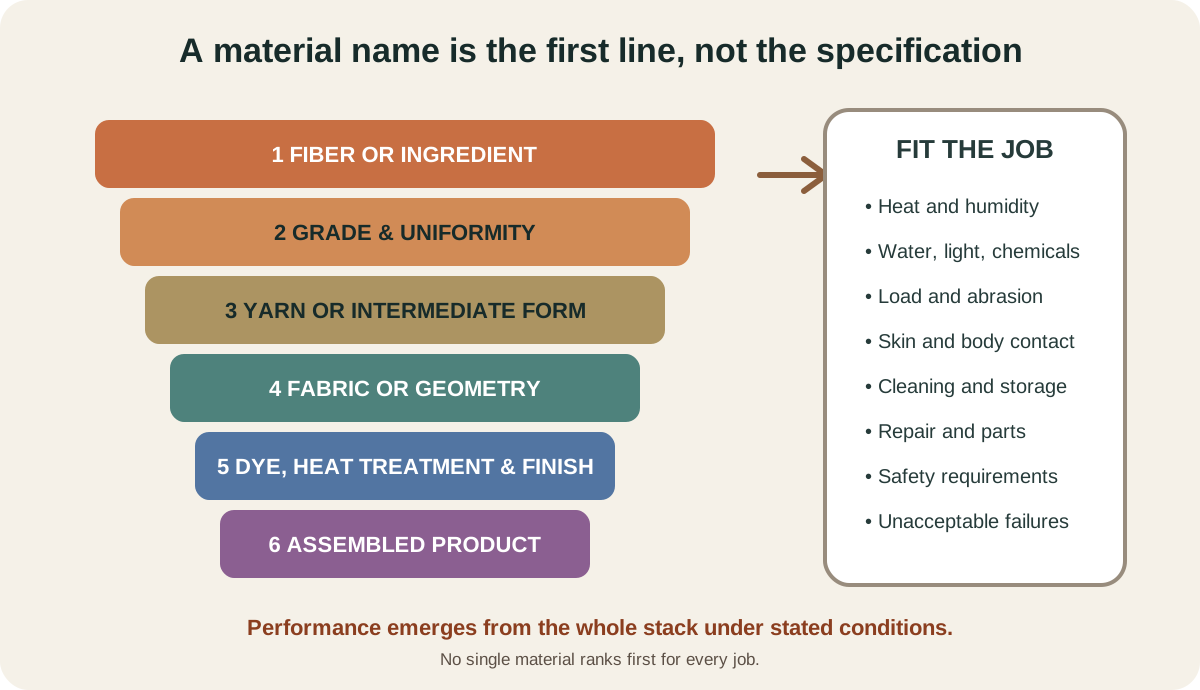
- Write the final specification, not merely the winner’s fiber: composition, grade if relevant, construction, mass or dimensions, finish, assembly, care, test threshold, and service plan.
Rule of thumb
“Best” must be followed by “for.” The right material is not the rarest, most natural, most technical, heaviest, or most expensive. It is the specified system that meets the important thresholds, survives the real exposure, fits the user, and carries an acceptable lifecycle burden.
Practice
Material fitness is conditional. Fiber properties matter, but yarn, construction, mass, finish, assembly, exposure, and user requirements determine the result.
Practice
Critical requirements act as gates. High scores on appearance or price cannot compensate for an unacceptable failure.
Practice
Controlled, job-relevant comparison of finished systems is stronger evidence than labels, proxies, or prestige.
Lesson complete
Nice work.
Sources for this lesson
- 1Fineas Jackson. The best summer fabric is…wool? #summer #wool #education. Fineas Jackson on YouTube. 2026. verifiedChasing Beauty episode 22; 2:16. Used as a case or observation prompt, not as the sole authority for technical claims. Cited at: episode 22.
- 2Quality Assurance Basics. CottonWorks by Cotton Incorporated. verifiedOverview of measurable textile attributes and standardized approaches to stretch, comfort, water behavior, stain release, and other performance claims. Cited at: test categories.
- 3Materials Benchmark Survey Guide 2025. Textile Exchange. 2025. verifiedIndustry framework that treats durability, longevity, disassembly, care information, and recyclability as separate design considerations. Cited at: design principles.
- 4Circular Economy. National Institute of Standards and Technology. verifiedExplains how reuse, repair, refurbishment, and recycling can preserve resources and economic value. Cited at: circular strategies.
- 5Material choices: what are things made from and why?. Victoria and Albert Museum. verifiedMuseum overview of how performance, process, meaning, feel, status, and lifecycle considerations influence material selection. Cited at: material selection factors.
- 6Breathability and Wool. International Wool Textile Organisation. verifiedWool-industry overview of humidity buffering and thermal comfort, with links to underlying research; useful evidence with the publisher's industry role kept visible. Cited at: research overview.