Tailored Jackets: Canvas, Fusing, Pressing, and Balance
Inside a tailored jacket: shell, canvas, padding, and lining, full canvas, half canvas, and fused fronts, pressing as forming cloth, balance before decoration, sleeve and lapel clues, where tailoring costs accumulate, and a ten-minute fitting audit.
- 7 min
- 10 steps
- 3 questions
- Lesson 25 of 49
In this lesson
- The exterior is only the weather surface
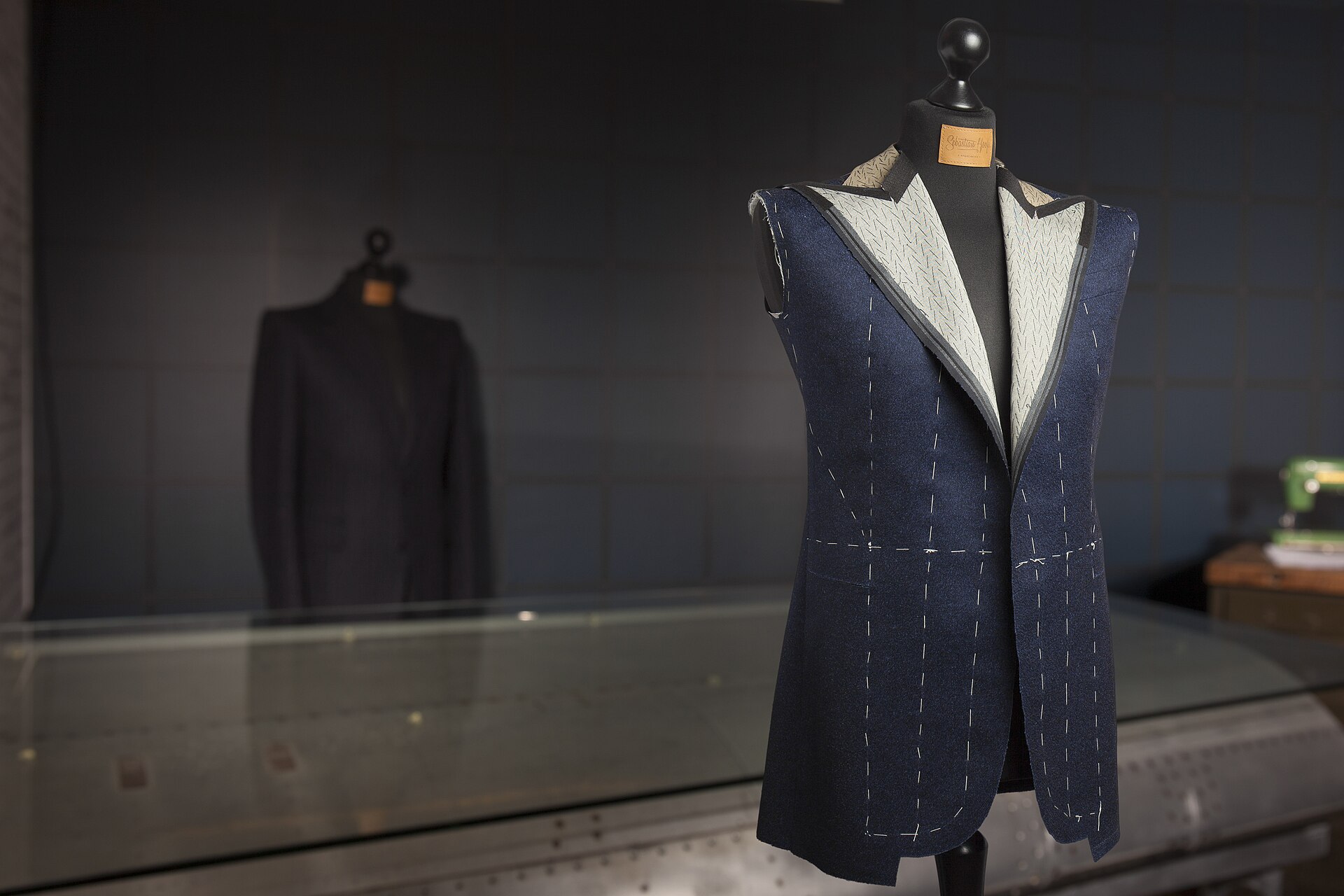
- Canvas, half-canvas, and fusing
- Pressing is forming
- Balance before decoration
- Sleeve and lapel clues
- Where tailoring cost accumulates
- Three construction offers
- A ten-minute fitting audit
- Rule of thumb
Open alongside this lesson
-
Fashion Unpicked: The Bar Suit by Christian Dior (opens in a new tab)
Follow how pattern pieces, padding, seams, internal support, and pressing cooperate to create shape rather than attributing the form to wool alone.
-
MW 232: Tailoring Techniques (opens in a new tab)
Prototype construction, sequence, standards, and evaluation make tailoring teachable and inspectable rather than mystical.
Picking up where you left off.
A tailored jacket is a soft structure pretending to be effortless. It must hang from shoulders, clear the neck, shape a chest, make room for arms, close across a moving torso, hold pockets, and return toward form after sitting.
Calling it a “wool jacket” is like calling a chair “wood.” Fineas Jackson’s suit episode opens the price question, but the revealing work begins when you separate cloth from the architecture that controls it 1.
Playback is optional. If the player is unavailable, open the video at its source.

The exterior is only the weather surface
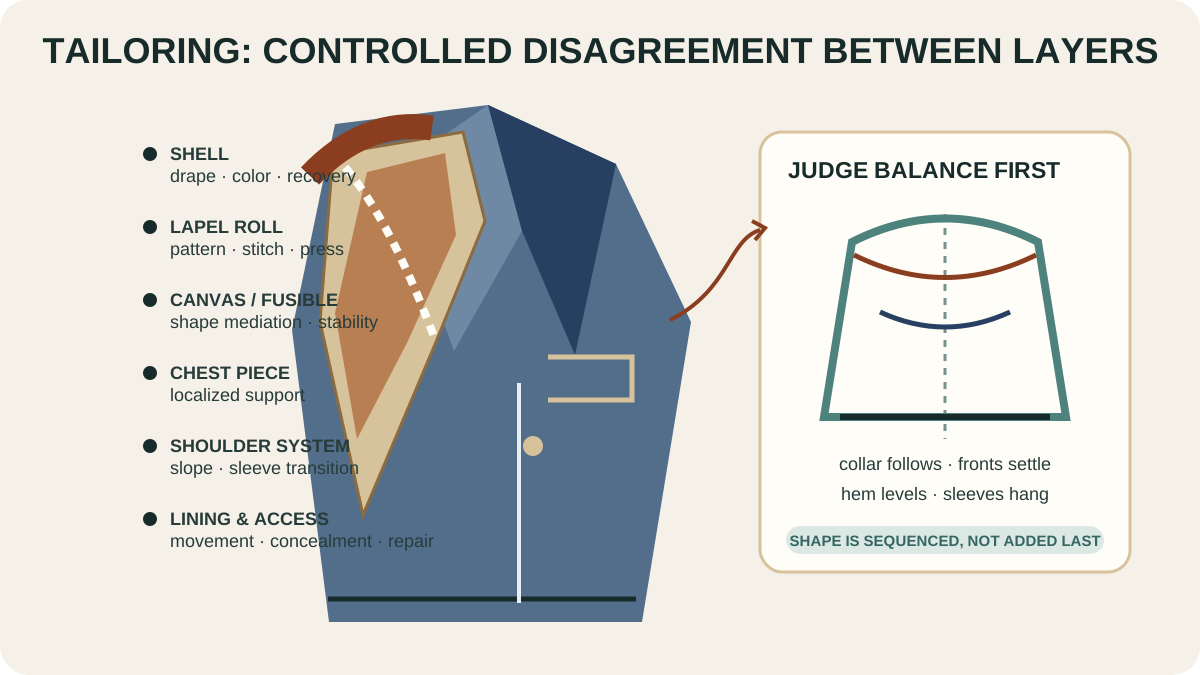
A conventional tailored jacket can contain:
- shell cloth;
- chest canvas or fusible interlining;
- haircloth or another chest reinforcement;
- shoulder pad and sleeve-head support;
- pocketing and pocket stays;
- tapes stabilizing roll lines and edges;
- facings;
- lining;
- buttons, thread, labels, and localized reinforcement.
Not every jacket needs every layer. An unstructured summer jacket intentionally removes support. A sculptural coat may add it. Quality is the coherence between intended silhouette, cloth, structure, climate, movement, and care.
The V&A’s construction reading of Dior’s Bar suit shows how internal support, padding, pattern pieces, seam placement, and shaping cooperate to produce the famous outline 2. The silhouette is made, not discovered inside expensive fabric.
Canvas, half-canvas, and fusing
Full canvas usually means a floating or partially secured internal structure extends through much of the front. Half canvas concentrates a floating chest structure higher in the jacket while lower regions may be fused. Fused construction bonds interlining to the shell over a larger area.
These labels are imprecise across sellers, so ask for a diagram or inside view. The tradeoffs:
Floating structure
- can shape gradually through cutting, pad stitching, and pressing;
- allows the shell and structure some independent movement;
- may be altered or repaired with more access;
- consumes skilled time and can add bulk if badly chosen.
Fused structure
- can be thin, light, consistent, and efficient;
- stabilizes difficult or loose cloth;
- depends on adhesive, temperature, pressure, time, and material compatibility;
- can delaminate or bubble when bond or care is poor.
ASTM D2724 includes methods for evaluating bond strength before and after laundering or dry cleaning 3. The existence of a test is the point: “fused” ranges from well-engineered production to a fragile shortcut.
Woolmark’s profile of Anderson & Sheppard describes a lightweight canvas as essential support inside a soft bespoke system 4. More canvas is not the goal. The right support in the right place is.
Pressing is forming
An iron in tailoring does more than remove wrinkles. Heat, moisture, pressure, and cooling can:
- shrink one edge relative to another;
- stretch a region within the cloth’s tolerance;
- curve a collar or lapel;
- open or flatten seam allowances;
- create fullness over chest, elbow, or shoulder blade;
- set a crease or remove temporary construction marks.
This work converts flat pieces into a controlled three-dimensional shell. It also creates failure risks: shine, scorching, seam impressions, adhesive contamination, distorted nap, and shapes that disappear after cleaning.
Skilled pressing is expensive because it is distributed across the sequence. A jacket cannot be fully assembled and then “given shape” at the end. Each seam is pressed while access remains.
Balance before decoration
Jacket balance is the relationship among front length, back length, shoulder angle, neck position, chest, and posture. Stand naturally with arms relaxed and check:
- collar follows the shirt collar without a gap or hard pressure;
- lapels lie rather than bow;
- fronts hang near vertical and do not swing dramatically open or overlap;
- buttoning creates modest radiating tension, not an X of strain;
- hem appears level for the intended cut;
- side seams remain near the body’s side;
- back falls without a horizontal shelf below the collar;
- sleeves hang with limited twisting.
No ready-to-wear block fits every posture. A high shoulder, prominent blades, erect stance, forward hips, or asymmetry can require alteration or a different pattern. Expensive construction cannot compensate for incompatible geometry.
Sleeve and lapel clues
The sleeve must join an armhole whose perimeter and shape differ. The sleeve cap often includes controlled ease: a small excess distributed without visible gathers. Smoothness, mobility, and intended roping depend on pattern, feed control, support, pressing, and cloth.
At the lapel, inspect the roll rather than demanding a particular style. Does it transition consistently toward the buttoning point? Does it spring naturally or look crushed? A hand-padded lapel can carry subtle roll, but a well-developed industrial process can also create a stable result.
Pick stitching, surgeon’s cuffs, and hand buttonholes may be beautiful. They are secondary evidence. None proves balance, durable pockets, or compatible internal structure.
Where tailoring cost accumulates
A useful decomposition:
jacket cost ≈ cloth / cutting yield + pattern development + internal materials + cutting + sequential assembly and pressing + fittings/alterations + rejects + finishing + service
Pattern matching raises cloth consumption. Checks and stripes require adjacent pieces to meet deliberately, while nap or one-way designs restrict how pieces rotate. Bespoke work adds individual drafting or adjustment, basted fittings, disassembly, recutting, and a maker’s low volume. V&A notes that McQueen’s apprenticeship grounded later creative work in established cutting and construction skills 5. FIT likewise teaches tailored jacket prototypes, methods, sequence, and professional standards as a technical discipline 6.
The word “bespoke” alone is not evidence. Ask who cuts the pattern, how many fittings occur, which operations happen where, and what can be altered later.
Three construction offers
| Offer | A legitimate version | Weak version | Best buyer question |
|---|---|---|---|
| Efficient fused ready-to-wear | stable light interlining, repeatable block, clean pressing, sensible size range | bubbling, hard chest, generic balance, little allowance | How was the bond and finished jacket tested through cleaning? |
| Half-canvas or hybrid | support concentrated where shape needs it, efficient lower front | label used without construction detail | Where is canvas, where is fusing, and why? |
| Full canvas / bespoke | individual balance, shaped internal layers, fittings, alteration access, skilled press work | craft language hiding poor fit or outsourced work | What changes after each fitting, and who remains responsible? |
A ten-minute fitting audit
Wear the intended shirt. Button the jacket normally. Photograph front, side, and back at chest height, then:
- stand without “correcting” posture;
- check collar, lapel, front swing, button strain, hem, side seams, and sleeve hang;
- reach a steering wheel or keyboard;
- sit and stand;
- place a normal phone or wallet in the intended pocket;
- inspect the inside for clean access, allowances, and strain around pockets;
- ask which symptoms are alterable without moving every neighboring part.
Rule of thumb
Judge tailoring from balance outward. Hidden structure and handwork are valuable when they help the jacket settle, move, recover, alter, and age—not because an internal technique has prestige on its own.
Practice
Canvas is one part of a shaped system. Weight, placement, attachment, and compatibility must suit cloth, silhouette, and wearer.
Practice
Construction route is not a moral rank. Judge result, compatibility, durability, repair, and price.
Practice
Balance describes how lengths and angles let the garment settle around a particular posture and shape.
Lesson complete
Nice work.
Sources for this lesson
- 1Fineas Jackson. All wool suits are the same right? Then how can one fall apart while the other gets better with age?. Fineas Jackson on YouTube. 2026. verifiedChasing Beauty episode 64; 2:50. Used as a case or observation prompt, not as the sole authority for technical claims. Cited at: episode 64.
- 2Fashion Unpicked: The Bar Suit by Christian Dior. Victoria and Albert Museum. 2026. verifiedMuseum construction study of a shaped tailored jacket, its internal support, pattern pieces, padding, seam placement, and controlled silhouette. Cited at: museum analysis.
- 3ASTM D2724: Bond Strength of Bonded, Fused, and Laminated Apparel Fabrics. ASTM International. verifiedStandard methods for measuring bond strength and dimensional behavior before and after cleaning, relevant to fused interlinings and laminated components. Cited at: bond test.
- 4Off the Row: Anderson & Sheppard. Woolmark. verifiedTailoring profile describing the lightweight canvas inside a bespoke jacket and the interaction among cloth, structure, drape, and movement. Cited at: tailoring profile.
- 5Tailoring. Victoria and Albert Museum. verifiedMuseum account of Alexander McQueen's tailoring apprenticeship and the relationship between traditional cutting skills and later design. Cited at: tailoring history.
- 6MW 232: Tailoring Techniques. Fashion Institute of Technology. verifiedAcademic course description treating jacket prototypes, tailoring methods, construction sequence, and professional standards as learnable technical practice. Cited at: course description.