How an Object Explains Itself
How objects tell you how to use them: Don Norman's affordances, signifiers, and feedback, coherence as clues that agree, Apple and Braun without the lone-genius story, what 'unibody' does and doesn't mean, brass doorknobs, and a silent-use test.
- 7 min
- 7 steps
- 3 questions
- Lesson 36 of 49
In this lesson
- The object–user conversation
- Coherence is agreement among clues
- Apple, Braun, and the danger of the lone-genius story
- Two words that explain less than they seem to
- Material can communicate—and invite a false history
- The silent-use test
Open alongside this lesson
-
Why do Apple products look so…good? #technology #apple #education (opens in a new tab)
Track enclosure, edge treatment, openings, control hierarchy, material finish, packaging, and software as related choices rather than one magic shape.
-
Dyson products look weird, but there’s a reason. Behind their iconic product design... (opens in a new tab)
Pause before each explanation and predict which part moves air, collects matter, provides grip, releases a component, or reports state.
-
It looks like dirt, but it’s not. The hidden reason old doorknobs were made of brass… (opens in a new tab)
Separate visible material, experimentally supported copper-alloy behavior, maintenance condition, and undocumented historical intent.
Picking up where you left off.
Some objects seem to meet your hand halfway. A recessed area says “grip here.” A hinge line predicts motion. A click confirms that a latch has seated. Other objects ask you to memorize arbitrary instructions while hiding their state. The first group often feels not only easier but more beautiful because its parts appear to agree about what the object is and how it works.
Fineas Jackson reads Dyson’s unusual forms as consequences of operation 1. Visible chambers, air paths, release points, handles, and repeated circular elements can make an appliance’s work legible while also creating a recognizable family. That does not make every protrusion necessary or every Dyson solution best. It gives us a sharper question than “Why does it look weird?”: what does the form let a person predict?
Playback is optional. If the player is unavailable, open the video at its source.
The object–user conversation
Don Norman’s The Design of Everyday Things gives practical language for this conversation 2:
- An affordance is an action relationship that is actually possible for a particular user—grasping, pressing, rotating, standing, or pouring.
- A signifier is perceptible information about where and how to act—a plate, handle, arrow, texture, gap, label, or alignment.
- Mapping is the relationship between an action and its effect. A left burner control placed at the left is easier to map than four identical knobs in one row.
- Feedback makes the result perceptible through movement, resistance, sound, light, temperature, or changed position.
- A conceptual model is the user’s working explanation of how the parts and states fit together.
Norman later emphasized that designers often call every visual cue an affordance when “signifier” is the more exact word 3. A painted button cannot by itself create the ability to press. It can only indicate—or falsely imply—an action.
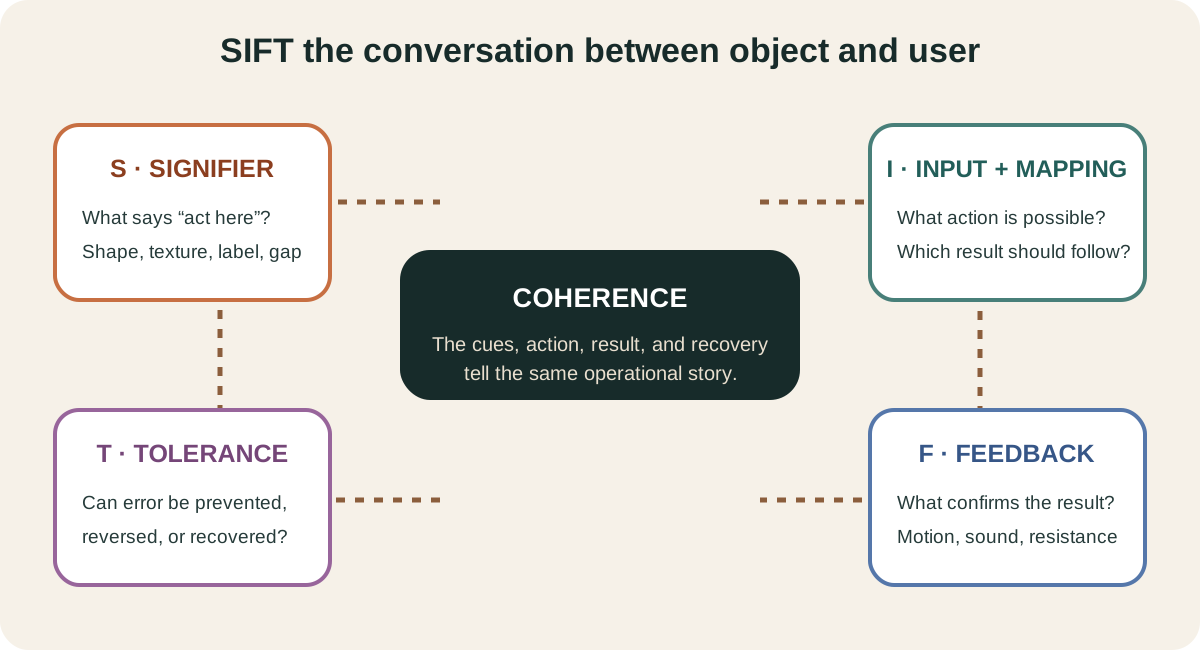
Use SIFT as a four-pass reading:
- S — Signifier: What says where to act?
- I — Input and mapping: What action is possible, and which result should follow?
- F — Feedback: How does the object confirm its state?
- T — Tolerance: Does the design prevent, forgive, or help reverse error?
Coherence is agreement among clues
Imagine an electric kettle with a handle that visually merges into the hot metal body, a lid release identical to the power switch, and one light that remains on after boiling. Each clue tells a different story. The kettle can still function, but the user must replace visible logic with memory.
Now imagine that touch-safe material clearly defines the handle, the thumb lands naturally on the lid control, the base guides the kettle into only one stable position, and the switch changes position with a click when boiling ends. The parts are not minimal for minimalism’s sake. They are mutually explanatory.
Coherence can include deliberate contrast. An emergency stop should break a quiet control rhythm because its job is to be found fast. A repair fastener may need to remain visible. A transparent bin can display an unpleasant material because state visibility matters. “Everything must match” is not coherence; everything must support the intended reading.
Apple, Braun, and the danger of the lone-genius story
Jackson connects Apple’s family resemblance to Dieter Rams and Braun 4. The influence is meaningful, but “Apple copied Rams” erases authorship and transformation on both sides. Cooper Hewitt describes Steve Jobs and Jonathan Ive’s admiration for Braun while discussing influence across different generations of technology 5. Influence can include restraint, clear control order, honest grids, neutral fields, and a consistent product family without making two objects the same design.
Braun itself was collaborative. MoMA credits the 1956 SK 4/10 radio-phonograph to both Dieter Rams and Hans Gugelot 6. Engineers, graphic designers, model makers, manufacturers, executives, and other Braun designers contributed to the wider program. Apple products likewise emerge from industrial design, hardware, software, interface, operations, manufacturing, and accessibility teams. A coherent product can have many authors precisely because shared rules coordinate their decisions.
Rams’s famous ten principles are best treated as normative theses, not physics 7. “Good design is as little design as possible” expresses a priority. It cannot prove that a quiet object is good, nor that complexity is bad. Medical equipment, children’s learning tools, ceremonial objects, and emergency systems may need visibility, redundancy, play, or explicit instruction.
Two words that explain less than they seem to
Unibody names an integrated body or enclosure idea, not one manufacturing process. A unibody part might be machined, cast, forged, stamped, extruded, bonded, welded, or built through several operations. The term alone tells you nothing decisive about alloy, yield loss, tolerance, repairability, embodied energy, or cost. Ask for the process chain.
Squircle is often used loosely for a shape between a square and circle. It may refer to a mathematical superellipse, a rounded rectangle, or simply a brand’s softened-square corner treatment. Without dimensions or an equation, it is a descriptive nickname—not a precise geometry. Judge the actual continuity, corner radius, fit with neighboring parts, and role in the product family.
These distinctions improve visual criticism. “The corners repeat one radius family across hardware and interface” is evidence. “It uses the perfect squircle” is applause.
Material can communicate—and invite a false history
Jackson uses brass doorknobs to connect material with antimicrobial behavior 8. Carefully bounded evidence exists. The EPA has registered specified high-copper alloys for residual antimicrobial claims under stated test conditions, while warning that these surfaces supplement ordinary cleaning and infection control 9.
Yet this present behavior does not establish why an earlier maker selected brass. Color, polish, castability, machinability, wear, corrosion behavior, availability, and status may also have mattered. A material explains itself only partially. Its visible patina may communicate age and touch; its complete design history still requires records.
The silent-use test
Choose an unfamiliar appliance at a store, a borrowed tool, or a public fixture. Do not operate anything unsafe.
- Mute the brand story. Cover labels that only advertise; leave safety instructions visible.
- Predict. Mark every place you think accepts an action and write the expected result.
- SIFT. Record signifier, input/mapping, feedback, and error tolerance for three actions.
- Test gently. Compare the actual result with your prediction.
- Find the contradiction. Identify one cue that suggested the wrong action or state.
- Redesign one cue. Change shape, position, texture, resistance, or feedback—not merely add a paragraph.
If possible, ask another person to perform the same first-use test. Familiarity can make a poor mapping feel natural. The best evidence that an object “explains itself” is not the designer’s confidence; it is a new user’s accurate prediction and recoverable error.
Three rules finish the reading:
- A hidden mechanism may still need a visible model. You need not expose every component, but actions and states need understandable cues.
- Consistency earns trust until the exception has a job. Make exceptions loud and purposeful.
- Beauty is not proof of usability. A coherent surface can conceal repair barriers, inaccessible controls, or dangerous failure.
An articulate object does not eliminate learning. It gives the learner good evidence. Its beauty comes from a kind of fairness: the form makes promises that the behavior keeps.
Practice
A signifier communicates where or how to act. An affordance concerns a possible relation between user and object; feedback reports what happened afterward.
Practice
Unibody describes an enclosure or structural integration. It does not identify one process, cost, alloy, tolerance, or quality level by itself.
Practice
Influence is a useful historical relation; “copy” is too simple when teams transform a visual and operational vocabulary for new systems.
Lesson complete
Nice work.
Sources for this lesson
- 1Fineas Jackson. Dyson products look weird, but there’s a reason. Behind their iconic product design.... Fineas Jackson on YouTube. 2026. verifiedChasing Beauty episode 43; 3:00. Used as a case or observation prompt, not as the sole authority for technical claims. Cited at: episode 43.
- 2Don Norman. The Design of Everyday Things. MIT Press. 2014. verifiedRevised design classic introducing a practical vocabulary for affordances, signifiers, constraints, mapping, feedback, and conceptual models. Cited at: revised edition.
- 3Don Norman. Affordances and Design. JND.org. 2008. verifiedNorman's clarification that action possibilities and the perceptible information that communicates them are different concepts. Cited at: terminology clarification.
- 4Fineas Jackson. Why do Apple products look so…good? #technology #apple #education. Fineas Jackson on YouTube. 2026. verifiedChasing Beauty episode 11; 2:32. Used as a case or observation prompt, not as the sole authority for technical claims. Cited at: Apple episode.
- 5An Apple Inspiration. Cooper Hewitt, Smithsonian Design Museum. 2013. verifiedMuseum discussion of Apple designers' admiration for and influence from Braun, framed as influence across different technologies and teams rather than proof of simple copying. Cited at: museum interpretation.
- 6Dieter Rams, Hans Gugelot. Radio-Phonograph (model SK 4/10). Museum of Modern Art. 1956. verifiedMuseum object record crediting both Dieter Rams and Hans Gugelot, evidence against reducing Braun's design program to a lone-author story. Cited at: object record.
- 7Dieter Rams. Ten Principles for Good Design. Dieter Rams Foundation. verifiedRams's evolving theses on usefulness, clarity, honesty, longevity, detail, environmental responsibility, and restraint. Cited at: Rams Foundation.
- 8Fineas Jackson. It looks like dirt, but it’s not. The hidden reason old doorknobs were made of brass…. Fineas Jackson on YouTube. 2026. verifiedChasing Beauty episode 50; 2:20. Used as a case or observation prompt, not as the sole authority for technical claims. Cited at: brass episode.
- 9EPA Registers Copper Surfaces for Residual Use Against Coronavirus. United States Environmental Protection Agency. 2021. verifiedOfficial, carefully bounded claims for specified high-copper alloy surfaces under test conditions, with the warning that they supplement rather than replace infection-control practices. Cited at: official limits.