Proportion, Rhythm, and Hierarchy
Turning 'it looks off' into observations: proportion as relationships rather than a magic ratio, rhythm as repetition with difference, hierarchy as an attention budget, cultural references that need hierarchy too, and an index-card redesign.
- 7 min
- 7 steps
- 3 questions
- Lesson 37 of 49
In this lesson
- PACE your reading
- Proportion is relational, not a magic number
- Rhythm needs both repetition and difference
- Hierarchy is an attention budget
- Cultural references need hierarchy too
- The index-card redesign
Open alongside this lesson
-
Boro, Basquiat, and the RL show #mensfashion #ralphlauren #art #basquiat (opens in a new tab)
Distinguish historical boro born from scarcity and repeated repair from modern luxury work that is boro-inspired or visually adjacent.
-
Anime does fashion better than streetwear. Change my mind. Ep. 7 of Chasing Beauty #fashion #anime (opens in a new tab)
Treat color, silhouette, exaggeration, and costume repetition as Jackson's reading unless creator interviews or production records establish authorial intent.
-
Why do some leather jackets look so much better? #education #leather (opens in a new tab)
Look past leather alone to panel proportion, collar scale, zipper placement, hardware density, grain matching, fit, and finishing.
-
This hoodie looks ruined…so why is it $1,800? (opens in a new tab)
Ask whether abrasion, fading, holes, repairs, and clean construction create a deliberate rhythm or merely an unsupported scarcity story.
-
The hidden reason your clothes look so strange (opens in a new tab)
Freeze frames and measure relationships among shoulder, torso, rise, hem, sleeve, shoe, body, and negative space.
Picking up where you left off.
“It looks off” is the beginning of observation, not the end of criticism. Often the discomfort comes from a relationship: a collar too small for the lapel, a shoe too visually light for a wide trouser, four equally loud hardware finishes, or a run of repeated seams broken at an awkward interval. Fineas Jackson’s clothing episode directs attention toward these hidden relations 1.
Three ideas turn the feeling into language:
- Proportion compares the size of one part with another or with the whole.
- Rhythm organizes repetition and interval across time or space.
- Hierarchy decides what attracts attention first, second, and last.
They are not natural laws that mechanically produce beauty. They are design principles—shared vocabulary for making and defending choices 2. Their value lies in comparison: change the relationship and see what the experience does.
Playback is optional. If the player is unavailable, open the video at its source.
PACE your reading
Use PACE when an object feels either resolved or strangely noisy:
- P — Proportion: Which part-to-part and part-to-whole ratios dominate?
- A — Accent: Where does contrast create emphasis and hierarchy?
- C — Cadence: What repeats, at what interval, and where is the pattern interrupted?
- E — Economy: Does each major visual move earn its share of attention?
Economy does not mean minimalism. A richly patterned textile can be economical if many details serve one organized field. A nearly blank object can be uneconomical if one arbitrary seam distracts from every action.
Proportion is relational, not a magic number
Measure a jacket in a photograph. Let torso length be 1.0. Estimate shoulder width, lapel width, collar height, pocket opening, sleeve width, and visible shirt cuff as fractions of that baseline. The numbers are not quality scores. They let you compare versions without relying on mood.
Then make one controlled change. Widen the lapel while keeping the collar, shoulder, and chest unchanged. The lapel may now overwhelm the face or make the collar look timid. Widen the shoulder too, and the same lapel can feel integrated. A proportion is never “large” alone; it is large relative to something.
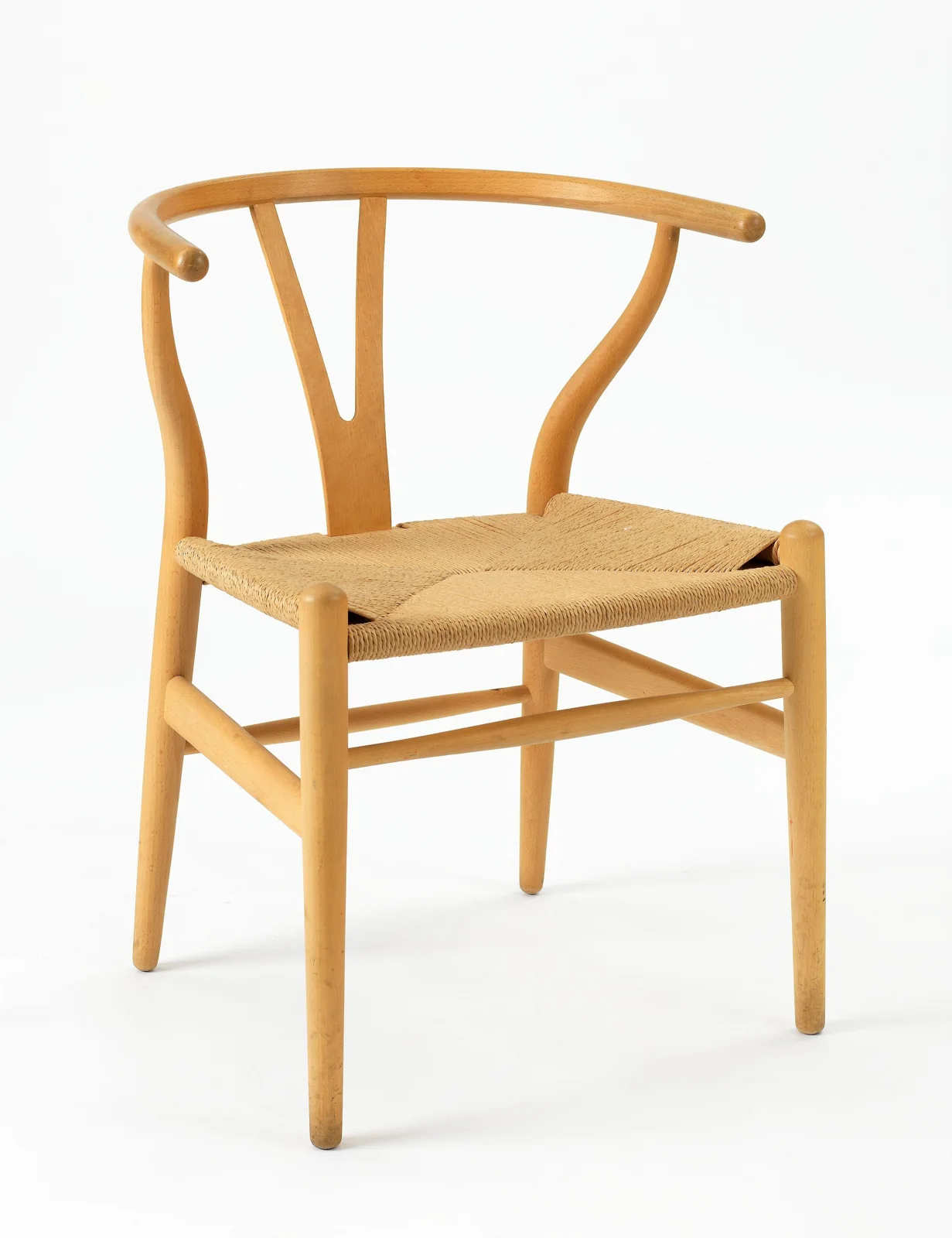
The same method works on a lamp: shade diameter to base width, stem height to total height, switch size to finger, cord thickness to stem. Or a chair: seat depth to leg height, back width to seat width, member thickness to span. Human dimensions and the intended room add scale. A miniature spoon can preserve perfect part ratios and still fail a human hand.
Be skeptical when one celebrated ratio is offered as the cause of beauty. If an analyst draws a golden rectangle after the object is finished, allows generous rounding, and selects whichever edges fit, the exercise can explain anything. A useful proportion claim identifies the measurement in advance and compares alternatives: “When the pocket is raised 25 millimeters, the jacket’s lower field becomes calmer while hand access remains acceptable.”

Rhythm needs both repetition and difference
Corduroy wales, cable-knit columns, zipper teeth, grille slots, stitches, windows, buttons, and perforations all create beats. Rhythm depends on four variables:
- Unit: the repeated thing.
- Interval: space between units.
- Sequence: regular, alternating, accelerating, clustered, or irregular.
- Break: a pause or exception that redirects attention.
A row of identical buttons can stabilize a shirt front. Make the top button larger or change its color and the rhythm gains an accent. Place the exception accidentally and it looks like an error. Place it where the action changes and it can become hierarchy.
The distressed hoodie in Jackson’s case creates a difficult judgment 3. Fading, holes, abrasions, patches, and exposed edges can form a controlled distribution across the garment. But randomness performed at scale is still designed: placement, intensity, clean seam construction, and untouched areas create a cadence. The visible damage does not by itself prove long use, hand labor, rarity, or value. Read the pattern first; verify the production story separately.
Hierarchy is an attention budget
Every contrast spends attention. Size, position, brightness, color, texture, isolation, motion, and meaning can make an element lead. If everything leads, nothing supports.
On a leather jacket, perhaps the silhouette should register first, diagonal closure second, collar and hardware third, stitching last. If the logo, zipper, snaps, quilting, grain, and contrast thread all shout equally, the jacket may feel less coherent even when every component is expensive 4. The fix is not always deletion. Lowering one contrast or grouping repeated details can restore order.
Try the three-glance test:
- At two seconds, write the first shape or contrast you notice.
- At ten seconds, write the path your eye follows.
- At one minute, name the detail that rewards close attention.
Then ask whether that order matches the object’s purpose. A fire alarm should not save its critical control for the one-minute glance. A ceremonial watch may intentionally reward slowness.
Cultural references need hierarchy too
Jackson’s first episode connects boro, Basquiat, and a Ralph Lauren show 5. Visual relationships can be illuminating, but context must not be flattened. The V&A describes historical boro as the repeated piecing, patching, and stitching of scarce textiles to extend use, often across generations in impoverished rural families 6. A luxury garment made new with planned patches may be boro-inspired. It does not inherit the earlier object’s scarcity, necessity, or life history.
That distinction sharpens rather than forbids comparison. You can analyze shared asymmetry, indigo fields, repair-like marks, and layered cadence while naming the changed economics and power. “Inspired by” is a relationship; “is” is an identity claim.
Similarly, Jackson’s reading of anime fashion can reveal how enlarged collars, long coats, repeated colors, and silhouette exaggeration clarify a character at a glance 7. Unless interviews, model sheets, or production notes support the interpretation, call it a close reading, not the creator’s documented intention. A viewer can find a persuasive hierarchy that no artist consciously planned.
The index-card redesign
Choose one outfit, appliance, package, webpage, or room corner. Make three quick grayscale sketches—detail is unnecessary.
- On card A, trace only the outer silhouette and largest divisions.
- On card B, mark repeated units as dots or lines and show their intervals.
- On card C, shade attention from darkest first-glance element to lightest background.
- Complete PACE in four sentences.
- Make one alternate version by changing only a single proportion, rhythm, or contrast.
- Put both versions five meters away or shrink them to thumbnail size. Record what survives.
Three useful rules follow:
- Measure relationships, not prestige. A famous label cannot repair a confused scale.
- One loud thing needs quiet neighbors. Contrast becomes emphasis only against restraint.
- Break rhythm where meaning changes. An exception should point to action, structure, or deliberate surprise.
Proportion, rhythm, and hierarchy do not settle taste. They do something better: they locate the choice. Once you can point to the exact relation carrying the effect, “beautiful” becomes an argument someone else can inspect, test, and improve.
Practice
Hierarchy orders attention. The remedy may be reducing contrast, scale, or density on secondary details—not necessarily removing them all.
Practice
A measured relation can support analysis, but naming a celebrated number is not a causal test or a universal design law.
Practice
Similar surface effects do not erase differences in scarcity, labor, use, repair, price, and the maker’s circumstances.
Lesson complete
Nice work.
Sources for this lesson
- 1Fineas Jackson. The hidden reason your clothes look so strange. Fineas Jackson on YouTube. 2026. verifiedChasing Beauty episode 68; 3:33. Used as a case or observation prompt, not as the sole authority for technical claims. Cited at: episode 68.
- 2Principles of Design. University of Minnesota. verifiedVocabulary for proportion, scale, balance, rhythm, emphasis, repetition, variety, and unity. Cited at: principles overview.
- 3Fineas Jackson. This hoodie looks ruined…so why is it $1,800?. Fineas Jackson on YouTube. 2026. verifiedChasing Beauty episode 49; 2:51. Used as a case or observation prompt, not as the sole authority for technical claims. Cited at: episode 49.
- 4Fineas Jackson. Why do some leather jackets look so much better? #education #leather. Fineas Jackson on YouTube. 2026. verifiedChasing Beauty episode 27; 2:40. Used as a case or observation prompt, not as the sole authority for technical claims. Cited at: leather-jacket comparison.
- 5Fineas Jackson. Boro, Basquiat, and the RL show #mensfashion #ralphlauren #art #basquiat. Fineas Jackson on YouTube. 2026. verifiedChasing Beauty episode 1; 2:56. Used as a case or observation prompt, not as the sole authority for technical claims. Cited at: episode 1.
- 6Make Your Own: Japanese 'Boro' Bag. Victoria and Albert Museum. 2024. verifiedMuseum account of boro as repeated piecing, patching, and stitching that extended scarce textiles, with a clear distinction between historic working garments and contemporary boro-inspired luxury or craft. Cited at: museum account.
- 7Fineas Jackson. Anime does fashion better than streetwear. Change my mind. Ep. 7 of Chasing Beauty #fashion #anime. Fineas Jackson on YouTube. 2026. verifiedChasing Beauty episode 7; 2:51. Used as a case or observation prompt, not as the sole authority for technical claims. Cited at: episode 7.