Constraints Become Form
How limits shape objects: constraints as editors rather than authors, reading form backward from a diagonal zip, QWERTY as a constraint that outlived its cause, fan-cooled jackets as unfamiliar beauty, and a one-change constraint study.
- 7 min
- 7 steps
- 3 questions
- Lesson 34 of 49
In this lesson
- Constraint is an editor, not an author
- Read form backward, cautiously
- When an expired constraint stays active socially
- Constraints can make unfamiliar beauty
- The one-change constraint study
- Rules of thumb
Open alongside this lesson
-
It seems wrong, but there’s a hidden reason. Behind the crooked zip lies masterful design #fashion (opens in a new tab)
Treat the zipper as one part of a riding system: posture, overlap, wind, pocket access, seams, and manufacturing all matter.
-
The strange design of keyboards #design #education (opens in a new tab)
Use the keyboard to distinguish an original mechanical constraint from compatibility, training, and network effects that remain active.
-
Why the Iconic NYC Staircase Is Vanishing (opens in a new tab)
Read the visible staircase as a negotiation among safety rules, old buildings, street space, access, and later cultural identity.
-
Why are people wearing puffer jackets in the sweltering Japanese summer sun? (opens in a new tab)
Notice how heat, battery volume, fan placement, garment leakage, and body movement produce an unfamiliar silhouette.
-
How Pilots Created the World’s Most Iconic Sunglasses (opens in a new tab)
Compare lens area, bridge, temple geometry, glare control, equipment clearance, and later fashion meaning.
-
History of espresso. Ep. 4 of Chasing Beauty. #espresso #history (opens in a new tab)
Track speed, portioning, temperature, and pressure across Moriondo, Bezzera and Pavoni, Gaggia, and the Faema E61; treat this as an evolving lineage, not one instant invention of modern espresso.
-
How to shave perfectly with a safety razor. Ep. 5 of Chasing Beauty #razor #shave (opens in a new tab)
The title and narration name different tools. For a double-edge safety razor use comfortably warm water, light pressure, short strokes, and a suitable working angle; pores do not open and close, and razors should not be shared.
Picking up where you left off.
Uncoil a safety pin in your imagination. One length of wire must pierce material, store spring energy, hold the point shut, shield that point from skin, provide a place for fingers, survive repeated flexing, and remain inexpensive to form. Walter Hunt’s 1849 patent joined spring and clasp in one piece; the Smithsonian’s account quotes his aim of using the wire’s own spring to retain the point 1. The familiar loop is not a doodle applied after engineering. It is the visible path of several demands meeting.
Fineas Jackson calls that arrangement nearly perfect 2. “Perfect” is useful enthusiasm, not a technical verdict. A safety pin can snag, fatigue, rust, open under the wrong load, be hard to handle with limited dexterity, or be unsafe for a particular child. Its endurance supports a narrower claim: for a common fastening job, its compact geometry satisfies an unusually coherent set of constraints.
Playback is optional. If the player is unavailable, open the video at its source.
Constraint is an editor, not an author
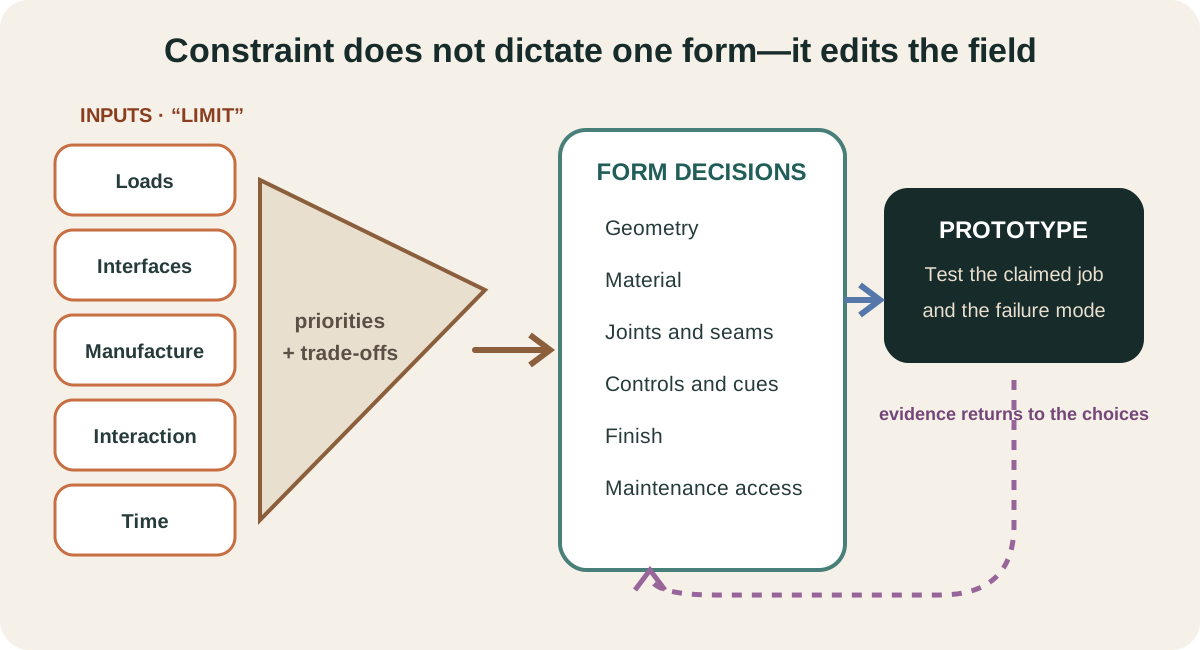
A constraint makes some options impossible, unsafe, expensive, incompatible, or inconvenient. It does not normally draw the answer by itself. A designer still chooses which constraints dominate and which compromise is acceptable.
Remember LIMIT:
- L — Loads: force, heat, moisture, light, vibration, pressure, impact.
- I — Interfaces: bodies, tools, replacement parts, neighboring systems, laws, and standards.
- M — Manufacture: available material, process, tolerances, assembly sequence, volume, and cost.
- I — Interaction: reach, grip, posture, perception, error, feedback, and learning.
- T — Time: wear, cleaning, maintenance, repair, changing rules, and inherited compatibility.
For the safety pin, the spring loop answers load and interaction while the single wire reduces parts and assembly. The clasp manages skin contact and accidental release. Wire diameter, bend radius, alloy, heat treatment, and finish mediate between stiffness, fatigue life, formability, corrosion, and cost. Change one variable and the “simple” silhouette can change with it.
Read form backward, cautiously
Jackson’s diagonal-zip jacket invites a reverse reading: begin with the visible line, then infer the conditions that might reward it 3. On a riding jacket, an offset closure can create overlapping front panels, move hardware away from the center, and interact with a bent riding posture. But an observed diagonal does not prove one exclusive historical intention. Pattern layout, pockets, lapels, branding, and the choice to wear the jacket open also shape it.
The Perfecto is commonly credited as the first purpose-built zip-front motorcycle jacket, but “purpose-built” does not mean every later copy is protective equipment 4. Traditional horsehide may resist abrasion better than a thin fashion fabric, yet it is not impact armor. A jacket’s safety performance depends on the entire specification—material thickness, seams, protectors, fit, closure retention, and test method—not on a famous silhouette.
Use a reverse brief:
- Describe the geometry without explaining it.
- List three constraints that could favor it.
- List two other forms that could meet those constraints.
- Identify a test that would distinguish the options.
- Mark every historical claim that still lacks a dated source.
If you can imagine no alternative, you probably have not found the full design problem.
When an expired constraint stays active socially
QWERTY is the classic warning against tidy mechanical folklore. It developed with early typewriters and appeared in Sholes’s 1878 patent, but the Smithsonian Lemelson Center notes that historians dispute the precise motive for the letter arrangement 5. “It was designed to slow typists” is too confident. Type-bar interference, telegraph practice, iterative layouts, manufacturing, and adoption all enter the history.
Digital keyboards no longer have colliding type bars. Yet QWERTY is not constraint-free. Billions of learned users, training materials, labeled hardware, software defaults, keyboard shortcuts, shared workplaces, accessibility routines, and repair inventories create an installed-base constraint. A historical layout becomes present infrastructure. Its form persists not because the old mechanism is secretly active, but because switching imposes costs across a system.
This is path dependence, not proof of excellence. An enduring form may be well resolved, merely compatible, or both.
Constraints can make unfamiliar beauty
The fan-equipped jacket in Jackson’s Japanese summer episode looks inflated because the desired system needs moving air, room for circulation, openings with controlled leakage, fan modules, and a power source 6. Judge its silhouette after stating the job. Compared with a close-fitting fashion jacket, the volume may look strange; compared with the airflow requirement, it becomes intelligible.
Likewise, aviator sunglasses can be read through visual coverage, glare reduction, optical quality, weight, bridge support, headset compatibility, and a wide field of view. The National Museum of American History documents Bausch & Lomb advertising from the 1930s that described Ray-Ban lenses as developed for Army and Navy aviators 7. That evidence supports the period association. It does not prove that pilots alone authored every feature or that every aviator-shaped fashion frame meets aviation requirements.
An exterior fire escape is another system-scale case. Its shape is negotiated among egress, existing openings, façade structure, clearance, emergency access, weather, regulation, and limited interior space 8. Once repeated across a city, it also becomes visual identity. The constraint operates at several scales: a person’s foot on a tread, a landlord’s retrofit, a fire code, a streetscape, a film audience’s idea of New York.
The one-change constraint study
Choose a safety pin, zipper bag, keyboard, fan, lamp, or folding chair.
- Make five LIMIT rows and record one observed constraint in each.
- Draw the current object as five major decisions—not as a polished picture.
- Change one condition: gloved hands, twice the load, half the volume, outdoor storage, one-handed use, or repair with common tools.
- Redraw only the parts that must respond.
- Circle one feature that did not need to change. Is it an efficient invariant, a convention, or an oversight?
Then write: “Because ___ changed, ___ became less suitable; I changed , accepting .” That last clause matters. Design quality appears not in escaping trade-offs but in making the chosen trade-off fit the purpose.
Rules of thumb
- Five constraints before one compliment. “Elegant” becomes informative only after you can name what was resolved.
- Form is evidence, not a confession. It suggests a brief; it does not reveal intention without records.
- Old constraints can become new interfaces. Compatibility and learned behavior may preserve a once-mechanical form.
- Principles are guidance, not natural laws. Simplicity, symmetry, or minimalism are normative priorities; a real brief may reward redundancy, asymmetry, visibility, or excess.
Constraint-made beauty feels earned because the object’s lines participate in the work. The more precisely you can describe that participation, the less you need the empty phrase “form follows function”—and the better you can see when function is only being performed as style.
Practice
A constraint rules out or penalizes options; it rarely yields one inevitable answer. Weighting, trade-offs, convention, and iteration remain design decisions.
Practice
The documented machine history and the contested motive should be separated from today’s active constraints of training, interoperability, and installed systems.
Practice
Time makes durability, service, institutional memory, standards, and path dependence part of the form-generating brief.
Lesson complete
Nice work.
Sources for this lesson
- 1The Inventive Mind of Walter Hunt, Yankee Mechanical Genius. Smithsonian Magazine. 2013. verifiedSmithsonian account and patent excerpt describing Hunt's 1849 one-piece wire pin, spring, and protective clasp. Cited at: patent context.
- 2Fineas Jackson. It looks like a bent wire, but it’s perfect. Why the safety pin hasn’t changed in 177 years…. Fineas Jackson on YouTube. 2026. verifiedChasing Beauty episode 54; 2:31. Used as a case or observation prompt, not as the sole authority for technical claims. Cited at: episode 54.
- 3Fineas Jackson. It seems wrong, but there’s a hidden reason. Behind the crooked zip lies masterful design #fashion. Fineas Jackson on YouTube. 2026. verifiedChasing Beauty episode 6; 2:25. Used as a case or observation prompt, not as the sole authority for technical claims. Cited at: diagonal-zip case.
- 4Schott Perfecto Jacket — Beyond Rebellion, Fashioning the Biker Jacket. Museum at the Fashion Institute of Technology. 2014. verifiedMuseum account describing the 1928 Perfecto as widely regarded as the original black leather biker jacket and connecting its cropped waist, fasteners, and asymmetrical closure to riding use. Cited at: Museum at FIT history.
- 5Was the Patent Application for the Typewriter Handwritten?. Smithsonian Lemelson Center for the Study of Invention and Innovation. 2017. verifiedHistorical account of the Sholes typewriter, QWERTY's 1878 patent appearance, manufacturing and adoption, and the continuing dispute over the layout's precise motive. Cited at: contested history.
- 6Fineas Jackson. Why are people wearing puffer jackets in the sweltering Japanese summer sun?. Fineas Jackson on YouTube. 2026. verifiedChasing Beauty episode 51; 2:25. Used as a case or observation prompt, not as the sole authority for technical claims. Cited at: airflow-jacket case.
- 7Ray-Ban Sunlenses. National Museum of American History. verifiedMuseum record documenting Bausch & Lomb's 1936 introduction and period advertising that described the glasses as developed for Army and Navy aviators. Cited at: museum object record.
- 8Fineas Jackson. Why the Iconic NYC Staircase Is Vanishing. Fineas Jackson on YouTube. 2026. verifiedChasing Beauty episode 40; 2:20. Used as a case or observation prompt, not as the sole authority for technical claims. Cited at: New York staircase case.
Further reading
- Fineas Jackson. The strange design of keyboards #design #education. Fineas Jackson on YouTube. 2026. verifiedChasing Beauty episode 25; 2:34. Used as a case or observation prompt, not as the sole authority for technical claims.
- Fineas Jackson. How Pilots Created the World’s Most Iconic Sunglasses. Fineas Jackson on YouTube. 2026. verifiedChasing Beauty episode 69; 3:02. Used as a case or observation prompt, not as the sole authority for technical claims.