Eyeglasses: Lenses, Coatings, Frames, and Fit
Eyeglasses as an optical system on a frame: the prescription as a brief, lens materials and surfacing, coatings, FDA impact rules versus optical quality, acetate and metal frames, hinges, fit as part of the optics, and budgeting vision and frame separately.
- 6 min
- 11 steps
- 3 questions
- Lesson 30 of 49
In this lesson
- The prescription is the brief, not the finished lens
- Lens material changes thickness and behavior
- Surfacing creates the optics
- Safety and optical quality are different baselines
- Frame material creates possibilities
- Hinges are wear interfaces
- Fit is part of optical performance
- Three offers
- The two-ledger budget
- Rule of thumb
Open alongside this lesson
-
How Are Eyeglass Lenses Manufactured? (opens in a new tab)
Separate surfacing and polishing from hard coat, antireflective layers, top coat, cleaning, inspection, and final verification.
-
Impact-Resistant Lenses: Questions and Answers (opens in a new tab)
Impact resistance is a regulated finished-lens requirement in the United States, not a luxury extra or a complete lens-quality ranking.
Picking up where you left off.
Eyeglasses are unusual consumer goods: a precise optical device is fitted into a fashion object and worn on a moving, asymmetric face for thousands of hours. The most expensive visible component—the frame—may be less important to vision than measurements no one else notices.
Fineas Jackson’s eyeglass and aviator episodes make the market story legible 1 2. A quality audit should then separate prescription, lens, coating, frame, fitting, and service.
Playback is optional. If the player is unavailable, open the video at its source.
The prescription is the brief, not the finished lens
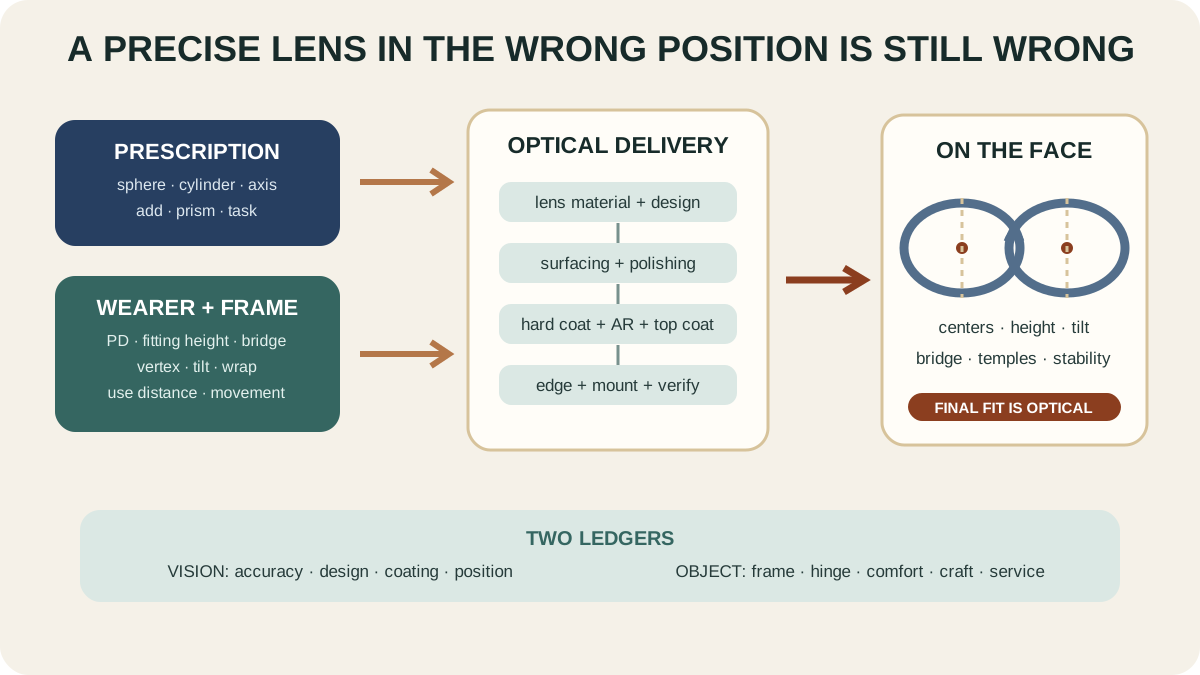
A prescription may contain sphere, cylinder, axis, prism, addition power, and other instructions. To deliver it, a dispenser and laboratory also need measurements such as:
- monocular pupillary distances;
- fitting height;
- frame eye shape and size;
- bridge and temple geometry;
- vertex distance from eye to lens;
- pantoscopic tilt;
- frame wrap;
- intended working distance and use.
Small placement changes can matter more for strong, progressive, or prism prescriptions. “Same prescription” does not guarantee the same visual experience if optical centers and design corridors sit differently.
Lens material changes thickness and behavior
Common lens families include conventional plastic, polycarbonate, Trivex-type urethane, and higher-index plastics. Tradeoffs include:
- refractive index and resulting thickness;
- density and total mass;
- impact behavior;
- chromatic aberration;
- surface reflection;
- tinting and coating compatibility;
- edge appearance and drilling suitability.
Higher index can reduce thickness for a strong prescription, especially with an appropriately sized frame. It also often increases reflections, making a good antireflective coating more valuable. It is not a universal upgrade for mild prescriptions.
Frame choice is part of lens design. A smaller eye shape can reduce edge thickness in minus lenses. Accurate decentration can prevent a fashionable oversized frame from adding unnecessary thickness and weight.
Surfacing creates the optics
A laboratory selects a blank, generates the required curves or freeform surface, fines or smooths it, polishes, marks, coats, edges the lens to the frame, inserts it, and verifies the finished result.
ZEISS describes freeform processing, polishing, intensive cleaning, a hard coat for plastic lenses, vacuum-deposited antireflective layers, a final smooth top layer, and quality checks 3. Each interface can fail:
- surface form is inaccurate;
- polishing adds haze or wave;
- coating adhesion is poor;
- dust becomes trapped;
- edging chips a brittle layer;
- insertion stress warps the frame or lens;
- optical centers shift from ordered positions.
Coatings are functional thin-film systems, not one “blue” color. Their jobs can include abrasion resistance, reflection reduction, water/oil release, static control, or selective spectral behavior. Ask what problem the coating solves and how it is warranted.
Safety and optical quality are different baselines
FDA guidance explains impact-resistance requirements for finished eyeglass lenses in the United States 4. Passing a safety test does not establish low distortion, accurate prescription, durable coating, or comfortable fit. Conversely, an optically refined lens still needs appropriate impact performance.
Keep separate:
safety + optical accuracy + visual design + surface durability + position on face
Frame material creates possibilities
Cellulose acetate sheet supports layered color, translucency, milling, heat adjustment, and polishing. Mazzucchelli documents sheet composition, color work, processing, physical properties, and attention to cutting direction 5.
But “Italian acetate” does not tell you:
- whether the frame was cut with sensible orientation;
- how long material and frame were stabilized;
- whether edges were finished without waves;
- hinge quality and attachment;
- temple reinforcement;
- symmetry under no load;
- how it fits your bridge and ears.
Injection-molded polymers can be light, repeatable, and tough. Titanium and stainless alloys can create thin structures, but welding, screw threads, surface treatment, and adjustment still matter. Natural horn can be beautiful and repairable in skilled hands while requiring care and variable material selection.
Hinges are wear interfaces
Inspect the transition from front to temple:
- barrels align without forcing;
- screws seat cleanly and can be replaced;
- embedded hinge hardware does not pull from acetate;
- spring hinges return without side play;
- temple opening stops consistently;
- no sharp edge meets skin.
Spring hinges accommodate width variation but introduce more parts. A five-barrel hinge offers broad bearing area but needs precise alignment. A simple pinned or screw hinge can be excellent when the frame geometry fits.
ISO 12870:2024 defines fundamental requirements and test methods for unglazed spectacle frames 6. A frame is a testable wearable mechanism, not only sculpture.
Fit is part of optical performance
Check:
- bridge contact without concentrated pressure or sliding;
- eyes positioned sensibly within lens shapes;
- temples not bowing outward from excessive width;
- earpieces following the head without digging;
- frame level relative to the face, while acknowledging facial asymmetry;
- eyelashes and cheeks clearing the lens;
- stable position during reading, stairs, and head movement;
- tilt and distance consistent with the ordered lens design.
Adjustment is skilled work. Heat, controlled bending, pad placement, and temple shaping change comfort and optical position. A retailer’s fitting, remake policy, and later service may legitimately cost more than a direct shipment.
Three offers
| Offer | Where value can live | Warning |
|---|---|---|
| Efficient package | standard lens design, durable frame, basic coating, competent measurement | rushed measurement, unclear remake terms, frame chosen only by trend |
| Optical upgrade | design matched to task, verified measurements, useful coating, careful edging and fit | technical language without position or warranty detail |
| Craft / luxury frame | distinctive material, low-volume cutting, hinge fitting, polish, repair and style authorship | expensive frame paired with generic or poorly placed optics |
The two-ledger budget
Allocate separately:
- vision ledger: exam, measurements, lens material, design, coatings, lab verification;
- wearable-object ledger: frame material, construction, comfort, appearance, repair, service.
Spending on appearance is legitimate. It becomes confusing only when frame price is treated as proof of optical superiority.
Rule of thumb
A lens is only correct in position. Buy eyeglasses as a measured optical system attached to a comfortable, serviceable frame—and ask which part of the price improves vision, wear, craft, or fashion.
Practice
The prescription defines required correction, not every design and manufacturing decision used to deliver it.
Practice
A named material creates possibilities; production and fitting decide the result.
Practice
Final assembly can change position and stress, so the finished wearable system needs checking.
Lesson complete
Nice work.
Sources for this lesson
- 1Fineas Jackson. Your glasses cost $15 to make...so why are they $300? The hidden company behind every pair. Fineas Jackson on YouTube. 2026. verifiedChasing Beauty episode 46; 2:55. Used as a case or observation prompt, not as the sole authority for technical claims. Cited at: episode 46.
- 2Fineas Jackson. How Pilots Created the World’s Most Iconic Sunglasses. Fineas Jackson on YouTube. 2026. verifiedChasing Beauty episode 69; 3:02. Used as a case or observation prompt, not as the sole authority for technical claims. Cited at: episode 69.
- 3How Are Eyeglass Lenses Manufactured?. ZEISS Vision Care. verifiedPrimary manufacturer account of surfacing, polishing, cleaning, hard coating, vacuum-deposited antireflective layers, final top coating, and quality assurance. Cited at: manufacturer process.
- 4Impact-Resistant Lenses: Questions and Answers. U.S. Food and Drug Administration. verifiedFDA guidance on impact-resistance testing requirements for finished eyeglass lenses under 21 CFR 801.410. Cited at: regulatory guidance.
- 5Materials and Processing. Mazzucchelli 1849. verifiedPrimary sheet-material maker account of cellulose acetate composition, color development, sheet production, extrusion, physical properties, and cutting direction. Cited at: material maker.
- 6ISO 12870:2024: Spectacle Frames. International Organization for Standardization. 2024. verifiedOfficial standard page for fundamental requirements and test methods for unglazed spectacle frames intended for prescription lenses. Cited at: standard scope.