Small Edge Tools: Razors, Clippers, and Scissors
Small edge tools: sharpness as force, geometry, and material, initial sharpness versus edge life in CATRA testing, razor heads, nail clippers as compound levers, scissors as a moving line of shear, endangered scissor making, and inspecting edges safely.
- 6 min
- 10 steps
- 3 questions
- Lesson 32 of 49
In this lesson
- Sharpness is force, geometry, and the material cut
- Initial sharpness and life are two graphs
- Razors: a supported edge moving across skin
- Nail clippers: opposing edges driven by a compound lever
- Scissors: a moving line of shear
- The lost-skill dimension
- Three offers
- A safe inspection
- Rule of thumb
Open alongside this lesson
-
Nail Clippers Manufacturing Process (opens in a new tab)
Stamping is only the opening operation; welding, hardening, tempering, blasting, grinding, overlap adjustment, assembly, and inspection create the cutting mechanism.
-
Scissor Making (opens in a new tab)
Sheffield scissor making illustrates how forging, hardening, grinding, fitting, setting, testing, specialist tools, and apprenticeship form a vulnerable production ecosystem.
Picking up where you left off.
A razor blade, nail clipper, or pair of scissors can look almost trivial. Yet each asks a small volume of metal to concentrate hand force at an edge while remaining aligned through thousands of contacts. Because the parts are small, errors do not hide.
Fineas Jackson’s razor and nail-clipper episodes show how price can rise through steel, forming, grinding, coating, assembly, and brand 1 2. The deeper lesson is to distinguish edge sharpness from the mechanism that presents it.
Playback is optional. If the player is unavailable, open the video at its source.

Sharpness is force, geometry, and the material cut
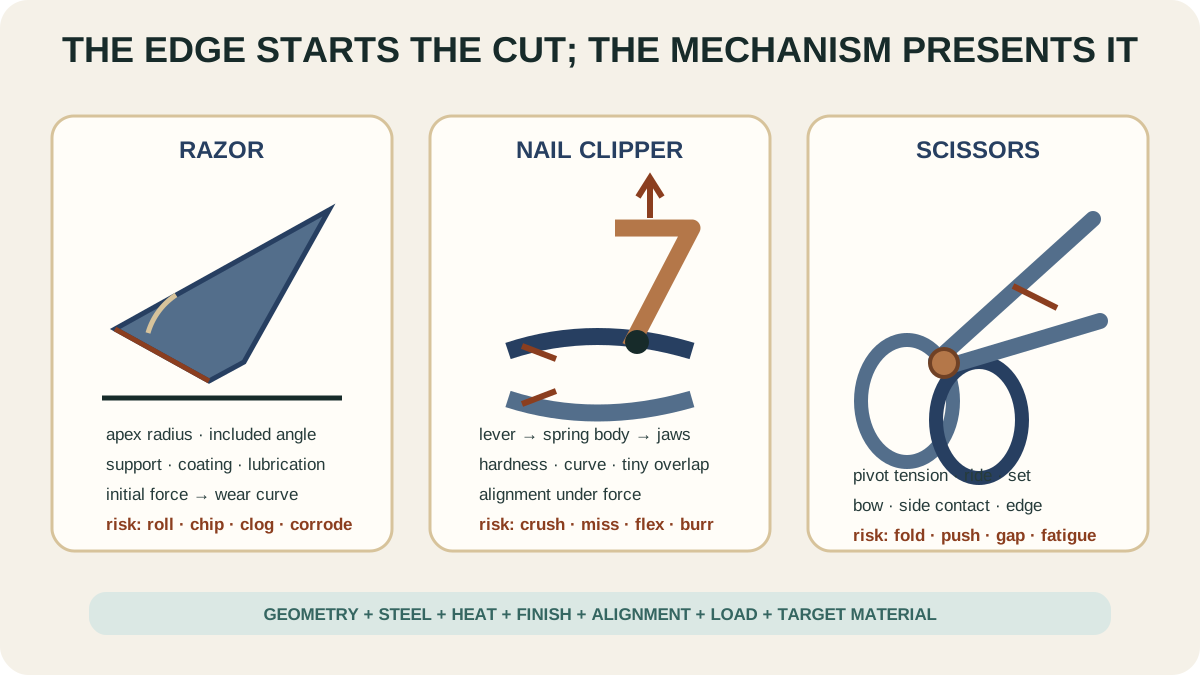
At a simplified level, an edge separates material by concentrating force onto a very small region. Relevant variables include:
- apex or edge radius;
- included angle;
- bevel shape and thickness behind the edge;
- micro-serration or polish;
- hardness, toughness, carbide or grain structure;
- coating;
- edge support;
- speed, direction, and lubrication;
- toughness and thickness of the target material.
A smaller included angle can reduce cutting force, but leaves less metal supporting the apex. A thick tool can have a sharp apex and still wedge badly behind the cut. A toothy finish may initiate fibrous material better than a mirror polish.
Do not compare “sharp” without naming the test and target.
Initial sharpness and life are two graphs
CATRA’s razor tester measures force while a blade cuts controlled media; lower force indicates easier cutting, and repeated strokes build a wear curve 3.
Think:
new edge:       first-cut force
durability:     slope of force increase across repeated cuts
failure mode:   rolling, chipping, wear, corrosion, coating loss, clogging
A coated disposable razor may begin extraordinarily sharp and glide well, then change as coating and apex wear. A thicker reusable blade may begin with more force but tolerate different abuse. The appropriate curve depends on skin, hair, nails, cloth, paper, or industrial material.
Razors: a supported edge moving across skin
A cartridge razor combines multiple edges, spacing, exposure, guard, lubrication, head pivot, rinsing paths, and handle control. More blades can distribute work and reduce the amount each blade protrudes, but can also trap hair and make repeated contact across sensitive skin.
A safety razor uses a replaceable thin blade clamped by a cap and baseplate. Performance changes with blade gap, exposure, head curvature, alignment, handle leverage, preparation, and technique. A straight razor adds spine geometry, hollow grind, honing, stropping, corrosion care, and substantial user skill.
Price may buy tight head alignment, durable threads, serviceable components, controlled surface finish, and ergonomic balance. A heavy handle is not automatically safer or more efficient.
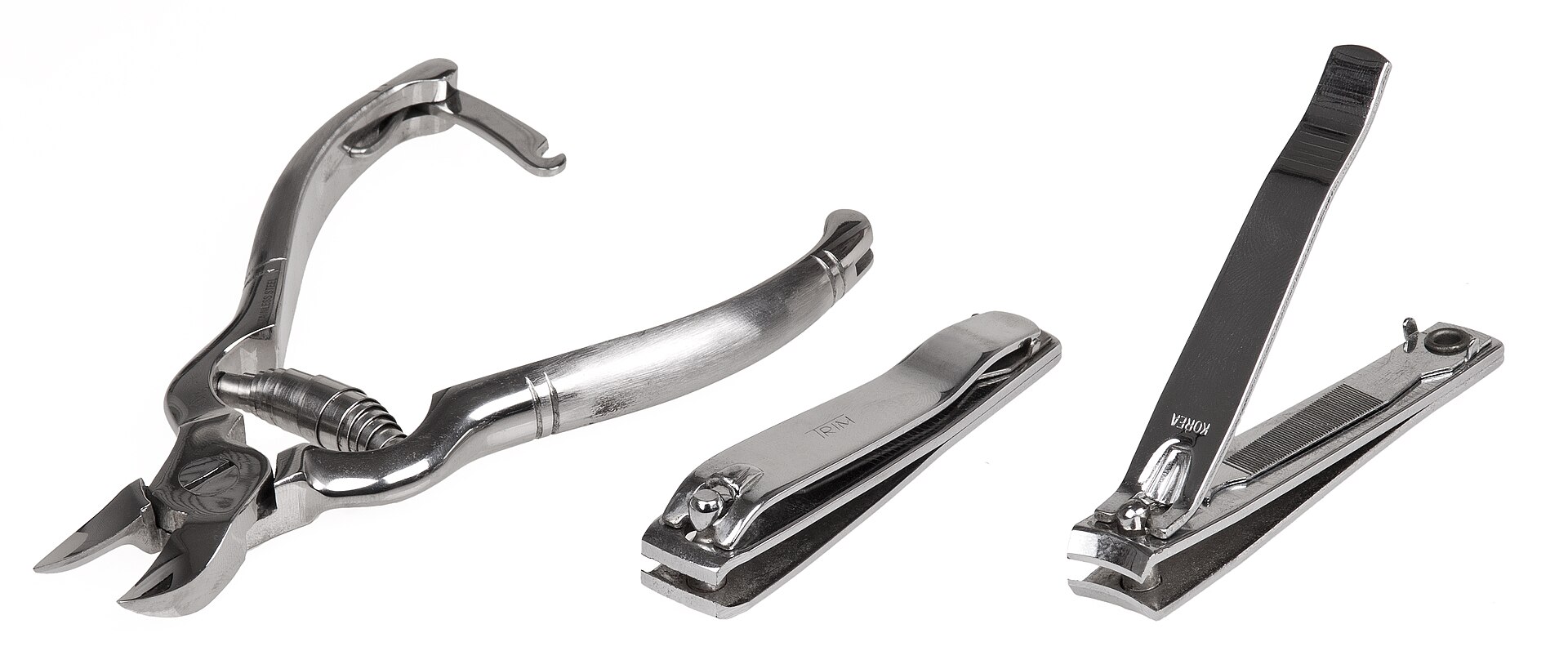
Nail clippers: opposing edges driven by a compound lever
The top lever presses one body arm toward the other. Curved jaws approach and slightly overlap, converting bending into a localized cut. The mechanism needs:
- spring in the body;
- hard, ground jaw edges;
- matching curvature;
- controlled overlap and no lateral offset;
- a pin and lever that do not buckle;
- a comfortable force path;
- corrosion-resistant finish;
- clearance for the nail thickness.
KAI documents stamping and welding followed by heat treatment around 1,000°C, tempering and localized processing, shot blasting, grinding, adjustment to a very small overlap, assembly, and inspection 4. That sequence shows why “stamped metal” is not a complete cost description.
If the jaws meet only at one corner, the clipper crushes or tears before the cut travels. If the body is too soft, force opens the alignment. If the edge is hard but brittle, a fall or thick nail can chip it.
Scissors: a moving line of shear
Scissors need two edges to meet progressively from pivot toward tips. Their blades are not perfectly flat twins. Depending on type, they use:
- set: lateral relationship that keeps edges meeting;
- bow or curvature: controlled shape along blade length;
- ride: contact region near the pivot;
- pivot tension: enough contact without excessive friction;
- handle alignment: directing hand force without twisting;
- edge geometry: adapted to cloth, paper, hair, metal, thread, or food.
CATRA’s scissors tester controls cutting effort and can investigate blade geometry, hardness, coatings, and side pressure 5. A sharp pair with a loose pivot folds fabric. An overtight pair fatigues the hand and wears contact regions.
Dressmaker’s shears keep the lower blade close to a table. Hair scissors prioritize refined moving contact and clean tips. Kitchen shears may separate for cleaning and add serration for slippery food. One premium shape is not universal.
The lost-skill dimension
Heritage Crafts currently classifies traditional scissor making as critically endangered and describes a Sheffield ecosystem of forging, hardening, grinding, fitting, setting, testing, specialized tools, and limited training routes 6.
That can justify value beyond cut-per-dollar:
- preservation of repair and setting knowledge;
- patterns for specialized trades;
- local toolmaking capacity;
- apprenticeships and maintained machinery;
- a relationship with a maker who can refit the tool.
It does not mean every old pair outcuts modern industrial scissors. Support the craft honestly as cultural and technical continuity rather than inventing a universal performance claim.
Three offers
| Offer | Legitimate value | Evidence |
|---|---|---|
| Mass precision | automated forming and grinding, consistent heat treatment, standardized replaceable unit | clean cut, alignment, corrosion control, repeat tests, accessible replacement |
| Professional service tool | task-specific steel and geometry, ergonomic handles, adjustable or serviceable pivot | maker specifications, sharpening route, spare hardware, user-community evidence |
| Heritage craft | low-volume forging/grinding/fitting, specialist pattern, maker accountability and repair | named maker, process record, training continuity, refitting service |
A safe inspection
Never test edges on a fingertip. Instead:
Clipper
Cut a dry fingernail normally. Observe force, complete separation, crushing, torn layers, jaw alignment, and sharp edges on the body.
Scissors
Use the intended material. Cut from heel to tip slowly, then at normal speed. Watch for folding, pushing, snagging, tip failure, pivot loosening, and hand pressure.
Razor
Use only for its intended grooming task with proper preparation. Track comfort and result over multiple uses. Dispose or service when tugging, corrosion, chipping, or contamination appears.
Rule of thumb
Pay for controlled geometry over decorative mass. The edge starts the cut; heat treatment preserves it, alignment presents it, the mechanism supplies it, and testing reveals whether those parts stay in agreement.
Practice
Edge sharpness is necessary, but the moving relationship between blades creates the scissor action.
Practice
A very acute edge can start sharp yet lose geometry quickly; materials and use determine the best balance.
Practice
Hard but poorly aligned jaws crush or miss; aligned but too-soft jaws can roll and dull.
Lesson complete
Nice work.
Sources for this lesson
- 1Fineas Jackson. How to shave perfectly with a safety razor. Ep. 5 of Chasing Beauty #razor #shave. Fineas Jackson on YouTube. 2026. verifiedChasing Beauty episode 5; 2:55. Used as a case or observation prompt, not as the sole authority for technical claims. Cited at: episode 5.
- 2Fineas Jackson. $100 for Japanese nail clippers…why? How is that even possible?. Fineas Jackson on YouTube. 2026. verifiedChasing Beauty episode 41; 2:27. Used as a case or observation prompt, not as the sole authority for technical claims. Cited at: episode 41.
- 3Razor Edge Durability and Sharpness Tester. CATRA. verifiedTechnical test-equipment explanation showing how initial cutting force and change across repeated cuts distinguish sharpness from edge durability. Cited at: test principle.
- 4Nail Clippers Manufacturing Process. KAI Group. verifiedPrimary factory account of stamping, welding, hardening, tempering, shot blasting, edge grinding, fine overlap adjustment, assembly, and inspection. Cited at: factory process.
- 5Scissors Cutting Performance Tester. CATRA. verifiedTechnical test description measuring controlled cutting effort and examining blade geometry, hardness, coating, and side pressure. Cited at: test description.
- 6Scissor Making. Heritage Crafts. verifiedCurrent craft inventory documenting Sheffield scissor making, specialist operations and tools, training constraints, and its critically endangered status. Cited at: craft inventory.