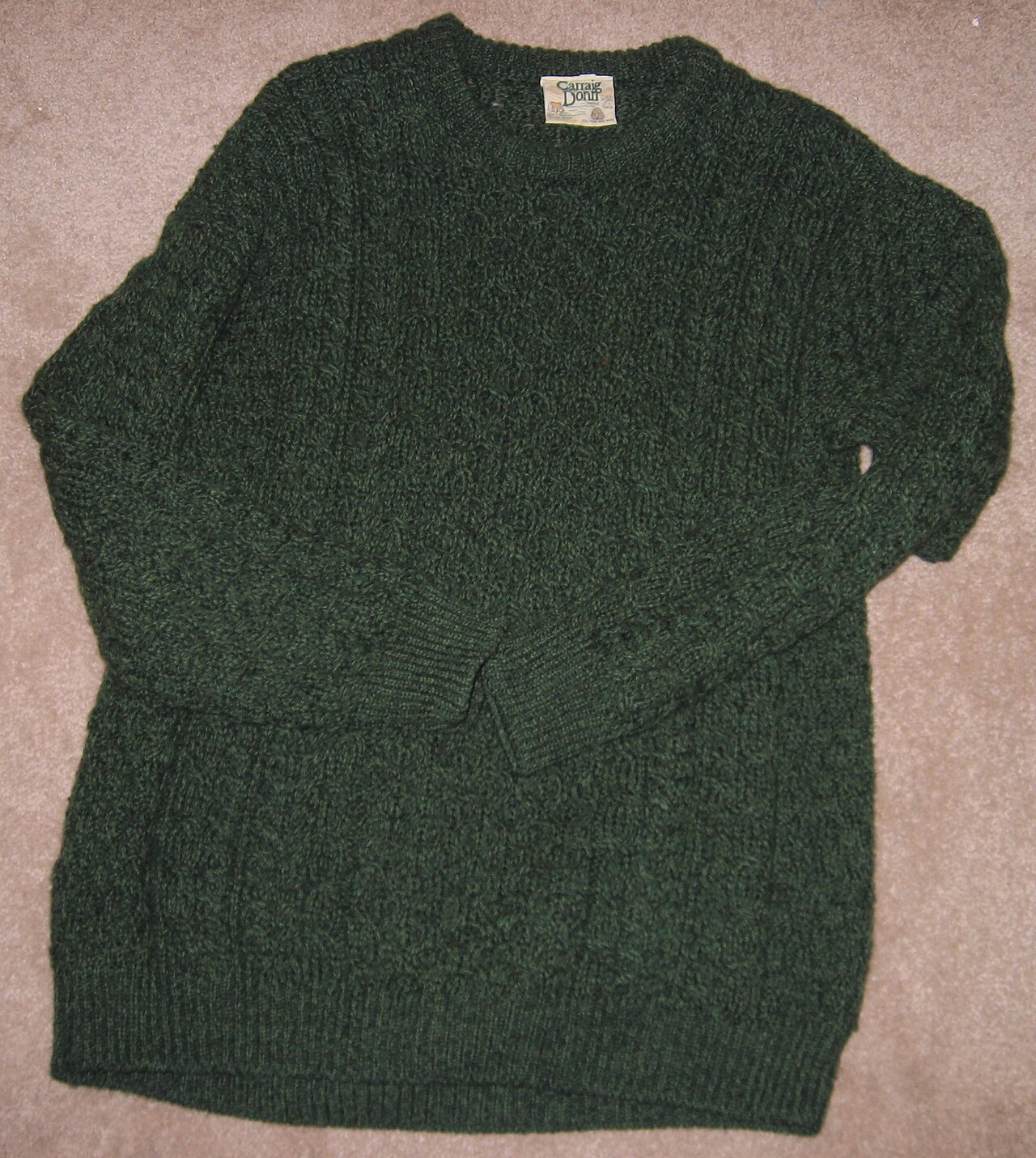
Fisherman Sweaters: Gansey, Guernsey, and Aran
Sorting fisherman sweaters: gansey, Guernsey, and Aran as related but different, construction that makes a working sweater do its job, three quality levels, a rough model of yarn and knitting time, and reading one sweater carefully.
- 6 min
- 7 steps
- 3 questions
- Lesson 15 of 49
In this lesson
- Separate three related names
- Construction makes the job visible
- Three quality levels
- A rough time-and-yarn model
- Field audit: read one sweater
- Rule of thumb
Open alongside this lesson
-
How did the 500 year old cableknit become a global icon? #fashion #education #cableknit (opens in a new tab)
Use the episode as the visual question, then separate the histories and construction of Aran, gansey, and Guernsey sweaters.
-
Knitting Traditions of the British Isles and Ireland (opens in a new tab)
Follow material, stitch, construction, trade, tourism, and migration rather than repeating the clan-code and drowned-fisherman legends.
Picking up where you left off.
“Fisherman sweater” sounds like one ancient object. It is better understood as a family of practical pullovers, local industries, later revivals, and fashion interpretations.
Fineas Jackson begins with the cable knit as an icon 1. The cable is only the visible surface. Under it sit yarn thickness, twist, stitch density, body shape, sleeve attachment, gussets, edge treatments, finishing, and hours of work.
Playback is optional. If the player is unavailable, open the video at its source.
Separate three related names
The V&A’s history gives us a careful starting point 2:
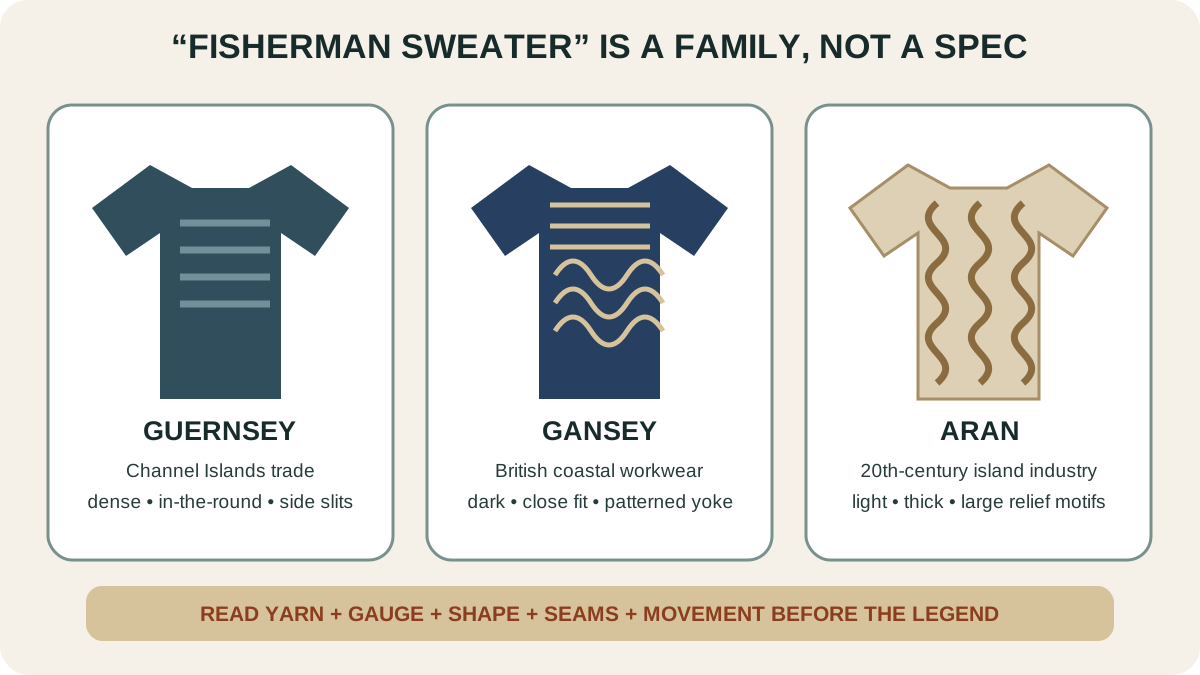
- A Guernsey or Guernsey frock belongs to the Channel Islands’ long knitting trade. Traditional examples could be knitted in the round, with a knotted cast-on edge and side slits for movement.
- A gansey became closely associated with British coastal fishing communities. It was commonly dark blue, densely knitted, high-necked, close through the body and sleeves, and patterned in combinations that could vary by maker and place.
- The heavily patterned Aran jumper—often thick, light-colored, and covered with large cables, honeycombs, and diamonds—is mainly a twentieth-century development. Government training, cottage industry, tourism, print patterns, and export helped make it global.
This does not make Aran knitting “fake.” It makes it a successful modern tradition rather than proof of an unchanged medieval code.
Stories that every stitch named a clan, or that a recovered fisherman could always be identified by his sweater, are attractive and weak as universal history. Patterns did move among places; the V&A notes that workers following the herring fleet could carry ideas along the coast. Treat a documented local pattern as evidence. Treat a total decoding system as a claim that needs much more.

Construction makes the job visible
A working sweater has to warm the body without snagging constantly, soaking immediately, or fighting the arms.
Dense gauge means more loops in a given area. With an appropriate worsted-spun wool yarn, density can resist wind and surface abrasion better than an open, fluffy fabric. Density also raises yarn use and knitting time.
Close sleeves keep cuffs away from gear and reduce loose fabric flapping in wind. Underarm gussets or shaped armholes recover reach that a tight tube would otherwise lose. Side slits release the hem over the hips. Ribbing adds elastic recovery at cuffs, hems, or necks.
Texture can do several jobs:
- ribs stretch and recover;
- moss or seed textures thicken the surface and disguise small wear;
- cables move stitches across one another, building relief and reducing effective width;
- patterned upper bodies can add local identity or visual hierarchy without placing every labor-intensive stitch below the apron or oilskin line.
No stitch makes wool literally waterproof. Wool fiber can buffer moisture and a dense fabric can slow wind and droplets, but seams, openings, saturation, pressure, and wear remain.
Three quality levels
| Level | Likely construction | What the price may omit or include | What to inspect |
|---|---|---|---|
| Budget fashion knit | Coarser gauge, simplified repeat, cut-and-sewn body, synthetic blend, minimal linking or finishing | Less yarn, faster knitting, fewer sizes, low-cost assembly, large volume | distortion, weak seams, pilling, acrylic heat/odor behavior, pattern interruption |
| Competent utility knit | Specified wool or blend, stable gauge, sensible ribbing, reinforced openings, clean seams, useful fit | Better yarn, more knitting time, wash testing, stronger assembly, smaller runs | recovery after stretch, shoulder comfort, cuff durability, care instructions |
| Exceptional craft or industrial knit | carefully chosen yarn lot, dense or complex fabric, shaped panels or seamless construction, deliberate matching, hand finishing or mending provision | low yield, long machine time or hand time, skilled linking, sampling, correction, finishing, provenance | even tension, planned shaping, unobtrusive joins, balanced weight, evidence of maker and method |
“Hand-knit” belongs in the process column, not automatically at the top. A machine can hold very even tension, shape complex panels, and produce a durable sweater. A hand knitter can make adjustments, repair during production, and achieve structures that are awkward to automate. Either can choose poor yarn, bad proportions, or a neckline that never recovers.
A rough time-and-yarn model
For comparison, write:
making cost ≈ yarn + knitting time + assembly/finishing + sampling/rework + overhead
Hand knitting makes the second term large. Industrial knitting makes setup and machine time important, then spreads programming and sampling across the run. Complex cables can slow both routes because stitches travel, tension changes, and defects become obvious.
Do not turn a seller’s “hours” into proof by itself. Ask what those hours accomplished:
- Was the garment shaped to a body or simply made as rectangles?
- Were sleeve and body patterns aligned deliberately?
- Were ends secured and hidden?
- Was the sweater washed, blocked, measured, and corrected?
- Is a repair yarn or repair service available?
Field audit: read one sweater
- Name it carefully. Record whether the seller says Aran, gansey, Guernsey, cable knit, or only fisherman-style.
- Read the yarn. Fiber content is not enough; note ply, twist, hairiness, elasticity, and whether the yarn feels dense or inflated.
- Estimate gauge. Count stitches and rows over 10 cm in an undistorted area. Compare left and right.
- Trace construction. Look for side seams, shoulder seams, linked loops, cut edges, gussets, fashioned decreases, and where pattern repeats stop.
- Test movement. Reach forward and overhead. Note hem lift, cuff pull, neck pressure, and bunching under the arm.
- Inspect recovery. Stretch a rib gently, release it, and see whether it returns.
- Plan care and repair. A dense wool sweater may last for decades if moth prevention, drying, de-pilling, and darning are realistic.
Rule of thumb
The impressive fisherman sweater is not the one with the grandest legend. It is the one whose loops, shape, and finish make a demanding piece of cloth useful—and whose history is told without erasing how the tradition actually changed.
Practice
The V&A documents related but distinct traditions. Local variation and later storytelling make universal motif codes unreliable.
Practice
Time, skill, correction, and small-scale production can be genuine cost drivers, but they still need to produce a suitable garment.
Practice
Quality is fitness plus execution. Hand or machine is only one production variable.
Lesson complete
Nice work.
Sources for this lesson
- 1Fineas Jackson. How did the 500 year old cableknit become a global icon? #fashion #education #cableknit. Fineas Jackson on YouTube. 2026. verifiedChasing Beauty episode 9; 3:00. Used as a case or observation prompt, not as the sole authority for technical claims. Cited at: episode 9.
- 2Knitting Traditions of the British Isles and Ireland. Victoria and Albert Museum. 2025. verifiedMuseum history distinguishing Guernsey, gansey, and Aran traditions, including construction, use, trade, and the limits of later pattern mythology. Cited at: museum account.
Further reading
- Wool Fibre — Properties, Facts & Benefits. The Woolmark Company. verifiedFibre-level overview of diameter, crimp, cuticle scales, moisture behaviour, and the relationship between fibre dimensions and end use. Woolmark is an industry organization, so product claims are paired with processing and test sources.