Knitwear: Cut-and-Sewn, Fully Fashioned, and Seamless
Three ways to make a sweater: cut-and-sewn, fully fashioned, and seamless, gauge as a system, yarn cost and behavior, finishing that rescues or ruins a knit, what each price level buys, and six places to inspect.
- 6 min
- 8 steps
- 3 questions
- Lesson 16 of 49
In this lesson
- The three main routes
- Gauge is a system, not a number on a tag
- Yarn cost and yarn behavior
- Finishing can rescue or ruin the knit
- What each price level usually buys
- Six places to inspect
- Rule of thumb
Open alongside this lesson
-
WHOLEGARMENT Business (opens in a new tab)
Distinguish fabric that is cut and sewn, panels shaped on the machine and linked, and a three-dimensional garment knitted as one piece.
-
$600 for a sweatshirt…why? How is that even possible? #cotton #fashion #hoodie (opens in a new tab)
Use the price question, then replace vague “premium construction” with a map of yarn, fabric formation, shaping, assembly, finishing, testing, and scale.
Picking up where you left off.
Two sweaters can use the same fiber and weight yet differ sharply in shape, waste, seam bulk, labor, and repair. The missing specification is often how the garment emerged from the knitting machine.
Playback is optional. If the player is unavailable, open the video at its source.
The three main routes
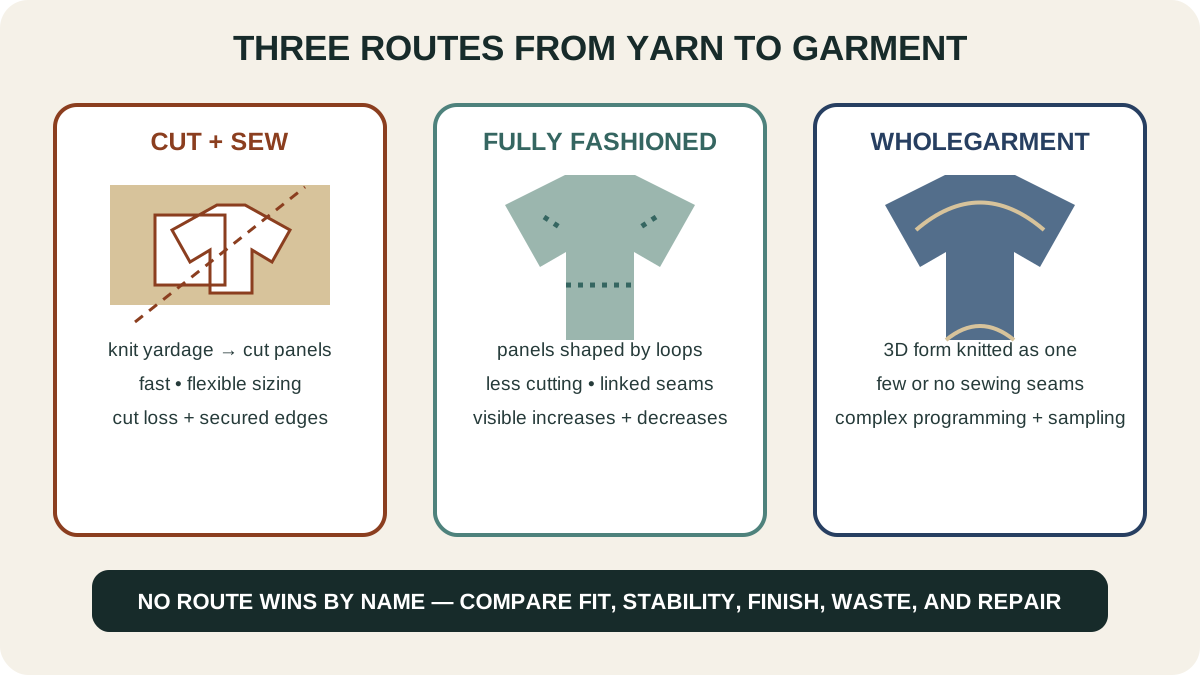
1. Cut-and-sewn knit
A machine produces knitted yardage or broad panels. Paper or digital pattern pieces are nested on that material, cut out, and sewn together much like a woven garment.
Advantages:
- fast fabric production and familiar apparel assembly;
- freedom to use standard cutting rooms;
- easy placement of prints, appliqués, and many trims;
- efficient at large volume with stable patterns.
Costs or risks:
- cut loss between pieces;
- cut loops must be secured so the fabric does not run or shed;
- seams can be bulky and less elastic than the cloth;
- stripe or motif matching consumes time and area;
- a poorly stabilized shoulder can lengthen in wear.
2. Fully fashioned or shaped-panel knit
The machine changes panel width by increasing, decreasing, holding, or transferring stitches. Front, back, sleeves, collars, and bands emerge close to final shape. A linker or sewing process joins the live or finished edges.
The small diagonal marks beside an armhole or shoulder can be fashioning marks—visible evidence that shaping happened in the loop structure. Linking can align one edge loop to another with little bulk, but it is skilled, eye-intensive work. Missing a loop can create a hole; misalignment can twist a seam.
3. Seamless or whole-garment knit
Specialized flat-knitting equipment can form a three-dimensional garment in one piece. SHIMA SEIKI describes the route as eliminating conventional cutting and most sewing, reducing seam allowance and allowing dimensional shaping 1.
That can improve stretch continuity, reduce bulky joins, and cut material loss. It does not make the garment free. Programming, virtual or physical sampling, yarn testing, specialized capital, machine occupancy, finishing, and the risk of rejecting a nearly completed piece remain.
Gauge is a system, not a number on a tag
In hand knitting, gauge is often recorded as stitches and rows per measured square. In industrial knitting, machine gauge concerns needle spacing, but yarn count, number of ends, loop length, take-down tension, structure, finishing, and relaxation all change the final fabric.
A coarse-looking sweater may use:
- genuinely thick yarn;
- several fine yarns fed together;
- long loose loops that make an inflated but unstable surface;
- brushed finishing that hides a light substrate.
A fine-gauge knit may feel luxurious because it is smooth and light, yet be more vulnerable to snagging or abrasion. Density, not fineness alone, determines whether the structure is stable.
Yarn cost and yarn behavior
Fiber price is only the first line:
- longer, more uniform fibers can support smoother and stronger yarns;
- combing removes short fibers and aligns the rest;
- twist changes strength, liveliness, softness, and pilling behavior;
- plies balance one another and change roundness;
- dyeing before or after spinning changes mélange, depth, and lot control;
- cashmere, fine wool, cotton, linen, synthetics, and blends each impose different knitting and finishing constraints.
Yarn use can be estimated:
garment yarn cost = finished yarn mass × yarn price per unit mass ÷ expected first-quality yield
The last term matters. If shade variation, broken yarn, barre, oil marks, dropped stitches, or finishing shrinkage reject pieces, saleable garments absorb the loss.

Finishing can rescue or ruin the knit
Newly knitted fabric is not necessarily ready to wear. Relaxation, washing, milling, steaming, pressing, brushing, shearing, or resin treatments can change width, length, hand, hairiness, and stability.
A sample should be measured before and after the actual care cycle. If a sweater grows 6% in length and loses 4% in width, the nominal size means little without compensation in the pattern.
Use:
dimensional change % = (after − before) ÷ before × 100
Negative means shrinkage; positive means growth. Measure body length, chest width, sleeve length, and neck opening separately because structures react differently.
What each price level usually buys
Budget: high machine speed, simplified shape, cut-and-sew assembly, broad size blocks, inexpensive yarn, little hand finishing, and limited wash correction. It can still be good if the specification is honest and the seams survive.
Competent: stable yarn, appropriate gauge, shaped shoulders or armholes, reinforced neck and shoulder, consistent linking or seaming, wash-tested dimensions, and inspection for dropped stitches and skew.
Exceptional: yarn selected for the exact structure; deliberate loop architecture; complex shaping; careful motif continuity; low-bulk linking or sophisticated seamless programming; hand finishing where it changes the result; documented measurements; repair support; and the willingness to reject or correct visible faults.
Exceptional is not synonymous with delicate. A dense work sweater and an airy luxury knit solve different problems.
Six places to inspect
- Shoulder: Is there tape, linking, fashioning, or a cut seam? Does it support hanging weight?
- Underarm: Does a gusset, shaped sleeve, or seam intersection allow reach without a hard lump?
- Neck: Is the collar attached cleanly? Does it recover after gentle stretch?
- Side: Is the seam straight and elastic, or does it torque around the torso?
- Pattern: Do stripes or cables meet where the design implies they should?
- Inside finish: Are yarn ends secured, seams soft, labels tolerable, and repairs possible?
Rule of thumb
Do not rank knitwear by seam count. Rank the production route by how intelligently it turns yarn into the intended shape, then inspect whether the difficult transitions—neck, shoulder, underarm, hem, and repair—were solved.
Practice
Fully fashioned describes loop-level shaping. It does not mean seamless, handmade, or automatically superior.
Practice
Less sewing and cutting loss do not erase capital, programming, sampling, machine-time, and defect risk.
Practice
Cut-and-sewn construction begins with knitted cloth or broad panels that are cut like woven fabric, so edges need securing.
Lesson complete
Nice work.
Sources for this lesson
- 1WHOLEGARMENT Business. SHIMA SEIKI. verifiedPrimary manufacturer explanation of cut-and-sew, shaped-panel, and three-dimensional seam-free knitwear production, including labor, fit, and cutting-loss tradeoffs. Cited at: manufacturer explanation.
Further reading
- Fineas Jackson. $600 for a sweatshirt…why? How is that even possible? #cotton #fashion #hoodie. Fineas Jackson on YouTube. 2026. verifiedChasing Beauty episode 32; 2:49. Used as a case or observation prompt, not as the sole authority for technical claims.
- How Wool Is Made — Processing & Manufacturing. The Woolmark Company. verifiedTechnical overview of scouring, carding, combing, woollen and worsted spinning, fabric formation, dyeing, and finishing.