Capstone: Build a Design-Value Dossier
The capstone: carrying the course's six patterns forward, choosing a fair pair of objects, a five-step method for gathering and weighing evidence, a dossier template, and a worked opening using the button on a white shirt.
- 8 min
- 12 steps
- 3 questions
- Lesson 41 of 49
In this lesson
- The six patterns to carry forward
- Choose a fair pair
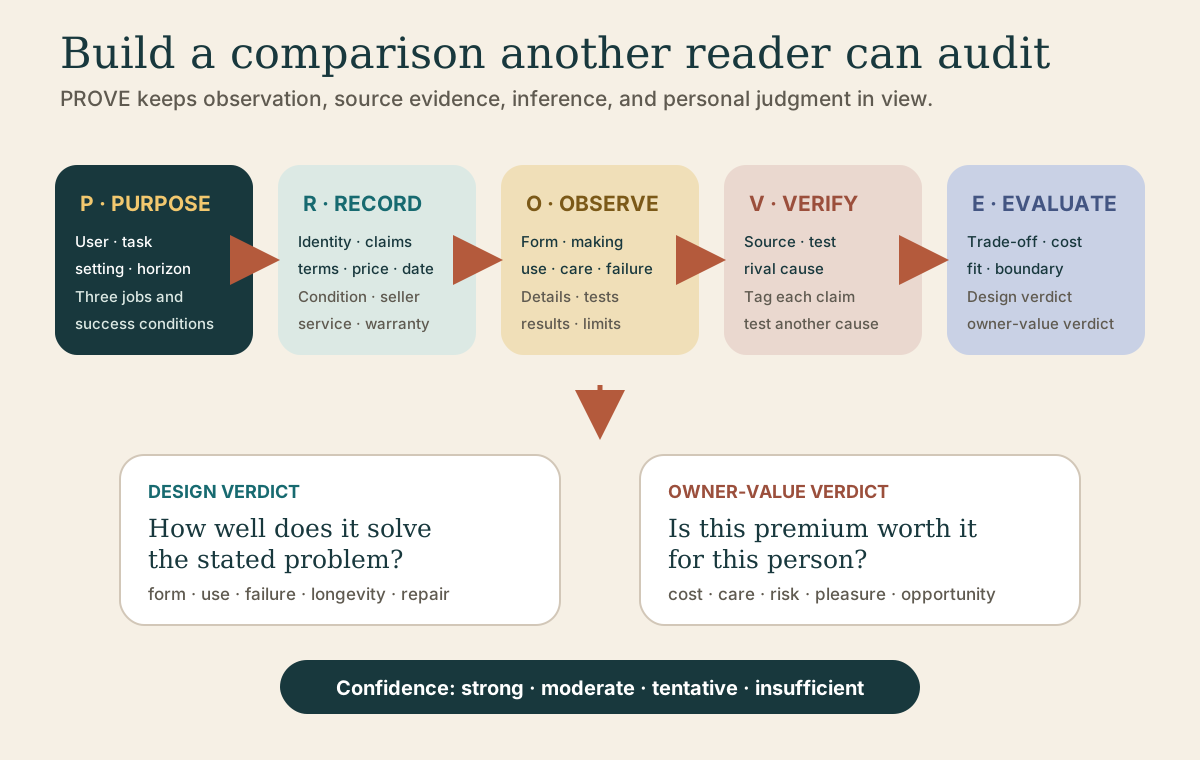
- The PROVE method
- A ready-to-use dossier template
- Worked opening: the white-shirt clue
- Final rule
Open alongside this lesson
-
Chasing Beauty (opens in a new tab)
Choose one unfamiliar object category or revisit a pair whose explanation you want to test more deeply.
-
How can two “selvedge” jeans be so different in price? What are you paying for? #denim #education (opens in a new tab)
Model the move from one attractive label to yarn, dye, weave, sewing, hardware, finish, and market evidence.
-
Why cheap umbrellas fail…and the ugly $60 umbrella that beats a $500 masterpiece (opens in a new tab)
Use failure and recovery as dossier categories instead of assuming the most refined-looking object is most robust.
-
Dyson products look weird, but there’s a reason. Behind their iconic product design... (opens in a new tab)
Trace a visible feature backward to the problem it claims to solve, then look for independent performance evidence.
-
$3,000 for perfume...why? How is that even possible? (opens in a new tab)
Practice separating ingredients and production from bottle, channel, scarcity, ownership experience, and brand.
-
All wool suits are the same right? Then how can one fall apart while the other gets better with age? (opens in a new tab)
Add an internal-construction row to the dossier; composition labels often omit the structure that predicts aging.
-
All diamonds are 'real'...right? So how can the same diamond be $1,400 and $8,000? (opens in a new tab)
Hold grade and seller terms constant before assigning a price difference to origin, scarcity, or story.
-
$345 for a basic white dress shirt…why? Is it different from one that costs $40? (opens in a new tab)
Use buttons as one clue, then test whether the rest of the garment supports the same quality story.
-
The hidden reason your clothes look so strange (opens in a new tab)
Ask how seersucker and waffle structures manipulate air rather than treating unusual texture as decoration.
-
How Pilots Created the World’s Most Iconic Sunglasses (opens in a new tab)
Connect bridge, lens, frame, coverage, weight, and glare requirements to the resulting silhouette.
Picking up where you left off.
The Chasing Beauty series succeeds because it treats familiar objects as puzzles. Why is one cotton shirt twenty times the price of another? Why does a zipper sit crooked? Why do two products with the same material label age differently? Why does an “ugly” umbrella survive when a beautiful one does not? Across 69 videos, the objects change but the investigative moves repeat 1.
Your capstone is to make those moves visible and testable. You will compare two similar-looking objects at different prices and produce a design-value dossier: an evidence-led account of what differs, why it may cost more, how it changes use, and whether the premium matters to you.
The result is not a shopping review with extra adjectives. It is a compact case study another person could audit.
The six patterns to carry forward
| Series pattern | Dossier question | Useful cases |
|---|---|---|
| Price is a stack | Which layers are product, process, channel, scarcity, story, and margin? | shirts, knives, watches, perfume, eyewear |
| A label is only the beginning | What grade, geometry, construction, and finish sit behind the category word? | cotton, linen, silk, wool, satin, selvedge |
| Form grows from constraint | Which problem made this odd feature reasonable? | biker jacket, Dyson, safety pin, fan jacket, aviators |
| Tiny details expose systems | Does the component reveal tolerance, wear strategy, assembly, or only decoration? | zippers, rivets, buttons, nibs, grinds |
| Function becomes a cultural fossil | What job disappeared, and what social meaning remains? | watch pocket, broguing, necktie, reeded coin, sweatshirt V |
| Price and owner value diverge | Which improvements affect my use, and which premiums affect meaning or access? | umbrellas, loafers, diamonds, coffee, distressed clothing |
Do not try to prove that every episode is correct. Jackson supplies sharp hypotheses and observation prompts. Your dossier improves on the short-video format by slowing down, comparing competing explanations, and showing sources.
Choose a fair pair
The best pair is neither identical nor unrelated. Choose objects that:
- claim the same primary purpose;
- share a visible category or headline label;
- differ enough in price to create a real question;
- are available for safe observation, use, or measurement;
- have specifications, maker information, or credible outside sources;
- matter enough that you can imagine choosing between them.
Good examples include two white shirts, two umbrellas, two skillets of the same diameter, two desk lamps, two notebooks, two nail clippers, or two dining chairs. Avoid a new object versus a worn-out one unless aging itself is the question. Avoid comparing different sizes or functions and then crediting price for an obvious task difference.
Write the question before collecting evidence:
For this user, doing this task over this ownership period, what does the additional $___ buy, and which differences create usable or meaningful value?
The PROVE method
P — Purpose
Define the user, setting, duration, frequency, and top three jobs. Name one feature that would be impressive but irrelevant. A summer event shirt and a weekly office shirt may reward different cloth, care, and longevity.
R — Record
Make an identity block for each object:
- maker, model, seller, date, and price observed;
- country of manufacture if disclosed;
- dimensions, weight, capacity, and composition;
- exact marketing claims, photographed or archived;
- warranty, return, parts, repair, and care terms;
- specimen age, condition, and known use history.
Record claims verbatim only in your private notes; paraphrase them in the lesson-sized dossier and link the source. A current price is a dated observation, not a permanent product property.
O — Observe
Inspect the whole object, then move inward.
- Form: silhouette, proportions, contact areas, controls, and visual hierarchy.
- Material: not just category, but thickness, grain, yarn, weave, hardness, coating, finish, and transitions.
- Construction: part count, joints, seams, fasteners, internal structure, alignment, and access.
- Use: setup, feedback, comfort, cleaning, storage, noise, and error recovery.
- Failure: wear points, replaceable parts, repair access, warning, and consequences.
The V&A’s material-choice framework is valuable because it treats strength, flexibility, weight, feel, manufacturing, symbolism, status, and lifecycle as connected selection criteria 2. Do not assume the most expensive material is the right one. Ask what the object requires.
Photograph both specimens in the same light and position: overall front, side, underside or interior when safely accessible, and matching detail views. Include a ruler or scale only where it lies in the same plane. Do not disassemble products, defeat guards, load unproven furniture, cut fibers, or perform destructive tests unless you have appropriate expertise, ownership, controls, and safety procedures. Published standard tests are better evidence than an improvised stunt; CPSC explains that standards use defined performance requirements and methods 3.
V — Verify
For every important claim, label the evidence:
- Direct: you measured or observed it with a documented method.
- Documented: a standard, patent, museum, maker specification, technical report, or credible study supports it.
- Corroborated: multiple independent sources agree, but you have not tested the specimen.
- Inferred: the feature plausibly supports the explanation, but alternatives remain.
- Claim only: marketing, seller, reviewer, or video assertion not yet independently supported.
Manufacturing cost deserves special restraint. MIT’s design-for-manufacture material separates materials, components, labor, tooling, assembly, and overhead while showing that process economics change with quantity 4. Unless you have a bill of materials, process route, volume, labor rate, reject rate, and channel terms, say cost driver rather than pretending to know the maker’s profit.
Test alternative explanations. If Shirt B drapes better, is the cause fiber, yarn, weave, fabric weight, cut, finishing, condition, or your fit preference? Fineas’s wool-suit case points to hidden canvas or fusing as a predictor of long-term behavior 5. Your specimen may use half canvas, newer fusibles, or a different structure. Inspect and document; do not assign construction from price.
E — Evaluate
Produce two verdicts.
Design verdict: How well does each object solve the stated problem? Discuss form, material, interaction, failure, longevity, repair, and meaningful simplicity. The Design Council’s framework encourages financial, social, and environmental value across design, production, use, and end of life 6.
Owner-value verdict: Which object would this user choose at these prices, given use frequency, maintenance, risk, pleasure, opportunity cost, and resale? Use a common ownership horizon. GSA’s lifecycle perspective includes purchase, installation, operation, maintenance, removal, and disposal rather than acquisition alone 7. NIST adds value-retention paths such as reuse, repair, refurbishment, and recycling 8.
Give each verdict a confidence label: strong, moderate, tentative, or insufficient evidence. State what would change it.
A ready-to-use dossier template
1. Comparison question
One sentence naming user, task, horizon, and price difference.
2. Object cards
| Field | Object A | Object B |
|---|---|---|
| Model and seller | ||
| Price and date | ||
| Headline material claim | ||
| Dimensions / weight | ||
| Warranty / repair | ||
| Condition |
3. Claim ledger
| Claim | A evidence | B evidence | Label | Why it matters |
|---|---|---|---|---|
| direct / documented / corroborated / inferred / claim only |
4. Difference map
For each object, trace input → process → detail → behavior → ownership consequence. Stop the arrow where evidence stops.
5. Failure and care
List three likely wear or failure points, warning signs, consequence, prevention, part availability, repairer, and estimated cost. “Durable” is not a row; a failure mode is.
6. Price and premium
Sort each plausible price driver into product/process, channel/service, scarcity, story/status, and unknown. Do not force the columns to add to retail price.
7. Whole-life estimate
Use low, likely, and high lifespan assumptions. Show purchase, care, consumables, repairs, replacements, downtime or failure, and residual value. Calculate cost per useful use where it helps.
8. Verdict and boundary
- best design for the stated problem;
- best owner value at the observed prices;
- real premium you would not personally pay for;
- unsupported claim;
- confidence and missing evidence.
Worked opening: the white-shirt clue
Playback is optional. If the player is unavailable, open the video at its source.
Jackson’s white-shirt episode examines button material as a small clue to a large price gap 9. A dossier should resist both overreactions: “buttons do not matter” and “mother-of-pearl proves the shirt.”
Begin with a button card: material evidence, thickness, attachment, shank, stitch security, spare, replacement difficulty, feel, and break behavior. Then ask whether the rest of the shirt tells a consistent story: cloth, pattern matching, collar and cuff structure, seam type and density, stress reinforcement, buttonholes, pressing, fit, care, alteration allowance, and service. A high-cost button on an indifferent garment is theater. An inexpensive button on a well-cut, durable garment may be an appropriate economy. One detail earns the next question.
Final rule
A good dossier does not announce that expensive things are good or that premiums are fake. It shows where the difference lives. Trace the problem into the form, the form into making, making into ownership, and ownership into a verdict whose assumptions another person can see.
Practice
A revealing detail is a lead. The dossier must still examine fabric, pattern, seams, construction, finish, fit, service, and price layers.
Practice
Similar purpose and condition, a common protocol, and recorded context reduce alternative explanations while preserving real ownership differences.
Practice
An explicit evidence boundary is a successful result. It identifies the missing test, source, time, or access needed for a stronger conclusion.
Lesson complete
Nice work.
Sources for this lesson
- 1Fineas Jackson. Chasing Beauty. Fineas Jackson on YouTube. 2026. verifiedOfficial 69-video playlist used as the recurring case library for this course. Cited at: complete playlist.
- 2Material choices: what are things made from and why?. Victoria and Albert Museum. verifiedMuseum overview of how performance, process, meaning, feel, status, and lifecycle considerations influence material selection. Cited at: material selection factors.
- 3Voluntary Standards Development FAQ for Consumers. U.S. Consumer Product Safety Commission. verifiedExplains how product-safety standards define performance requirements and repeatable test methods. Cited at: standards and repeatable testing.
- 4Design for Manufacture. MIT OpenCourseWare. 2010. verifiedTeaching material on direct and indirect manufacturing costs, part count, process choice, tooling, labor, and assembly. Cited at: manufacturing cost categories.
- 5Fineas Jackson. All wool suits are the same right? Then how can one fall apart while the other gets better with age?. Fineas Jackson on YouTube. 2026. verifiedChasing Beauty episode 64; 2:50. Used as a case or observation prompt, not as the sole authority for technical claims. Cited at: internal suit construction.
- 6The Design Value Framework. Design Council. verifiedFramework for financial, social, environmental, and democratic value across design, production, use, and end of life. Cited at: value dimensions.
- 7Life cycle perspective (life cycle thinking). U.S. General Services Administration. verifiedGovernment overview of financial and environmental effects from extraction and purchase through operation, maintenance, removal, reuse, and disposal. Cited at: lifecycle costs and impacts.
- 8Circular Economy. National Institute of Standards and Technology. verifiedExplains how reuse, repair, refurbishment, and recycling can preserve resources and economic value. Cited at: circular value retention.
- 9Fineas Jackson. $345 for a basic white dress shirt…why? Is it different from one that costs $40?. Fineas Jackson on YouTube. 2026. verifiedChasing Beauty episode 67; 2:56. Used as a case or observation prompt, not as the sole authority for technical claims. Cited at: button-material comparison.
Further reading
- Fineas Jackson. How can two “selvedge” jeans be so different in price? What are you paying for? #denim #education. Fineas Jackson on YouTube. 2026. verifiedChasing Beauty episode 19; 2:34. Used as a case or observation prompt, not as the sole authority for technical claims.
- Fineas Jackson. Why cheap umbrellas fail…and the ugly $60 umbrella that beats a $500 masterpiece. Fineas Jackson on YouTube. 2026. verifiedChasing Beauty episode 39; 2:43. Used as a case or observation prompt, not as the sole authority for technical claims.
- Fineas Jackson. Dyson products look weird, but there’s a reason. Behind their iconic product design.... Fineas Jackson on YouTube. 2026. verifiedChasing Beauty episode 43; 3:00. Used as a case or observation prompt, not as the sole authority for technical claims.
- Fineas Jackson. The hidden reason your clothes look so strange. Fineas Jackson on YouTube. 2026. verifiedChasing Beauty episode 68; 3:33. Used as a case or observation prompt, not as the sole authority for technical claims.
- World Intangible Investment Highlights 2026. World Intellectual Property Organization. 2026. verifiedEvidence that brands and other intangible assets carry economic value beyond a product's measurable physical attributes.