Upholstery Inside Out: Frame, Springs, Foam, and Cover
Reading upholstered furniture from the frame up: frame, springs or webbing, foam and padding, and cover, why patterned fabric uses more yardage, the hidden labor of reupholstery, three quality levels, and auditing a chair without cutting it open.
- 6 min
- 10 steps
- 3 questions
- Lesson 22 of 49
In this lesson
- Read the stack from the floor up
- Why patterned upholstery consumes fabric
- Upholstery labor is subtraction and prediction
- Three quality levels
- A chair audit without cutting it open
- Rule of thumb
Open alongside this lesson
-
Conserve O Gram 7/4 — Upholstered Furniture: Agents of Deterioration (opens in a new tab)
Historical furniture makes the hidden stack legible—frame, webbing, springs, fillings, covers, tacks, and adhesives can age and interact differently.
-
Foam Performance (opens in a new tab)
Learn density, indentation-force deflection, support factor, resilience, strength, and flex fatigue before comparing cushions by a five-second squeeze.
-
Physical Properties Guideline for Woven Fabrics, Indoor Use (opens in a new tab)
Lab results such as pilling, breaking strength, and seam slippage help specify a fabric, but no single abrasion number predicts a chair's full service life.
Picking up where you left off.
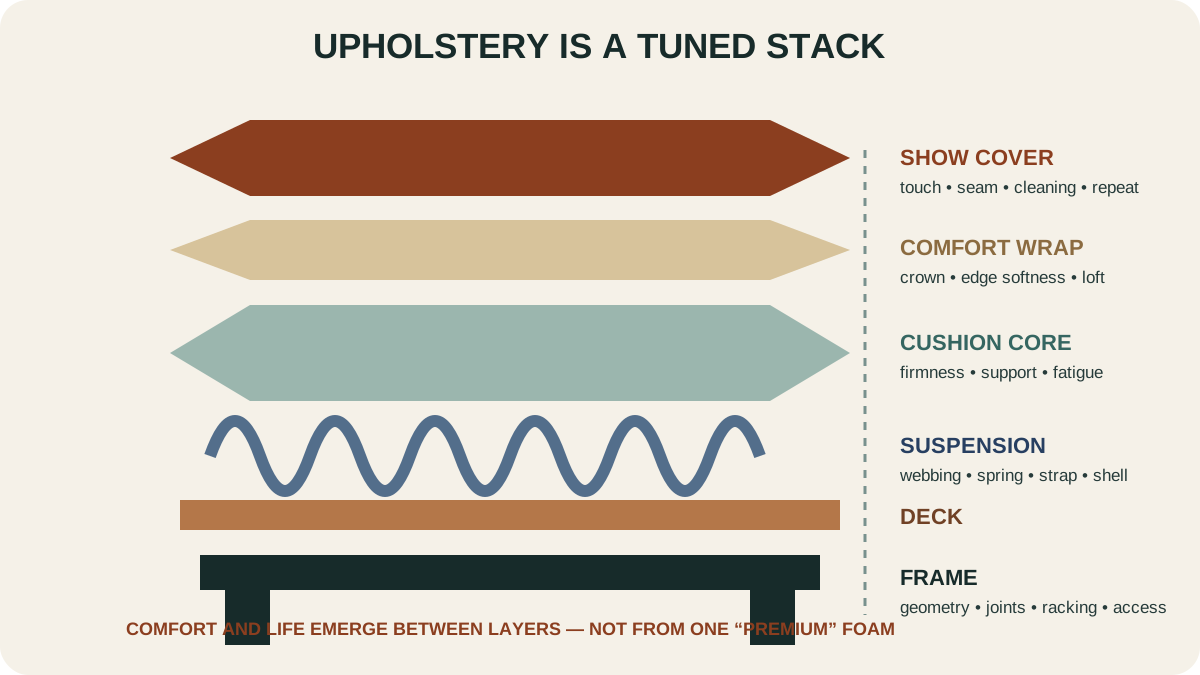
Upholstery is architecture you sit on. The cover receives attention because it is visible, but the chair’s behavior comes from a layered system below it.
The National Park Service describes upholstered furniture as a composite of frame, support, springs, fillings, cover fabrics, trimmings, tacks, and adhesives 1. Those layers move against one another. They also fail on different clocks.
Read the stack from the floor up
Frame
The frame establishes geometry and carries loads. Solid wood, plywood, laminated veneer lumber, steel tube, cast aluminum, and molded polymer can all make good frames.
Inspect:
- joinery and reinforcement at the front rail, back posts, and arm junctions;
- whether fasteners bite into adequate material;
- diagonals or corner blocks resisting racking;
- smooth edges where webbing or fabric passes;
- access to re-tighten or replace parts;
- whether the decorative outer form corresponds to structure.
A heavy frame is not automatically strong. Strategic section depth, grain direction, joints, and bracing matter more than mass alone.
Deck and suspension
The deck closes the seat structure and isolates layers. Above or within it, support may come from:
- jute or synthetic webbing, tensioned across a frame;
- sinuous springs, clipped in parallel;
- coil springs, tied to control vertical and lateral movement;
- elastomeric straps, offering quiet, controlled compliance;
- molded shells or flexible slats, where the structure itself deflects.
Traditional eight-way hand-tied coils demand substantial fitting and knotting. They can distribute loads beautifully and be repaired. They are not automatically superior in a shallow modern lounge chair where a tested elastomeric support or shaped shell better matches the geometry.
Cushion core and comfort layers
Polyurethane foam comparisons are often muddled. The Polyurethane Foam Association distinguishes 2:
- density: polymer mass per unit volume;
- firmness or IFD: force needed to indent the sample under a defined method;
- support factor: how resistance rises at deeper compression;
- resilience: spring-back behavior;
- flex fatigue: change after repeated compression;
- tensile, tear, and compression-set behavior: resistance to particular damage or lasting deformation.
Density is not firmness. A higher-density foam can be formulated soft; a lower-density foam can feel hard at first. Higher polymer content often helps retain properties, but formulation and test data still matter.
Layering lets a maker tune the response:
- firmer base foam prevents bottoming;
- softer top foam distributes local pressure;
- fiber or wool wrap softens edges and fills the cover;
- feather or down creates enveloping comfort but needs containment and regular redistribution;
- latex can offer lively resilience and long service, with cost, weight, and allergy or sourcing considerations;
- horsehair, cotton, coir, wool, or other traditional fillings behave differently and require skilled shaping.
Cover and seams
The show cover must survive tension, flex, body oils, light, spills, cleaning, and rubbing against its own seams. Specification can include fiber, weave, backing, finish, width, repeat, pilling, seam slippage, breaking or tear strength, colorfastness, and flame requirements.
The Association for Contract Textiles publishes minimum physical guidelines for indoor woven upholstery 3. Its caution is crucial: one test cannot predict all field performance. An enormous abrasion number does not tell you whether a loose weave will snag, dye will transfer, a seam will slip, or the fabric feels appropriate.
Why patterned upholstery consumes fabric
Fabric is purchased by length at a fixed width. Solid or non-directional cloth can often be nested efficiently. A directional motif or large repeat forces the cutter to align pattern landmarks.
Maharam’s specification pages illustrate the variables: width, horizontal repeat, vertical repeat, and whether a design is railroaded 4.
Railroaded means the pattern is oriented to run along the roll rather than up its width in the conventional direction. It can allow a long sofa back to be covered without a vertical seam—but only when the motif, weave, stretch, and manufacturer’s use guidance allow it.
A rough yardage model is:
required fabric = net pattern area ÷ layout yield + repeat-matching allowance + defect/re-cut allowance
Matching stripes across a T-cushion, centering a medallion on a back, and making a pair of chairs mirror each other can consume much more cloth than surface area suggests.
Upholstery labor is subtraction and prediction
Before a new cover appears, a restorer may need to:
- photograph and mark every panel;
- remove trim, tacks, staples, cover, padding, and support without damaging the frame;
- diagnose old repairs and structural movement;
- rebuild webbing, springs, or edge rolls;
- create or correct patterns;
- estimate how new foam and cloth will compress;
- cut with grain, direction, and repeat control;
- sew curved boxing, corners, zippers, and relief cuts;
- tension the cover evenly without distorting pattern;
- finish the underside and preserve access for future work.
The skill is predictive. Cloth that appears loose on the bench may tighten around a compound curve. Foam that feels perfect bare may become too firm under a low-stretch cover.
Three quality levels
| Level | Hidden build | Cover strategy | Likely service |
|---|---|---|---|
| Budget | stapled softwood or engineered frame, minimal webbing, lower-density foam, glued layers | simple solid, few panels, permanent cover | affordable and light; comfort or shape may change earlier |
| Competent | braced frame, suitable suspension, specified foam stack, protected edges, replaceable cushion | durable cloth, sound seam allowances, zippers where useful | balanced comfort, clean aging, practical re-covering |
| Exceptional | frame and suspension tuned and tested, zoned or traditional filling, careful crown and edge roll, service access | matched repeats, directional cutting, hand shaping, spare cloth or documented specification | refined response and appearance with a realistic repair path |
Public or lounge seating can also be tested as a finished product. ANSI/BIFMA X5.4 addresses safety, durability, and structural adequacy 5. That evidence answers different questions from textile abrasion or foam density.
A chair audit without cutting it open
- Lift one front corner: does the frame rack or creak?
- Press the seat slowly: note initial softness, deeper support, edge support, and bottoming.
- Stand up: observe recovery after one minute and again later.
- Feel below the deck for webbing or springs without forcing the dust cover.
- Inspect seams at the front edge and arm where load changes direction.
- Check pattern centering and matching.
- Find zippers, removable panels, screws, clips, labels, or other repair access.
- Ask for frame, suspension, foam, textile, cleaning, and test specifications separately.
Rule of thumb
Do not buy upholstery by squeezing the top inch. Read the stack, the transitions, and the repair path. Great upholstery feels simple because many hidden layers were made to cooperate.
Practice
Foams of different density can be formulated to similar firmness. A complete cushion specification needs more variables.
Practice
Visual matching constrains how pieces can be nested, reducing material yield.
Practice
Textile tests isolate properties. Finished-product durability also depends on seam design, cushioning, frame, exposure, maintenance, and use.
Lesson complete
Nice work.
Sources for this lesson
- 1Conserve O Gram 7/4 — Upholstered Furniture: Agents of Deterioration. U.S. National Park Service. 1993. verifiedGovernment conservation guide describing the composite build of upholstered furniture, historic fillings, coil springs, show covers, and interactions among materials. Cited at: conservation guide.
- 2Foam Performance. Polyurethane Foam Association. verifiedTechnical trade guidance distinguishing polymer density, firmness or IFD, support factor, flex fatigue, strength, resilience, and durability. Cited at: performance guide.
- 3Physical Properties Guideline for Woven Fabrics, Indoor Use. Association for Contract Textiles. verifiedVoluntary upholstery guideline covering pilling, breaking strength, seam slippage, test methods, minimums, and the limits of predicting field performance from one laboratory result. Cited at: ACT guideline.
- 4Multiply Upholstery Textile Specification. Maharam. verifiedReal specification sheet showing width, vertical and horizontal repeat, railroaded repeat, content, finish, backing, and abrasion result. Cited at: example specification.
- 5ANSI/BIFMA X5.4-2020 — Public and Lounge Seating. BIFMA. 2020. verifiedIndustry standards notice defining tests and minimum levels for safety, durability, and structural adequacy of public and lounge seating. Cited at: standard notice.
Previous: Leather Straps: Belts, Bags, Edges, and Saddle Stitch