Silk: Filament, Weave, and Weight
Silk from cocoon to cloth: reeled filament versus spun silk, degumming and sericin, how satin, crepe, organza, and twill change the same fiber, momme as a weight measure and its limits, and a light-table comparison.
- 6 min
- 8 steps
- 3 questions
- Lesson 10 of 49
In this lesson
- Cocoon to yarn: two major routes
- Degumming changes the hand
- Construction changes the same fibre
- Weight: useful, incomplete evidence
- The SILK read
- Light-table comparison
- Rule of thumb
Open alongside this lesson
-
All silk is the same…right? How can two 100% silk products be so different in price #silk #education (opens in a new tab)
Use the comparison to separate fibre identity from filament, yarn, construction, weight, dyeing, finish, and sewing.
-
Silk Reeling and Testing Manual (opens in a new tab)
Inspect how cocoon quality, reeling continuity, filament defects, degumming, waste, and spun-silk routes alter the material.
-
Silk Reeling and Testing Manual — Raw Silk Testing (opens in a new tab)
Move beyond shine to evenness, cleanness, cohesion, defects, colour, lustre, and smoothness.
Picking up where you left off.
Silk can arrive at cloth as smooth, reeled filament or as shorter fibres spun into yarn. It can be woven into satin, plain weave, twill, crepe, organza, habotai, velvet, or dozens of other constructions. It can be lightweight and crisp, dense and fluid, matte and nubby, or highly reflective. The fibre label is true in all of those cases.
Fineas Jackson’s silk comparison asks why two 100% silk products can differ so sharply 1. His satin episode supplies the companion distinction: satin names a construction, not a fibre 2. Put the two together and a product description becomes a coordinate system rather than a prestige word.
Playback is optional. If the player is unavailable, open the video at its source.
Cocoon to yarn: two major routes
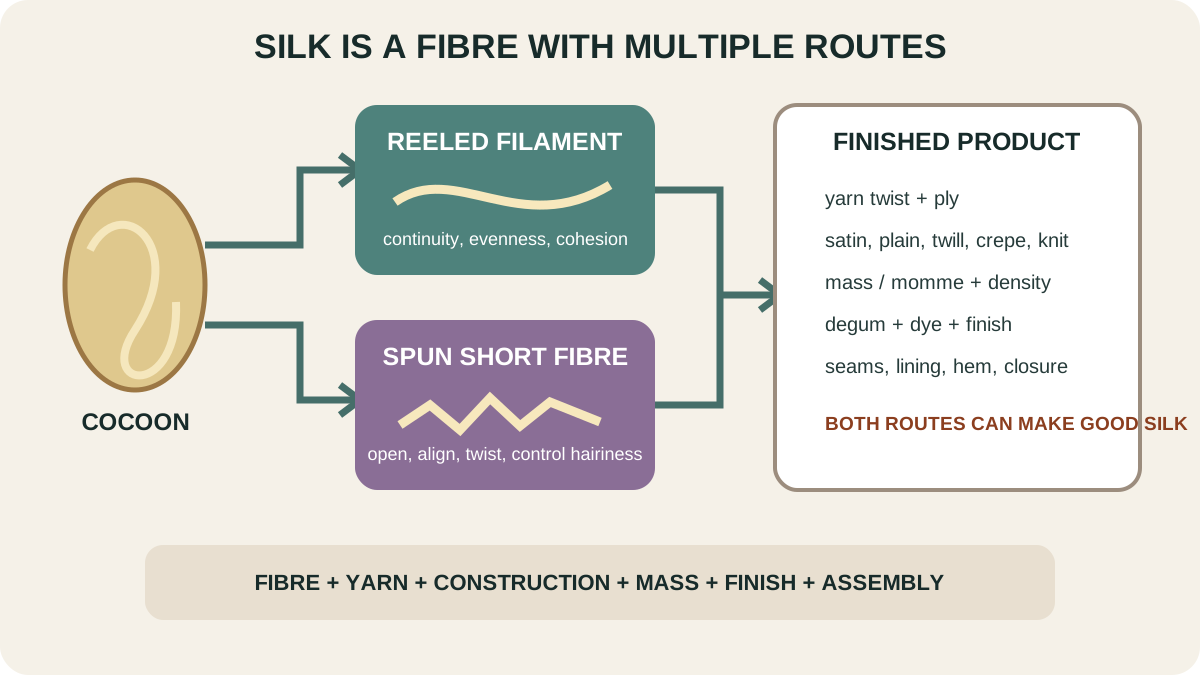
Reeled silk
A silkworm forms a cocoon from a long filament bonded by sericin, a gummy protein. In reeling, softened cocoon filaments are found, drawn together, and wound as a continuous raw-silk thread. Several fine filaments combine because one alone is too delicate for ordinary handling.
Continuity matters. Breaks require cocoon replacement and joining; uneven feeding can create thick places; poor cohesion can impair later weaving. The FAO manual connects cocoon reelability and filament defects directly to production interruption, waste, and raw-silk quality 3.
Spun silk
Pierced cocoons, reeling waste, broken filament, and other shorter silk fibres can be degummed, opened, aligned, and spun. The result is still silk. It commonly has a softer, less glassy, more staple-yarn surface. The FAO manual notes that good spun-silk fabric can provide good service when the fibre quality and processing are sound 3.
“Reeled” is not a moral category and “spun” is not a synonym for counterfeit. They are routes with different yield, labour, surface, uniformity, and end-use possibilities.
Degumming changes the hand
Degumming removes some or most sericin. Removing gum reveals softness and lustre, reduces mass, and alters dye uptake and handling. Too little removal can leave stiffness or unevenness; excessive processing can weaken material. Degumming can occur at different stages depending on the product.
Wild silks and cultivated mulberry silk may differ in colour, filament regularity, diameter, available length, sericin, and dye response. Species or feeding story is not a finished-cloth grade. The FAO testing material treats evenness, cleanness, cohesion, defects, colour, lustre, and smoothness as separate observations 4.
Construction changes the same fibre
Satin
Relatively long floats allow yarn to dominate the surface with fewer visible intersections, supporting smoothness, lustre, and drape. The same floats can be vulnerable to snagging, picking, and seam slippage. CottonWorks lists both effects when explaining satin structures 5.
Crepe
High-twist yarns and finishing can create a pebbled surface, dry hand, spring, and different drape. “Crepe” also describes a family, not one universal specification.
Organza
Fine, strongly twisted filament yarns in an open plain weave can create crisp transparency. Lightness is the point; judging it by upholstery abrasion criteria would be a category error.
Twill and plain weave
Frequent interlacements can change stability, opacity, wrinkle pattern, and surface reflection. A silk twill scarf and silk satin blouse share fibre yet behave differently before sewing begins.
Weight: useful, incomplete evidence
Silk fabric is often sold by momme, a traditional mass convention based on the pounds in a 45-inch-by-100-yard sample. A common conversion is approximately 1 momme = 4.3 grams per square metre, though sellers may round 6. Higher momme generally means more fabric mass per area, which can increase opacity and abrasion reserve and change drape. It does not automatically establish better filament, tighter quality control, safer dye, stronger seams, or fitness for summer.
Use mass as a specification, not a rank. A 12-momme scarf and a 25-momme pillowcase serve different jobs.
The SILK read
- S — Source and strand: Fibre percentage, cultivated or wild claim, reeled filament or spun staple, yarn twist and ply, documentation and unknowns.
- I — Interlacement: Satin, plain weave, twill, crepe, knit, pile, density, float length, and stretch direction.
- L — Load and lifecycle: Mass, opacity, expected abrasion, snag exposure, laundering or dry cleaning, perspiration, light, storage, repair.
- K — Kit of parts: Seams, needle size evidence, puckering, lining, hem, zipper, button, interfacing, pattern matching, and allowance.
The FTC fibre rule supports the first question by requiring covered products to identify fibre content 7. It does not answer the remaining three.
Light-table comparison
Use two owned silk items or legitimate swatches.
- Record labels, dimensions, and mass; calculate approximate mass per area only if the item geometry allows it.
- Place each over the same printed grid to compare opacity and construction.
- Tilt each under one fixed light and note whether reflection is broad, sharp, directional, or scattered.
- Inspect yarn surface with a magnifier: continuous and smooth, spun and fuzzy, highly twisted, slubbed, or unknown.
- Examine seam puckering, stitch holes, float snagging, hem depth, and stress points.
- State which use each construction appears designed for.
Do not perform burn tests on garments. Fibre identification by flame involves fire, fumes, damage, and ambiguous interpretation; use documentation or professional testing.
Rule of thumb
Silk names the fibre; it does not name the cloth. Ask filament or spun, yarn, construction, mass, degumming, dyeing, finish, and sewing. A useful premium points to a controlled difference you can connect to the product’s job.
Practice
Both routes can produce real silk. Filament continuity and yarn formation change surface, evenness, labour, yield, and appropriate uses.
Practice
Silk names fibre and satin names weave structure. Weight, yarn, density, finish, and assembly still require specification.
Practice
Mass affects opacity, drape and abrasion reserve, but it does not identify filament quality, weave, finish, dyeing, or sewing.
Lesson complete
Nice work.
Sources for this lesson
- 1Fineas Jackson. All silk is the same…right? How can two 100% silk products be so different in price #silk #education. Fineas Jackson on YouTube. 2026. verifiedChasing Beauty episode 20; 2:53. Used as a case or observation prompt, not as the sole authority for technical claims. Cited at: episode 20.
- 2Fineas Jackson. Satin…of what? How can two “satin” products be priced so differently? #satin #fabric #education. Fineas Jackson on YouTube. 2026. verifiedChasing Beauty episode 12; 2:33. Used as a case or observation prompt, not as the sole authority for technical claims. Cited at: episode 12.
- 3Silk Reeling and Testing Manual. Food and Agriculture Organization of the United Nations. verifiedTechnical manual covering cocoon quality, reeling, filament breaks, waste, raw-silk testing, degumming, spun silk, and wild silk. Cited at: reeling and defects; spun silk.
- 4Silk Reeling and Testing Manual — Raw Silk Testing. Food and Agriculture Organization of the United Nations. verifiedDetailed testing chapter describing evenness, cleanness, defects, cohesion, colour, lustre, smoothness, and inspection after degumming and dyeing. Cited at: quality categories.
- 5Basic Woven Fabric Designs. CottonWorks by Cotton Incorporated. verifiedTextile construction lesson comparing plain, twill, and satin weaves and explaining satin floats, luster, drape, and snag or seam-slippage risks. Cited at: satin tradeoffs.
- 6Textiles Guide — Kinetic Fabrics. Carnegie Mellon University IDeATe. 2025. verifiedCourse reference defining silk momme by the traditional 45-inch-by-100-yard sample and giving an approximate conversion to grams per square metre. Cited at: unit definition.
- 7Textile Fiber Rule. U.S. Federal Trade Commission. verifiedOfficial summary of U.S. disclosure requirements for generic fiber names, percentages by weight, responsible company, and country of processing or manufacture. Cited at: rule scope.