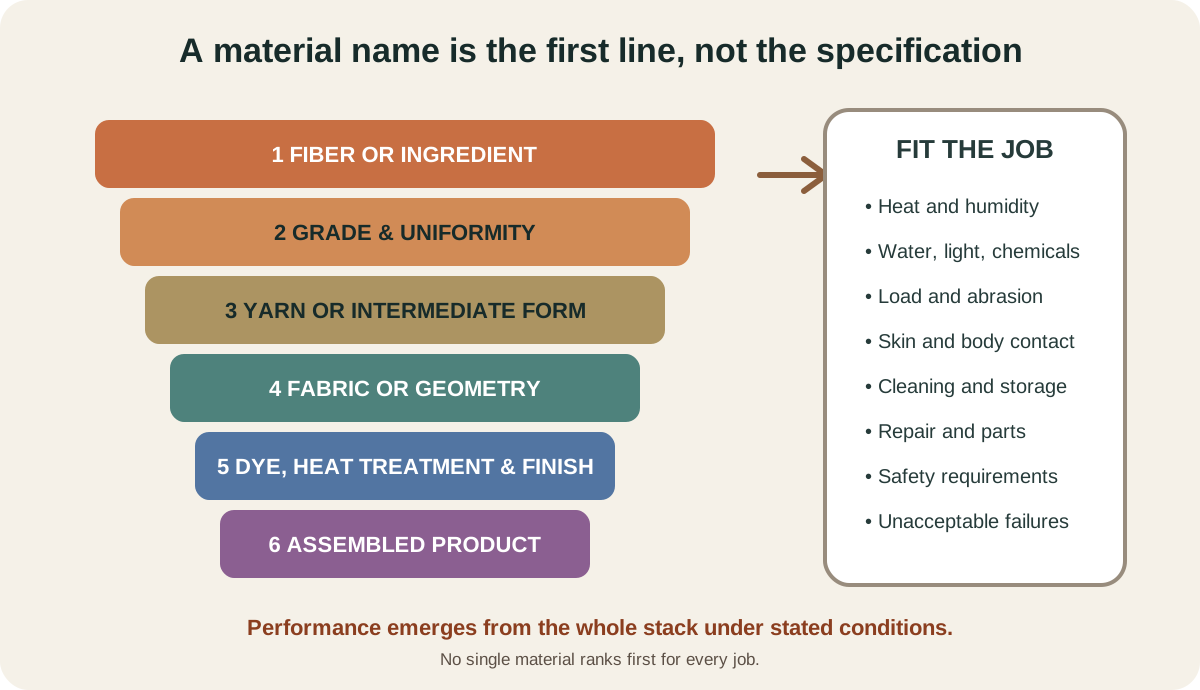
Fiber Is Not Fabric
Why '100% cotton' isn't a full description: what the U.S. fiber label requires, the layers from fiber and blend to yarn, weave or knit, density and mass, and dye and finish, two cotton shirts that behave differently, and a swatch lab.
- 6 min
- 10 steps
- 3 questions
- Lesson 4 of 49
In this lesson
- Read the label at its proper level
- BUILD a usable fabric description
- Same fiber, different behavior
- Side-by-side swatch lab
- Rule of thumb
Open alongside this lesson
-
Satin…of what? How can two “satin” products be priced so differently? #satin #fabric #education (opens in a new tab)
Use Jackson's satin comparison to practice separating fiber content from yarn, weave, weight, finish, and assembly.
-
Textile Fiber Rule (opens in a new tab)
Fiber percentages are essential identification, but they are not a complete construction or performance specification.
-
Basic Woven Fabric Designs (opens in a new tab)
See how plain, twill, and satin interlacements create different surfaces and tradeoffs even before finishing.
-
$200 for a cotton t-shirt…why? How is that even possible? #cotton #fashion #tshirt (opens in a new tab)
Treat staple length as one input property, then inspect yarn, knit, mass, finishing, sewing, labor, scale, traceability, channel, and brand before explaining the full price.
-
All silk is the same…right? How can two 100% silk products be so different in price #silk #education (opens in a new tab)
Separate fiber identity from filament quality, yarn, fabric construction, weight, dyeing, finish, assembly, and condition.
-
All cotton is the same right? Then how can two cotton shirts feel so different...? (opens in a new tab)
Use the BUILD checklist to move from a shared fiber label to yarn, construction, mass, finish, garment assembly, and care history.
Picking up where you left off.
“100% cotton,” “pure silk,” and “linen” sound like complete explanations. They are not. They identify an ingredient family, just as “made with wheat” does not tell you whether the result is a cracker, noodle, or cake.
Fineas Jackson’s satin episode makes the category error easy to see: satin is not a single fiber 1. It names a fabric construction family with a smooth surface created by relatively long yarn floats. Satin can therefore appear in products made from different fibers and at different levels of yarn, weaving, finishing, and assembly. The word is useful; it is simply answering a different question.
Playback is optional. If the player is unavailable, open the video at its source.
Read the label at its proper level
The U.S. Textile Fiber Rule requires covered products to disclose generic fiber names and percentages by weight, along with responsible-company and origin information 2. That disclosure is important. It helps prevent a synthetic product from being sold as silk and tells you the blend ratio.
But the rule does not turn a fiber label into a performance certificate. “100% cotton” does not specify:
- fiber length, maturity, strength, cleanliness, or uniformity;
- whether fibers became a fine combed yarn, a bulky open-end yarn, or something else;
- yarn size, twist, ply, or evenness;
- whether the fabric is woven or knitted, and in which structure;
- mass per area, thickness, density, stretch, or dimensional stability;
- dye method, colorfastness, softener, wrinkle treatment, coating, or compaction;
- seam type, stitch density, reinforcement, fit, or quality control.
The reliable rule is: a fiber label is an ingredients line, not the recipe or test result.
BUILD a usable fabric description
Use BUILD to expand a fiber name into five specification layers.
B — Base fiber and blend
Record generic fiber and percentage. Then ask which grade-relevant properties are known. For natural fibers, length, diameter, maturity, contamination, and strength may vary. For manufactured fibers, cross-section, filament form, crimp, and processing can matter. Do not assume “natural” always means comfortable or “synthetic” always means durable; those conclusions require a stated construction and job.
U — Units and yarns
Fibers may be spun into staple yarns or supplied as continuous filaments. Yarns differ in size, twist direction and amount, ply, texture, evenness, and hairiness. These choices influence surface, strength, drape, opacity, abrasion behavior, and cost.
A smooth filament and a fuzzy spun yarn can share a chemical fiber name while feeling and reflecting light very differently. Higher twist can add firmness or change appearance; lower twist can feel softer yet expose fibers differently. “Better” depends on the required effect.
I — Interlacement or interlooping
Woven fabric interlaces lengthwise warp and crosswise filling yarns. Knit fabric forms intermeshing loops. Within each family, geometry varies.
CottonWorks describes satin as one of the basic weaves. Long floats help create smoothness, luster, and drape, while also creating possible snagging, picking, skew, and seam-slippage concerns 3. Terminology varies: satin may refer to warp-faced construction and sateen to filling-faced or non-silk versions. Therefore, ask for the actual construction rather than policing a name in isolation.
Compare that with plain weave, where frequent interlacing produces a different surface and stability, or twill, where a diagonal interlacement pattern can change drape and abrasion behavior. None is universally highest quality.
L — Layout, density, and mass
Record fabric mass per area when available, thickness, yarn count, ends and picks for wovens, courses and wales for knits, and any stretch direction. A high thread count alone is not a universal ranking; count must be interpreted with yarn size, ply-counting convention, weave, finish, and intended use.
Weight affects opacity, warmth, drape, drying load, and abrasion life, but heavier is not automatically stronger or more comfortable. A summer layer and work apron have different targets.
D — Dye, finish, and product details
Finishing can alter hand, luster, wrinkle behavior, water response, shrinkage, stain behavior, and serviceability. CottonWorks defines chemical finishing as processes that impart desired properties and notes effects on appearance, performance, serviceability, and hand 4. Mechanical processes such as brushing, calendering, compacting, or raising can also transform a surface.
Finally, the textile becomes a product. Pattern layout, seam allowance, thread, needle damage, lining, interfacing, edge treatment, and fit can dominate service life. Fine fabric cannot rescue a seam that pulls out under normal movement.
Same fiber, different behavior
Imagine two 100% cotton shirts.
Shirt A uses a lightweight knitted jersey with a soft finish. It stretches through loop geometry, drapes casually, and may be comfortable against skin. Its dimensional stability depends on yarn, knit settings, wet-processing tension, finishing, and care.
Shirt B uses a dense woven twill. It may resist wind and surface abrasion differently, hold a sharper shape, and feel warmer or stiffer at the same fiber content. It does not need elastane to behave differently from A; structure already changed the system.
CottonWorks’ shrinkage training specifically connects dimensional change with construction parameters and forces applied during dyeing and finishing, and describes relaxation, compaction, and other treatments used to manage residual shrinkage 5. The shared cotton label cannot predict equal shrinkage.
Side-by-side swatch lab
Find two textiles with the same labeled fiber content but different construction—two cotton shirts, wool garments, polyester linings, or fabric samples. Do not damage store merchandise.
- Document: photograph labels; record fiber percentage, care, product mass, and dimensions.
- Identify: woven or knit? Plain, twill, satin, pile, or unknown? Use a magnifier and mark uncertainty.
- Observe: compare surface reflection, texture, opacity over the same background, drape over the same cylinder, and stretch in two directions.
- Recover: on owned samples, stretch each a consistent distance and see whether it returns. Do not call this a standardized test.
- Care: if you own both, mark dimensions and follow label instructions for several wash cycles. Calculate dimensional change with
change % = (after − before) ÷ before × 100. A negative result indicates shrinkage in that direction. - Specify: write one BUILD line for each. Use
unknownwhere the label and inspection stop.
Finish with two statements: “They share ___ fiber content,” and “They differ in ___ construction or treatment.” This grammar prevents sameness at one layer from swallowing difference everywhere else.
Rule of thumb
Name the layer before ranking the material. Fiber is not yarn; yarn is not fabric; fabric is not finish; finished fabric is not a well-assembled product. A useful design explanation follows the whole chain and ends with measured performance under the intended conditions.
Practice
Fiber content identifies the constituent fiber, not yarn structure, weave or knit, mass, finish, construction, or performance.
Practice
Satin is a construction term. Fiber, yarn, float pattern, density, and finish still need specification.
Practice
Same-fiber products can behave differently because performance is produced by the full material and product system.
Lesson complete
Nice work.
Sources for this lesson
- 1Fineas Jackson. Satin…of what? How can two “satin” products be priced so differently? #satin #fabric #education. Fineas Jackson on YouTube. 2026. verifiedChasing Beauty episode 12; 2:33. Used as a case or observation prompt, not as the sole authority for technical claims. Cited at: episode 12.
- 2Textile Fiber Rule. U.S. Federal Trade Commission. verifiedOfficial summary of U.S. disclosure requirements for generic fiber names, percentages by weight, responsible company, and country of processing or manufacture. Cited at: rule summary.
- 3Basic Woven Fabric Designs. CottonWorks by Cotton Incorporated. verifiedTextile construction lesson comparing plain, twill, and satin weaves and explaining satin floats, luster, drape, and snag or seam-slippage risks. Cited at: satin construction and tradeoffs.
- 4Chemical Finishing. CottonWorks by Cotton Incorporated. verifiedTextile-industry training defining finishing and explaining how it changes appearance, hand, performance, and serviceability. Cited at: finishing definition.
- 5Shrinkage and Skewing. CottonWorks by Cotton Incorporated. verifiedTechnical training on how construction, wet processing, tension, relaxation, compaction, and finishing affect dimensional stability. Cited at: construction and finishing effects.