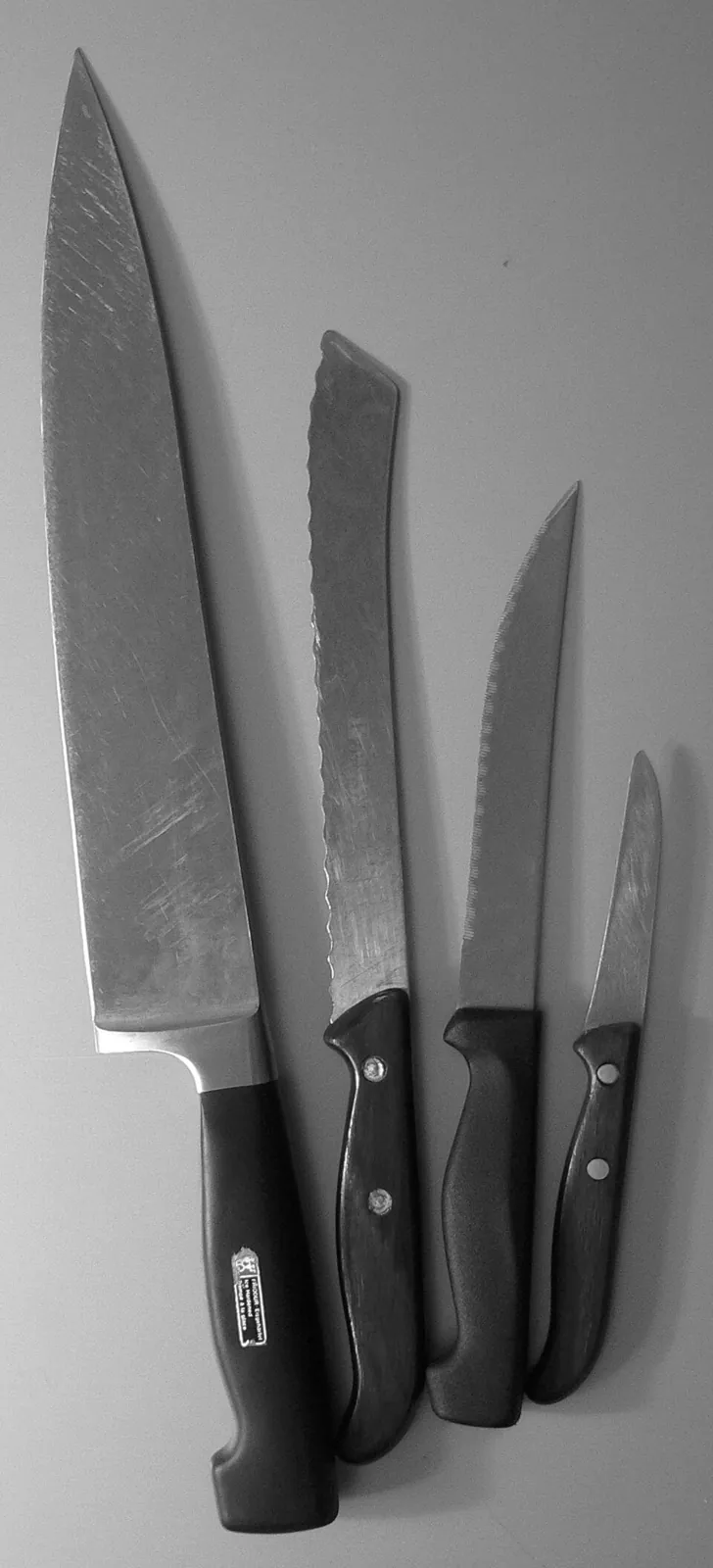
Kitchen Knives: Steel, Heat, and Geometry
What makes a kitchen knife cut: steel names as recipe families, heat treatment as the invisible step, forging versus stock removal, edge and blade geometry, what ISO 8442-5 sharpness testing shows and doesn't, and inspecting a knife safely.
- 6 min
- 9 steps
- 3 questions
- Lesson 13 of 49
In this lesson
- Steel name is a recipe family, not performance
- Heat treatment is the invisible manufacturing step
- Forged versus stock removal
- Geometry cuts
- How testing helps—and where it stops
- Use EDGE
- Safe inspection
- Rule of thumb
Open alongside this lesson
-
$2000 for Japanese kitchen knife…why? How is that even possible? (opens in a new tab)
Use the episode to identify labour and material claims, then test them against steel, heat treatment, grind, edge, fit, finish, consistency, and service.
-
Stainless Steels — Martensitic Stainless Steel and Heat Treatment (opens in a new tab)
Connect composition and heat treatment with martensite, hardness, toughness, corrosion resistance, and tradeoffs.
-
Automatic Edge Tester (opens in a new tab)
Separate initial cutting performance from accumulated cutting ability under a controlled abrasive-card method.
Picking up where you left off.
A kitchen knife is a wedge with an extremely thin working edge. The edge initiates a cut; the blade behind it separates food; the handle lets a hand guide force. Steel makes a thin geometry possible, heat treatment creates the steel’s working microstructure, grinding establishes shape, sharpening establishes the apex, and maintenance determines what survives.
Fineas Jackson’s Japanese-knife episode asks how one knife can cost $2,000 1. Rare material, specialist labour, small output, finishing, reputation, distribution, and collectibility can all contribute. None tells you how the knife will cut your onions. Translate the story into specifications.
Playback is optional. If the player is unavailable, open the video at its source.
Steel name is a recipe family, not performance
Knife steels combine iron with carbon and alloying elements that can support hardness, wear resistance, corrosion resistance, carbide formation, or processing behaviour. A name such as VG-10, AEB-L, White #2, Blue #1, 52100, or X50CrMoV15 narrows composition. It does not disclose:
.jpg)
- actual heat-treatment cycle;
- achieved hardness and variation;
- retained austenite, carbide size, decarburization, or overheating;
- blade thickness, taper, grind, edge angle, or apex finish;
- straightness, residual stress, surface condition, or consistency;
- whether the chosen properties match the user’s task.
Composition supplies possibilities. Production determines which possibilities become the blade.
Heat treatment is the invisible manufacturing step
For martensitic knife steel, a simplified route is:
- Austenitize: heat into a range where the desired structure and alloying elements are prepared for transformation.
- Quench: cool rapidly enough to form hard martensite.
- Temper: reheat below the austenite range to adjust stress, toughness, hardness, and carbide precipitation.
- Optional sub-zero or multiple treatments: manage retained phases and fine-tune the system for a specific steel and target.
The Cambridge metallurgy reference stresses that martensitic stainless steels require a balance between hardness and toughness, not hardness without limit 2. Excessively soft steel may roll or lose an edge quickly. Excessively hard or poorly supported steel may chip or fracture. Heat treatment cannot make a highly wear-resistant steel easy to sharpen, nor can it let a delicate edge survive twisting through bone.
Forged versus stock removal
Forging plastically shapes hot metal. It can efficiently move material, establish preforms, support laminated construction, and carry cultural or aesthetic value. Stock removal cuts or grinds a blade from rolled bar or sheet. It can deliver excellent consistency and geometry.
Neither route automatically creates better microstructure in a finished modern blade. Both still require sound steel, controlled thermal history, straightening, grinding, sharpening, and inspection. Decorative hammer marks demonstrate surface treatment; they do not measure heat-treatment control.
Geometry cuts
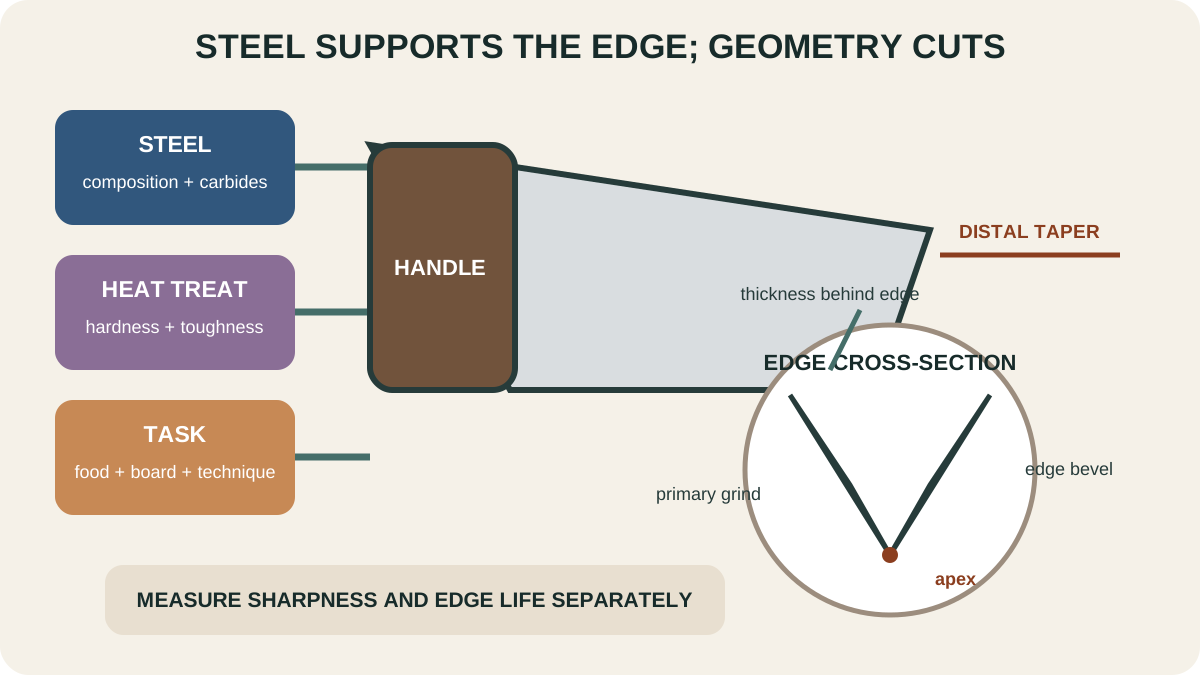
Apex
The apex is the final meeting of the two edge faces. Its radius, damage, burr state, angle, and finish strongly influence initial cutting. A polished edge can excel at push cuts; a toothier finish can engage fibrous skins. “Sharper” must name the test.
Behind-the-edge thickness
Once the apex enters food, blade thickness and wedge angle create resistance. A knife can shave hair yet split carrots violently because the blade thickens quickly behind the edge. Thin geometry can cut beautifully but may demand better technique and lower impact.
Primary grind and distal taper
Flat, convex, hollow, wide-bevel, and single-bevel geometries distribute thickness differently. Distal taper reduces thickness from heel toward tip. These choices affect stiffness, food release, steering, wedging, sharpening, and robustness.
Profile and handle
Edge curvature controls contact with the board and preferred motion. Handle shape, balance, clearance, texture, moisture response, and assembly influence fatigue and control. A beautiful blade that strikes knuckles or twists in a wet hand is not resolved.
How testing helps—and where it stops
ISO 8442-5 specifies a controlled cutting method for initial sharpness and edge retention using repeated strokes through a standardized synthetic medium 3. CATRA explains two outputs: initial cutting performance and total accumulated cut as the edge wears 4.
This is stronger than “stays sharp forever.” It still does not measure every kitchen requirement. Abrasive-card cutting may not predict chipping on hard contact, rolling during lateral load, wedging in squash, corrosion in acidic food, handle security, tip strength, or ease of resharpening.
Larrin Thomas’s controlled comparison held test-knife geometry more consistent to examine steel and heat-treatment effects, and explicitly frames edge retention against toughness 5. The method itself teaches the key lesson: control geometry before crediting steel.
Use EDGE
- E — Edge and entire geometry: Apex, angle, finish, behind-edge thickness, primary grind, taper, profile, straightness.
- D — Duty: Foods, board, motion, impact, lateral load, corrosion, sharpening skill, hand size, and acceptable fragility.
- G — Grade plus heat treatment: Steel composition, hardness range, maker’s process evidence, consistency, and known tradeoffs.
- E — Execution and ecosystem: Handle fit, grind symmetry, choil and spine finish, warranty, thinning, sharpening, repair, and replacement.
Safe inspection
Never run a finger along the edge. Do not perform destructive flex tests.
- Sight along the spine and edge under good light for gross warp.
- Place the blade gently on a flat cutting board and observe unintended rocking; protect the edge.
- Cut the foods you actually prepare and note initiation, wedging, steering, sticking, control, and fatigue.
- Photograph a small edge section under the same magnification before and after a defined number of uses.
- Record board material, food, washing, storage, and sharpening so the wear history means something.
- Judge edge stability and maintenance together: a knife you can restore safely may deliver more value than a harder blade you avoid using.
ISO’s quality framing asks whether characteristics fulfill requirements 6. Your requirement is a kitchen practice, not a metallurgy leaderboard.
Rule of thumb
Steel supports the edge; geometry does the cutting. Heat treatment connects them, manufacturing consistency repeats them, and maintenance preserves them. Pay for a controlled system that matches your food and technique—not for a steel name, forging marks, hardness number, or national story in isolation.
Practice
Initial sharpness matters at the apex, while thickness and grind behind the edge determine wedging and resistance as the blade advances.
Practice
Austenitizing, quenching, tempering, and related steps transform microstructure. The useful result depends on steel, process control, hardness target, geometry, and task.
Practice
A controlled method gives strong evidence for its stated conditions. Design judgment still requires the user’s foods, technique, board, maintenance, and failure risks.
Lesson complete
Nice work.
Sources for this lesson
- 1Fineas Jackson. $2000 for Japanese kitchen knife…why? How is that even possible?. Fineas Jackson on YouTube. 2026. verifiedChasing Beauty episode 48; 2:57. Used as a case or observation prompt, not as the sole authority for technical claims. Cited at: episode 48.
- 2H. K. D. H. Bhadeshia. Stainless Steels — Martensitic Stainless Steel and Heat Treatment. University of Cambridge, Department of Materials Science and Metallurgy. verifiedUniversity metallurgy reference explaining austenitizing, quenching to form martensite, tempering, and the necessary balance between hardness and toughness. Cited at: heat-treatment overview.
- 3ISO 8442-5:2004 — Specification for Sharpness and Edge Retention Test of Cutlery. International Organization for Standardization. 2004. verifiedOfficial abstract for a controlled forward-and-reverse cutting test using a standardized synthetic medium to measure initial sharpness and edge retention. Cited at: standard abstract.
- 4Automatic Edge Tester. Cutlery and Allied Trades Research Association. verifiedExplanation of the ISO 8442-5 test apparatus, loads, cutting medium, wear curve, and distinction between initial cutting performance and total card cut. Cited at: test principle.
- 5Larrin Thomas. Testing the Edge Retention of 48 Knife Steels. Knife Steel Nerds. 2020. verifiedControlled comparative test using standardized test knives and consistent geometry, useful for separating steel composition, heat treatment, hardness, geometry, toughness, and abrasive edge retention. Cited at: comparative study.
- 6ISO 9000:2026 — Quality management — Fundamentals and vocabulary. International Organization for Standardization. 2026. verifiedOfficial overview of the quality-management vocabulary, emphasizing consistent fulfillment of customer and regulatory requirements. Cited at: quality vocabulary.