Zippers: Precision in a Chain
How zippers work and fail: chain, slider, and stops, why 'strength' is several separate tests in YKK's published standards, installation as part of quality, a four-part zipper check, and auditing a zipper you own without damaging it.
- 5 min
- 7 steps
- 3 questions
- Lesson 12 of 49
In this lesson
- Open the mechanism
- “Strength” is several tests
- Installation is part of zipper quality
- The ZIP check
- A non-destructive zipper audit
- Rule of thumb
Open alongside this lesson
-
Why do some zippers cost so much more? They all work the same…right? #education (opens in a new tab)
Use the episode to open the mechanism, then distinguish chain type, gauge, slider, stops, tape, finish, installation, and tested performance.
-
Zipper Testing Methods (opens in a new tab)
See how chain, stops, separating unit, slider lock, and pull tab require different tests.
-
Voluntary Standards Development FAQ for Consumers (opens in a new tab)
Look for a named method, specimen, load, procedure, threshold, and result rather than the word tested by itself.
Picking up where you left off.
A zipper converts one pulling motion into repeated engagement or disengagement along a chain. That apparent simplicity depends on geometry repeated dozens or hundreds of times: element pitch, slider channels, tape position, stops, lock, pull attachment, and installation must work together.
Fineas Jackson’s zipper episode asks why one fastener can cost much more than another 1. Material is part of the answer. The deeper lesson is about tolerance chains and failure modes. A heavier metal does not rescue misaligned elements; a perfect chain does not rescue a weak stop or careless sewing.
Playback is optional. If the player is unavailable, open the video at its source.
Open the mechanism
Tape
The textile tape carries the element chain and connects it to the product. Its weave or knit, fibres, width, edge, dimensional stability, dyeing, and coating affect sewing, flexibility, colourfastness, moisture response, and load transfer.

Elements
Metal zippers clamp or form individual elements onto the tape. Moulded plastic zippers use individual polymer elements. Coil zippers form a continuous polymer spiral sewn to the tape. These are architectures, not automatic ranks.
Metal can suit a desired look and resist certain loads, but adds mass and may corrode or abrade adjacent material. Moulded elements can tolerate dirt and create bold geometry. Coil can bend easily and work on luggage or curved openings. Gauge, polymer or alloy, element geometry, pitch, and end use matter more than a folk hierarchy.
Slider
Inside the slider, a Y-shaped channel guides two rows together or forces them apart. Channel geometry and clearances must match the chain. A slider that is too loose may fail to close elements; one that is distorted or contaminated may bind. Locking sliders use a pin or spring arrangement to resist unintended movement.
Stops and separating unit
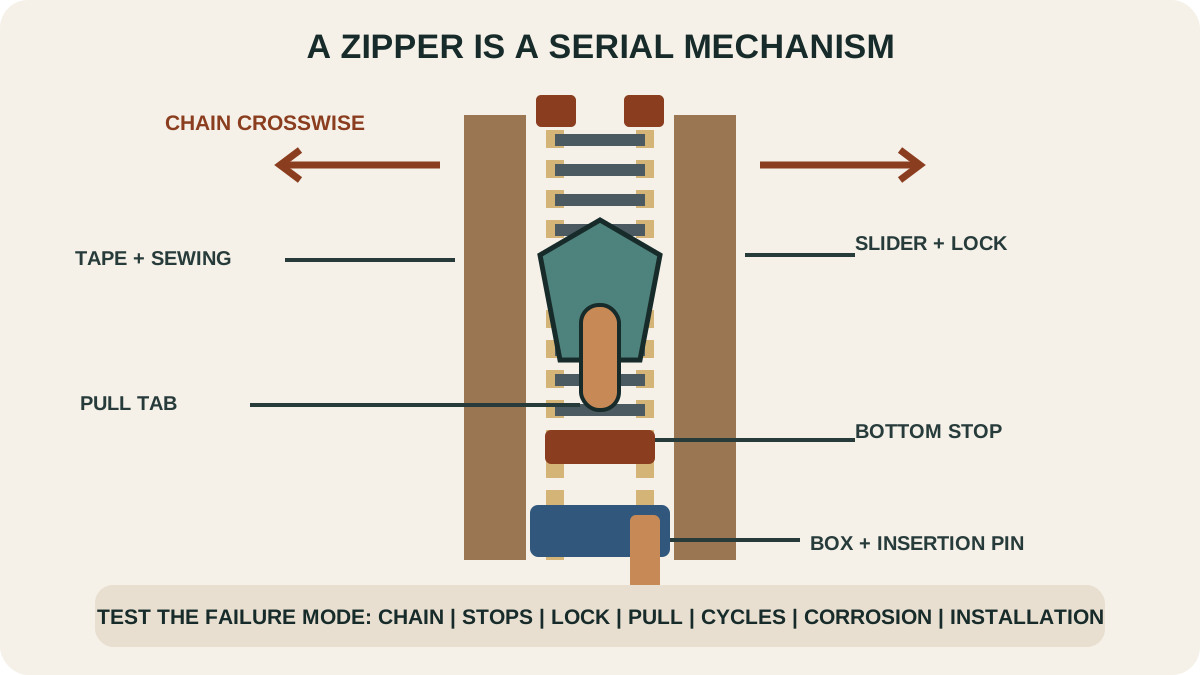
Top and bottom stops prevent the slider leaving the chain. An open-end jacket zipper adds an insertion pin and box. Each part sees a different load and can fail independently.
“Strength” is several tests
YKK publishes test descriptions based on JIS S 3015 and ASTM D2061. The list is valuable because it refuses one vague strength number 2. It includes:
- chain crosswise strength: pulling an engaged chain apart across its width;
- top-stop and bottom-stop holding strength: loading the slider against an end stop;
- separating-unit crosswise strength: pulling apart the box-and-pin region;
- slider lock strength: loading the chain while the slider lock is engaged;
- pull-tab strength: loading the tab and slider body at defined angles.
Other requirements may include repeated opening cycles, reciprocating wear, slider torque, tape shrinkage, colourfastness, corrosion, heat, laundering, salt exposure, or resistance to a stated water pressure. A result under one method cannot stand in for all of them.
NIST’s reliability distinction helps here: conformance at shipment and performance over time are related but separate questions 3. A new zipper can pass a pull test yet wear poorly after sand contamination; an old zipper can cycle well but have tape damaged by the garment.
Installation is part of zipper quality
The chain should follow the intended line without local stretching, sharp kinks, or mismatched sides. Stitching too close can interfere with the slider; too far away can reduce control of the opening. Thick seam intersections can tip the slider. Loose lining can be swallowed. An undersized zipper can carry loads the surrounding closure should have shared.
For a watertight or water-resistant zipper, coating and element geometry are only part of the barrier. End terminations, seam tape, needle holes, bends, slider parking position, and pressure requirement complete the system. “Waterproof zipper” without a test pressure and assembled-product method is incomplete.
The ZIP check
- Z — Zone and job: Jacket, trouser, boot, tent, bag, cushion, luggage, or dry suit? Record load direction, bend, dirt, laundering, water, heat, repair access, and opening frequency.
- I — Interface and installation: Chain type and gauge, tape, slider, stops, box and pin, sewing distance, alignment, backing, lining clearance, and surrounding reinforcement.
- P — Proof and prognosis: Named standards, test results, cycle claims, replaceable slider or pull, available repair, observed wear, and likely first failure.
A non-destructive zipper audit
Use an owned product.
- Photograph the entire closed chain and both ends.
- Operate it slowly with the product unloaded. Record binding location rather than yanking.
- Inspect element alignment, missing or deformed elements, slider spread, worn coating, stop movement, insertion-pin wear, tape fray, and skipped stitches.
- Repeat with the product in its normal shape and lightly loaded. A difference can reveal installation or product deformation.
- Rub pencil graphite on metal or plastic chain only if the manufacturer recommends it; do not improvise oils that can hold grit or stain tape.
- Decide whether the problem is chain, slider, stop, tape, sewing, lining, or product fit.
The CPSC explains that useful standards connect performance requirements with test methods 4. “Tested” without the method, specimen, threshold, and result is just a verb.
Rule of thumb
A zipper is as reliable as its weakest interface. Specify the job, chain, slider, stops, tape, installation, and evidence separately. Pay for the failure modes that matter—not merely for metal weight, a famous pull tab, or the word heavy-duty.
Practice
Performance depends on several components, their tolerances, and installation. Different tests isolate different failure modes.
Practice
A method and result connect a requirement to repeatable evidence; marketing adjectives and client lists do not.
Practice
Installation can distort the chain or obstruct the slider. Component quality cannot compensate for poor alignment or surrounding fabric caught in the mechanism.
Lesson complete
Nice work.
Sources for this lesson
- 1Fineas Jackson. Why do some zippers cost so much more? They all work the same…right? #education. Fineas Jackson on YouTube. 2026. verifiedChasing Beauty episode 23; 2:32. Used as a case or observation prompt, not as the sole authority for technical claims. Cited at: episode 23.
- 2Zipper Testing Methods. YKK Fastening Products Group. verifiedManufacturer test-method overview based on JIS S 3015 and ASTM D2061, covering chain crosswise strength, stop holding strength, slider lock strength, and pull-tab strength. Used as a transparent example of measurable requirements, not a universal endorsement. Cited at: test methods.
- 3Quality versus reliability. National Institute of Standards and Technology. verifiedEngineering-statistics explanation distinguishing conformance to specifications at shipment from reliability over time. Cited at: quality versus reliability.
- 4Voluntary Standards Development FAQ for Consumers. U.S. Consumer Product Safety Commission. verifiedExplains how product-safety standards define performance requirements and repeatable test methods. Cited at: standards overview.