Rotational Motion and Angular Momentum
Angular kinematics, torque and lever arms, moment of inertia, τ = Iα, rotational kinetic energy, conservation of angular momentum, and how torque, speed, and power trade off in motors, wrenches, and flywheels.
- 7 min
- 9 steps
- 3 questions
- Lesson 19 of 78
In this lesson
- Angular Kinematics
- Torque: The Rotational Force
- Moment of Inertia: Rotational Mass
- Newton’s Second Law for Rotation
- Rotational Kinetic Energy
- Angular Momentum and Its Conservation
- Torque, speed, and power in machines
- The Linear–Rotational Analogy
Picking up where you left off.
Every machine that spins — a turbine rotor, a drive shaft, a flywheel, a gyroscope — obeys the same physics as the translating bodies you have already studied. The remarkable feature of rotation is that it is the rotational analogue of linear motion: nearly every linear quantity and equation has a rotational twin. Once you see the correspondence, the entire subject follows from what you already know about kinematics, Newton’s laws, energy, and momentum 1.
Angular Kinematics
To describe a rotating rigid body, replace position with angular position \(\theta\), the angle (in radians) swept from a reference line. Its rate of change is the angular velocity
and the rate of change of angular velocity is the angular acceleration
These play exactly the roles that \(x\), \(v\), and \(a\) play in linear motion. For constant \(\alpha\), the kinematic equations carry over by direct substitution: \(\omega = \omega_0 + \alpha t\), and \(\theta = \theta_0 + \omega_0 t + \tfrac12 \alpha t^2\). A point at radius \(r\) from the axis moves with linear speed \(v = r\omega\) and tangential acceleration \(a_t = r\alpha\), which is how a rotating part transmits motion to whatever it drives 1.
Torque: The Rotational Force
A force changes linear motion; a torque changes rotational motion. Torque measures the turning effectiveness of a force and depends not only on the force’s magnitude but on where and at what angle it is applied:
where \(r\) is the distance from the axis to the point of application and \(\theta\) is the angle between \(\vec{r}\) and the force \(\vec{F}\). The factor \(r\sin\theta\) is the lever arm — the perpendicular distance from the axis to the line of action of the force. A force applied far from the axis, perpendicular to the radius, produces the most torque; a force aimed straight at the axis (\(\theta = 0\)) produces none. This is why a longer wrench loosens a stubborn bolt with less effort 1.
Quick check
τ = rF sin θ: maximize the lever arm r sin θ.
Moment of Inertia: Rotational Mass
In linear motion, mass measures resistance to acceleration. In rotation, that role belongs to the moment of inertia \(I\). Unlike mass, \(I\) depends not just on how much matter an object has but on how that matter is distributed about the axis. For a collection of point masses,
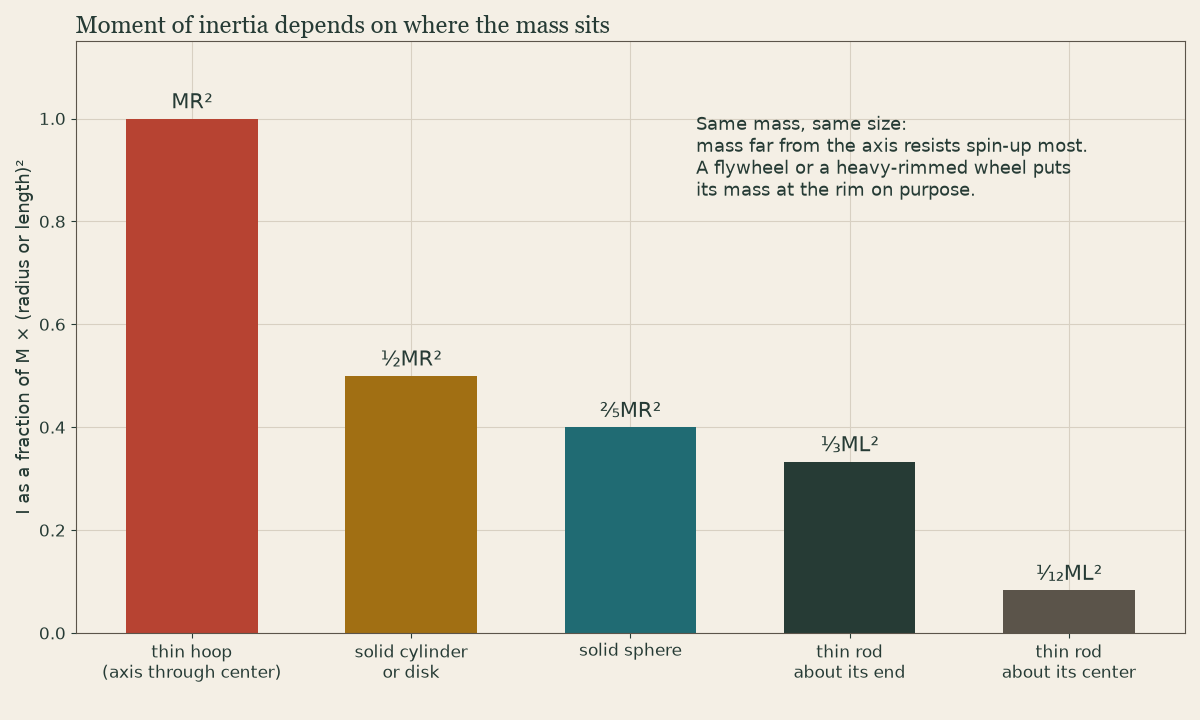
so mass farther from the axis contributes far more — the dependence is on \(r^2\). A thin hoop of radius \(R\) has \(I = MR^2\); a solid disk of the same mass and radius has only \(I = \tfrac12 MR^2\), because much of its mass sits closer to the axis. Engineers exploit this directly: a flywheel is built with its mass concentrated at a large radius to maximize \(I\) and thus its capacity to store rotational energy and smooth out fluctuations in a machine 1.
Quick check
The hoop’s I = MR² is twice the disk’s ½MR².
Newton’s Second Law for Rotation
With torque as the rotational force and moment of inertia as the rotational mass, Newton’s second law takes its rotational form:
This is the exact analogue of \(F_{net} = ma\): the net torque on a rigid body equals its moment of inertia times its angular acceleration. It governs the design of shafts and rotating machinery, where the torque a motor supplies must overcome the inertia of the load to bring it up to speed 1.
Rotational Kinetic Energy
A spinning body carries kinetic energy by virtue of its rotation:
the rotational twin of \(\tfrac12 mv^2\). Because energy scales with \(I\) and with \(\omega^2\), a flywheel spun to high angular velocity becomes a compact mechanical battery, storing energy that can later be drawn back out as useful work 1.
Angular Momentum and Its Conservation
The rotational analogue of linear momentum \(\vec{p} = m\vec{v}\) is the angular momentum
Just as linear momentum is conserved when no net external force acts, angular momentum is conserved when no net external torque acts on a system. This single principle explains a great deal of rotational behavior. The classic illustration is a spinning figure skater: with arms extended, the skater has a large moment of inertia and turns slowly. Pulling the arms inward reduces \(I\), and because \(L = I\omega\) must stay constant, \(\omega\) increases — the skater spins faster, even though no external torque was applied. The same conservation law makes a spinning gyroscope resist changes to its orientation, giving it the stability used in navigation and guidance systems 1.
Torque, speed, and power in machines
Power in rotation is \(P = \tau\omega\), the twin of \(P = Fv\). A 2 hp (1,491 W) motor spinning at 3,450 rpm (\(\omega = 361\) rad/s) delivers only about \(1491/361 \approx 4.1\) N·m of torque. A belt or gear reduction to 345 rpm multiplies the torque about tenfold, to 41 N·m, minus losses, at the same power. That’s why drill presses, lathes, and sawmills use pulleys and gears: the motor makes power at high speed, and the work needs torque at low speed.
Wrenches: torque is force times lever arm. Lug nuts specified at 100 ft·lb need about 67 lb of push at the end of an 18-inch wrench, or 100 lb on a 12-inch one. A cheater bar multiplies torque, which is how bolts get snapped.
Flywheels: a treadle lathe, a spinning wheel, or a pottery kick wheel puts mass at the rim of a heavy wheel to raise \(I\), so the uneven push of a foot becomes smooth rotation; energy stored as \(\tfrac12 I\omega^2\) carries the wheel between strokes.
Quick check
P = τω: cutting ω tenfold raises τ tenfold at constant power.
The Linear–Rotational Analogy
The unifying idea of this lesson is summarized below. Each rotational quantity behaves exactly like its linear counterpart in the equations you already know.
| Linear quantity | Rotational analogue |
|---|---|
| position \(x\) | angular position \(\theta\) |
| velocity \(v\) | angular velocity \(\omega\) |
| acceleration \(a\) | angular acceleration \(\alpha\) |
| mass \(m\) | moment of inertia \(I\) |
| force \(F\) | torque \(\tau\) |
| momentum \(p\) | angular momentum \(L\) |
Read across any row and the corresponding linear equation becomes its rotational form: \(F = ma\) becomes \(\tau = I\alpha\), \(p = mv\) becomes \(L = I\omega\), and \(\tfrac12 mv^2\) becomes \(\tfrac12 I\omega^2\). Mastering this correspondence is the key to analyzing the rotating components at the heart of mechanical engineering 1.
Lesson complete
Nice work.
Sources for this lesson
- 1University Physics, Volumes 1–3. OpenStax (Rice University). verifiedOpen calculus-based physics. Vol 1 mechanics; Vol 2 thermodynamics and electricity & magnetism; Vol 3 optics & modern physics. Cited at: Vol 1, Ch. 10–11.