Verification, FAT, SAT & Commissioning
Proving the automatic dust collection works: a bench test (the home version of a factory acceptance test) of sensors, state machine, and gate cycles with lamps standing in for the collector; an installed test (like a site acceptance test) measuring air speed in every drop with an anemometer against 3800 ft/min, response time, two tools at once, a power blip, and the manual bypass; a fault campaign; a month of logged use compared with the baseline; one fully written test case; and a punch list for release.
- 5 min
- 6 steps
- 3 questions
- Lesson 77 of 78
In this lesson
- Verification and validation
- Bench test: the home FAT
- Installed test: the home SAT
- Fault campaign
- A month of use
- Punch list and release
Picking up where you left off.
Verification and validation
Verification proves each requirement is met: did the gate confirm in under 2 seconds? Validation proves the system solves the problem in the brief: are there fewer clogs and forgotten starts than in the baseline log? Build the tests from the requirement IDs, not from whatever is easiest to demonstrate. NIST’s robotics program frames performance the same way: a capability is only real if there’s a test method and a metric someone else can repeat 1.
Bench test: the home FAT
In industry, a factory acceptance test (FAT) checks the integrated machine at the builder’s shop before it ships. The home version is a bench test, before anything is mounted to duct:
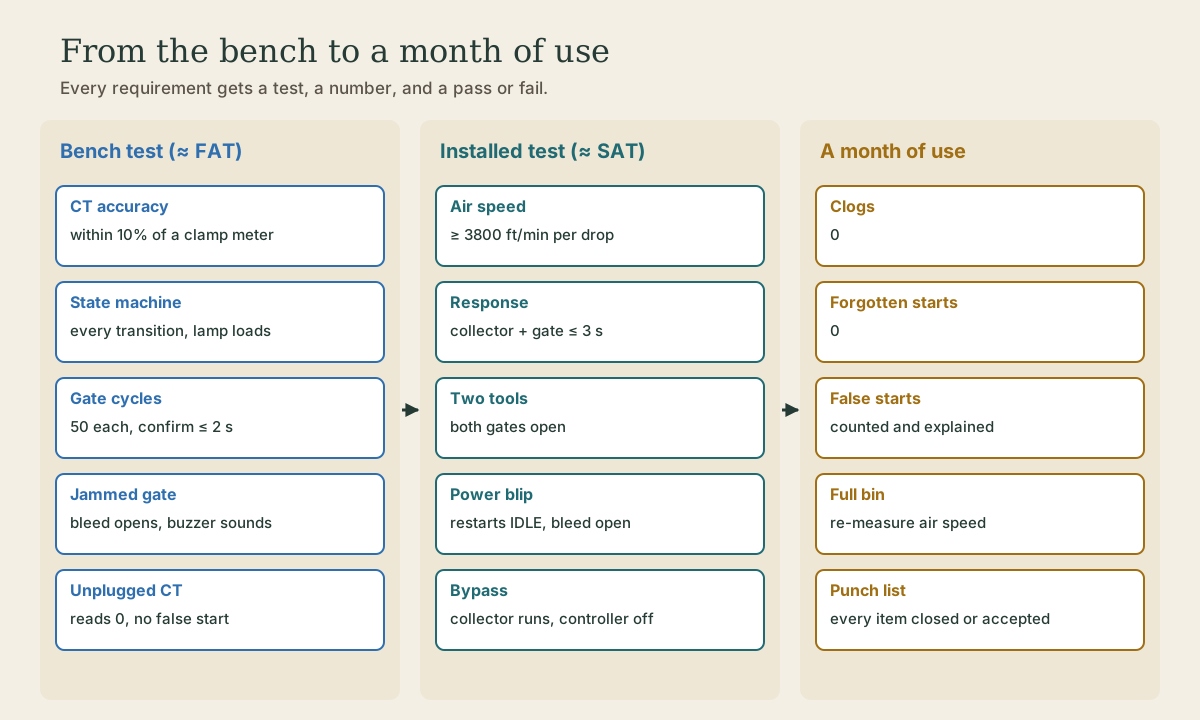
- CT accuracy: run each tool (or a heater on a test circuit) and compare the controller’s current reading with a clamp meter. Accept within 10 percent.
- State machine: with lamps standing in for the collector relay and bleed gate, drive every transition: start, second tool, one tool stops, last tool stops, spin-down, fault, reset. Check each against the state diagram.
- Gate cycles: 50 open-close cycles per gate on a dusty slide. Every one confirms open within 2 s.
- Jammed gate: hold a slide shut. The bleed gate opens and the buzzer sounds within 2 s.
- Unplugged CT: disconnect a sensor. It reads zero and nothing starts.
A simulation of the logic is useful before the bench, but it’s evidence about the model, not the hardware; NIST’s work on digital twins stresses verifying and validating models before trusting them 2. The bench test is where the model meets real parts.
Quick check
Find logic and wiring faults on the bench, where they’re cheap and safe to fix.
Installed test: the home SAT
A site acceptance test (SAT) repeats what matters with the real installation, because utilities, wiring, and the environment change behavior. Here:
- Air speed (AIR-01): drill a small hole in each 4-inch drop and measure with an anemometer, only that drop’s gate open. Accept at least 3800 ft/min, Pentz’s minimum for vertical runs 3. Multiply by area to get CFM; at 0.087 ft², 3800 ft/min is about 330 CFM. Record the readings; they’re the baseline for later.
- Response (RSP-02): start each tool 10 times, timing from switch-on to collector running with the gate confirmed. Accept at most 3 s every time.
- Two tools (GATE-03): run the saw and the router table together. Both gates open, the others stay closed.
- Power blip (SAFE-04): kill the controller’s power for a moment while running. It restarts in IDLE with the bleed gate open and the collector off.
- Bypass (MAN-05): unplug the controller. The manual switch still runs the collector.
- Inspection (ELEC-06): every line-voltage part listed and rated, every box closed, low-voltage wiring separate.
Playback is optional. If the player is unavailable, open the video at its source.
One complete test case
Write each test so someone else could run it. For SAFE-04:
- ID and requirement: SAFE-04, the collector never starts with all gates closed.
- Setup: system installed, collector plugged in, table saw running, controller in RUNNING.
- Steps: unplug the controller’s power supply for 2 s; plug it back in; watch for 30 s.
- Expected: on restart the bleed gate opens, all tool gates close, the collector stays off until a tool current is seen again, and the saw’s gate then reopens through OPENING.
- Pass/fail: any moment with the collector running and no gate confirmed open is a fail.
- Restore: stop the saw; return to IDLE.
- Record: date, code version, result, and anything odd.
Quick check
Ratings are maximums; real systems move much less, so measure.
Fault campaign
Run each fault deliberately and safely: a gate jammed shut, a limit switch unplugged, a CT unplugged, two tools started within half a second of each other, a tool started during spin-down, the bin nearly full, the controller reset in every state. For each, write what happened and whether it matched the design. A fault that does something unplanned is a finding to fix, not a failed project.
A month of use
Then validate. Keep the clipboard log for a month, the same way as the baseline:
- Clogs: target zero (baseline: 2 in two weeks).
- Forgotten starts and wrong gates: target zero (baseline: 15 in 64 starts).
- False starts: count and explain every one (a CT picking up another load? a threshold too low?).
- Full bin: re-measure air speed in one drop with the bin nearly full to see how much it falls, and set the emptying schedule from that.
Quick check
Validation asks whether the system fixed the problem the brief measured.
Punch list and release
Keep a punch list of everything found, with a severity: blocks use (a safety function failed), fix soon (a nuisance false start), or accepted (a known limitation, written down). Release the system for everyday use only when every safety test passes, every blocking item is closed, the code version in the controller matches the notebook, and the unplug rule is tagged on the collector.
Gate 5
Pass when every requirement has recorded evidence, the month’s log beats the baseline, every fault behaved as designed or was fixed, and the punch list has no blocking items.
Lesson complete
Nice work.
Sources for this lesson
- 1Robotic Systems for Smart Manufacturing Program. National Institute of Standards and Technology. verifiedMeasurement science, performance metrics, test methods, interoperability, planning, agility, and collaborative workcell integration.
- 2Digital Twins for Advanced Manufacturing. National Institute of Standards and Technology. verifiedRequirements, synchronization, interoperability, verification, validation, uncertainty quantification, and trustworthy manufacturing twins.
- 3Bill Pentz. Dust Collection Ducting. Bill Pentz Cyclone and Dust Collection Research. verifiedSmall-shop stationary tools need about 350 CFM to collect visible chips and about 1000 CFM for good fine-dust collection. Design air speed about 4000 FPM in vertical runs and 3000 FPM in horizontal runs (3800 minimum vertical, 2800 horizontal; 4500 for large chips). A 1.5 hp collector rated 1100 CFM maximum actually moves about 785 CFM through 6-inch duct, 550 through 5-inch, and 350 through 4-inch. Doubling airflow takes about four times the static pressure and much more horsepower. Thin 30-gauge duct can collapse if the system starts with no blast gates open. Static charge on PVC can shock you but experts find it insufficient to cause an explosion in hobby systems.