Vibration: Mounting a Compressor and a Dust Collector
Why a machine on rubber pads can shake the floor more, not less: natural frequency from static deflection (fn ≈ 15.76 / √δ in mm), the transmissibility curve with isolation starting at a frequency ratio of 1.41, worked mounts for a 3,450 rpm dust collector (pads work) and a slow compressor pump (pads barely help, springs needed), stiffening a stand that buzzes at one speed, and measuring damping by tapping and counting.
- 6 min
- 7 steps
- 4 questions
- Lesson 38 of 78
In this lesson
- Natural frequency from a ruler
- The transmissibility curve
- Worked mounts
- A stand that buzzes at one speed
- Tap and count
- Try it
Picking up where you left off.
Every machine that spins shakes a little, because no rotor is perfectly balanced. The question is where that shaking goes. Put a machine on soft feet and you can stop most of it from reaching the floor, or you can make it much worse. Which one you get depends on a single number: the frequency ratio.
Natural frequency from a ruler
Anything sitting on springy mounts has a natural frequency, the rate it bounces at if you push it down and let go: fn = (1/2π)√(k/m) 1. You don’t need to know k or m separately. Under gravity the mounts compress by a static deflection δ = mg/k, and substituting gives
fn ≈ 15.76 / √δ (fn in Hz, δ in mm)
So a ruler is enough. Measure how far the machine sinks into its mounts:
| Static deflection | Natural frequency | Typical mount |
|---|---|---|
| 1 mm | 15.8 Hz | thin pad |
| 4 mm | 7.9 Hz | rubber feet |
| 25 mm | 3.2 Hz | steel springs |
The more the mounts compress under the machine’s weight, the lower the natural frequency and the better they isolate 2.
Quick check
fn ≈ 15.76 / √4 ≈ 7.9 Hz. The mass cancels out: static deflection already contains it.
The transmissibility curve
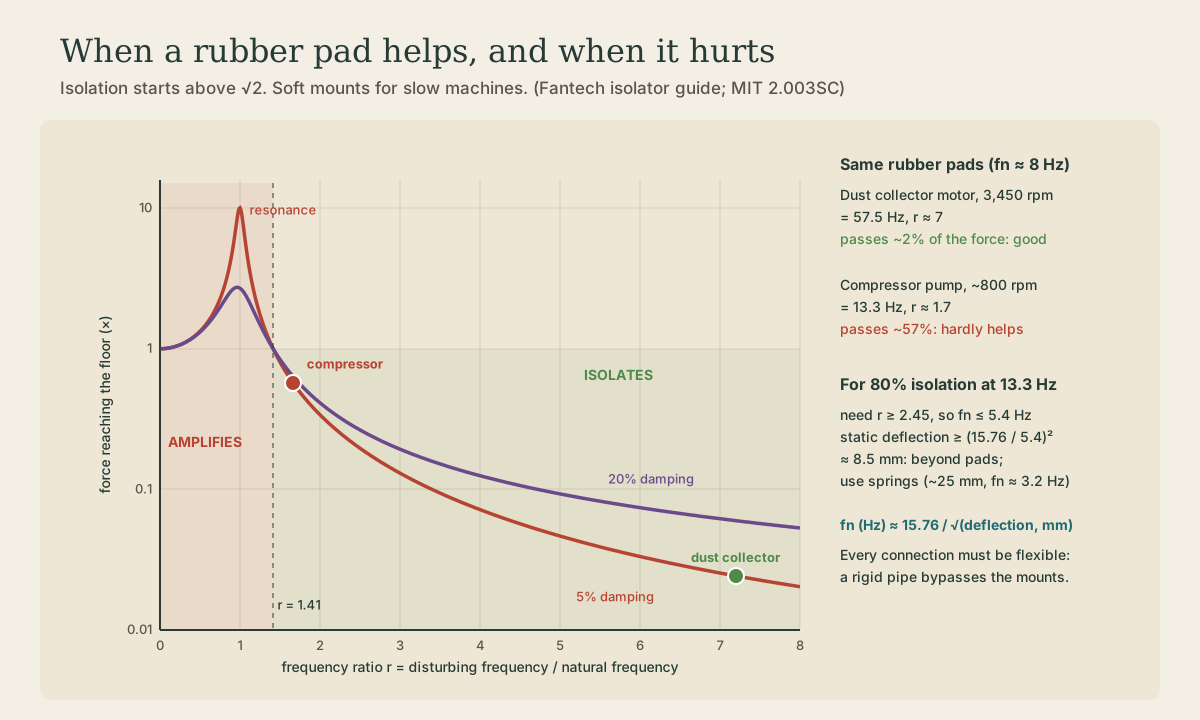
The disturbing frequency is how fast the machine shakes, usually its lowest running speed: 3,450 rpm is 57.5 Hz, 1,725 rpm is 28.75 Hz. Divide it by the natural frequency to get the ratio r. Transmissibility is the fraction of the shaking force that gets through to the floor 1:
- r well below 1: the mount acts almost rigid; everything gets through.
- r = 1: resonance. The machine bounces on its mounts and the force reaching the floor is multiplied: about 10 times with light damping.
- r = 1.41 (√2): break-even. Below this the mounts make things worse.
- r above 1.41: isolation. At r = 2.45 about 80% is blocked, at r = 3.3 about 90%, and it keeps improving from there.
Damping trades one end for the other. More damping (20% instead of 5%) cuts the resonance peak from about 10× to under 3×, but lets a little more through at high ratios. Every machine passes through resonance briefly while starting and stopping, so a little damping keeps that from being violent.
Fantech’s guide suggests about 80% isolation for workshops and garages and 95% or more next to offices or bedrooms, with more needed on a flexible upper floor than on a slab 2.
Quick check
Below √2 ≈ 1.41 the mounts amplify; at 1.0 they resonate.
Worked mounts
Dust collector, 3,450 rpm (57.5 Hz), on rubber pads. The pads compress about 4 mm, so fn ≈ 8 Hz and r ≈ 7. Transmissibility is about 1 / (r² − 1) ≈ 2%. The pads block nearly all of it, and that’s an easy win.
Belt-drive compressor, pump at about 800 rpm (13.3 Hz), on the same pads. Now r ≈ 1.7, just past break-even, and about 57% of the shaking still gets through. The motor spins fast, but the pump’s pistons are the big unbalanced mass, and they turn slowly. The fix is to work backward from the target:
- 80% isolation needs transmissibility 0.2, so r² − 1 = 5 and r ≈ 2.45.
- fn ≤ 13.3 / 2.45 ≈ 5.4 Hz.
- δ ≥ (15.76 / 5.4)² ≈ 8.5 mm of static deflection.
That’s more than rubber pads give. You need spring mounts or high-deflection mounts sized for the load at each corner. Fantech’s chart pairs low-speed equipment with 25 mm springs 2.
Three things undo isolation 2:
- Rigid connections. A hard-piped air line or a bolted duct carries vibration straight past the mounts. Use a short flexible hose or a flexible duct cuff.
- Uneven loading. Choose mounts so each corner deflects the same amount, or the machine rocks.
- Top-heavy machines on a narrow base. Spread the mounts out, using outriggers if needed, so soft mounts don’t let the machine tip and sway.
Quick check
Slow machines need soft mounts: for 80% isolation at 13.3 Hz you need about 8.5 mm of static deflection or more, which means springs.
A stand that buzzes at one speed
Sometimes you can’t isolate, for example a drill press or lathe with a variable-speed motor where some speed lands right on the stand’s own natural frequency. At that speed the sheet-metal stand roars, then calms down above and below it. That’s resonance in the structure, not in the mounts.
Then you go the other way: make the structure stiff so its natural frequency is well above any running speed, putting you on the far left of the curve. Add diagonal bracing, fill a hollow stand with sand, bolt it to the floor, or add mass low down. Or simply avoid running at that speed.
Playback is optional. If the player is unavailable, open the video at its source.
Tap and count
Damping is easy to measure. Tap the structure (or bump the machine on its mounts) and watch or record the ringing. Count how many cycles it takes for the swing to drop to half. For light damping:
ζ ≈ 0.11 / N
Halving in 1 cycle is about 11% damping, in 2 cycles about 5%, in 10 cycles about 1%. A phone’s slow-motion video or a vibration app makes counting easy. Lightly damped structures with long ringing are the ones that make trouble at resonance.
Quick check
ζ ≈ 0.11 / N, where N is the number of cycles to halve: 0.11 / 2 ≈ 0.055.
Try it
Pick the noisiest machine in the shop. Find its lowest running speed in hertz (rpm / 60). Measure how far it sinks into its feet and compute fn. Is r above 2.5? If not, work out the static deflection you’d need, and check what’s rigidly connected to it.
Lesson complete
Nice work.
Sources for this lesson
- 1Engineering Dynamics. MIT OpenCourseWare. verifiedOCW Scholar course with lectures, worked problems, assignments, and exams on kinematics, rigid-body dynamics, and vibration.
- 2Vibration Isolators: introduction and isolation efficiency chart. Fantech. 2024. verifiedIsolation depends on static deflection of the mounts; chart relating disturbing frequency (rpm), required isolation efficiency, natural frequency, and static deflection; 80% normally fine for workshops and factories, 90% general, 95% critical, 98% very critical; select springs by static deflection, rubber by dynamic natural frequency; all connections to isolated equipment must be flexible; uniform deflection; wide mounting base or outriggers for top-heavy machines; rigid base.