Requirements, Architecture Options & Concept Review
Turning the dust-collection brief into requirements that a test can fail: airflow checked with Q = V × A against Pentz's 4000 ft/min and 350 CFM figures, response time, gate logic, never starting with all gates closed, a manual bypass, and a line-voltage boundary. Then three concepts (manual gates with a remote switch, a listed current-sensing switch, full automation) scored openly, a sensitivity check that shows the choice is fragile, and the decision record.
- 6 min
- 5 steps
- 3 questions
- Lesson 74 of 78
In this lesson
- Why gate position matters
- Write requirements that can fail a test
- Generate three concepts
- Score the concepts openly
- Review and record the decision
Picking up where you left off.
Why gate position matters
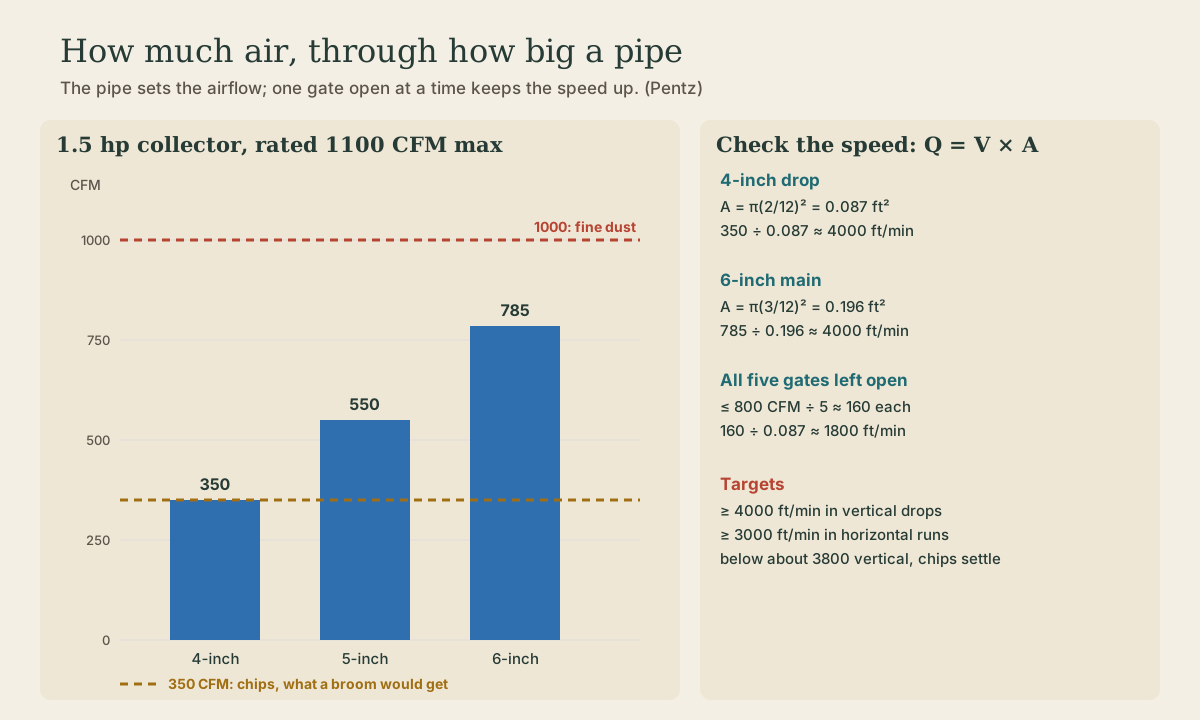
The first requirement comes from physics, so start there. Bill Pentz’s measurements of small-shop systems give the numbers 1:
- Stationary tools need about 350 CFM to collect the visible chips and sawdust a broom would get, and about 1000 CFM for good fine-dust collection.
- To keep chips moving, air in vertical duct should run about 4000 ft/min (3800 at least) and about 3000 ft/min in horizontal runs (2800 at least).
- A typical 1.5 hp collector rated at 1100 CFM really moves about 785 CFM through 6-inch duct, 550 through 5-inch, and 350 through 4-inch.
Check the speeds with Q = V × A. A 4-inch duct’s area is π(2/12)² ≈ 0.087 ft², so 350 CFM in a 4-inch drop is 350 ÷ 0.087 ≈ 4000 ft/min: just enough. The 6-inch main at 785 CFM is 785 ÷ 0.196 ≈ 4000 ft/min too. Now leave all five gates open. The main still can’t carry much more than about 800 CFM, which splits five ways to about 160 CFM per drop, or 160 ÷ 0.087 ≈ 1800 ft/min. That’s far below the speed that keeps chips airborne in a vertical drop, so they settle and the planer’s hose clogs. The baseline log’s “gates left open” count and its clogs are the same problem.
So: one gate open per running machine, the rest closed. And one more constraint from the same source: thin duct can collapse if the collector starts with no gate open 1. The system must never do that.
Quick check
Q = V × A, and a 4-inch circle is about 0.087 square feet.
Write requirements that can fail a test
A useful requirement names one thing to measure, the conditions, a limit, and how it’ll be checked. “The system shall be fast and reliable” can’t fail anything. Each requirement gets an ID so tests can point back to it:
| ID | Requirement | Source | Verification |
|---|---|---|---|
| AIR-01 | With only its gate open, air speed in each 4-inch drop ≥ 3800 ft/min | Pentz | anemometer, installed |
| RSP-02 | Collector running and the tool’s gate confirmed open ≤ 3 s after tool start | brief | stopwatch, 10 starts per tool |
| GATE-03 | While the collector runs, every running tool’s gate is open and all others closed | airflow check | observation, 2-tool test |
| SAFE-04 | The collector never starts with all gates closed, including after a power blip | Pentz | fault test |
| MAN-05 | The collector can be run by a manual switch with the controller unplugged | brief | demonstration |
| ELEC-06 | All line-voltage switching through listed devices rated for the motor; DIY electronics ≤ 12 V DC | brief | inspection |
| FALSE-07 | No collector start from other loads (lights, heater, radio) over one week | brief | log |
| OFF-08 | Collector stops 10 ± 2 s after the last tool stops | brief | stopwatch |
Keep four kinds of statement apart: a need (fewer clogs and less fine dust), a constraint (listed devices for line voltage), an assumption (a gate slide takes about 12 N to move; test it), and a design decision (servos or linear actuators). Mixing them lets a favorite solution pose as a requirement. NIST’s work on robotic manufacturing puts the same weight on stating performance so that someone else can measure it 2.
Quick check
It names what’s measured, the limit, and implies the test: start a tool and time it.
Generate three concepts
Always generate more than one, including a simple one:
- A. Manual gates with a remote switch: a key-fob remote for the collector. Cheapest; still depends on remembering the gate.
- B. A listed current-sensing switch: a bought switch that starts the collector whenever one tool’s outlet draws current, with manual gates. Fixes forgotten starts for that tool; gates still manual.
- C. Full automation: a current sensor on each tool circuit, an actuator and limit switch on each gate, a low-voltage controller, and a listed motor-rated relay or contactor for the collector. Fixes forgotten starts and gate errors; the most to build and maintain.
Do rough numbers only as precise as the decision needs: can a hobby actuator move the gate (next lesson), can a current sensor see an idling tool, does the collector have enough air for one drop at a time (yes, above).
Score the concepts openly
Weight the criteria, score each concept 1 to 5, and show the arithmetic:
| Criterion | Weight | A | B | C |
|---|---|---|---|---|
| No forgotten gates or starts | 30% | 1 | 3 | 5 |
| Cost | 20% | 5 | 4 | 2 |
| Reliability and upkeep | 20% | 5 | 4 | 3 |
| Electrical safety | 20% | 5 | 5 | 3 |
| Learning value | 10% | 1 | 2 | 5 |
| Total | 3.4 | 3.7 | 3.6 |
B wins narrowly. Now the sensitivity check: move 10 points of weight from cost to learning value, and A drops to 3.0, B to 3.5, and C rises to 3.9 and wins. A 10-point shift flips the decision, so the weights are the decision. For a capstone whose purpose is to practice integrating mechanics, sensing, and control, learning value deserves the higher weight, and C is chosen, with one change that raises its safety score: buy the line-voltage half (a listed relay or contactor with a low-voltage coil) and build only the low-voltage half. Say that openly in the review rather than tuning the numbers until C wins.
Quick check
When a small weight change flips the winner, the weights are the real decision.
Review and record the decision
Write a short decision record: concept C chosen; A and B rejected and why; the decisive evidence (the airflow check and the log); open assumptions (gate force, current-sensor signal at idle); and what would reopen the decision (for example, if the gate actuators prove unreliable in a month of use, fall back to B plus labeled gates). MIT’s project courses close each design stage the same way, with evidence and a decision instead of a rendering 3.
Gate 2
Pass when every requirement has a verification method, the chosen concept covers all of them, the line-voltage boundary is settled, and each risky unknown (gate force, sensor signal) has a small experiment planned before detailed design.
Lesson complete
Nice work.
Sources for this lesson
- 1Bill Pentz. Dust Collection Ducting. Bill Pentz Cyclone and Dust Collection Research. verifiedSmall-shop stationary tools need about 350 CFM to collect visible chips and about 1000 CFM for good fine-dust collection. Design air speed about 4000 FPM in vertical runs and 3000 FPM in horizontal runs (3800 minimum vertical, 2800 horizontal; 4500 for large chips). A 1.5 hp collector rated 1100 CFM maximum actually moves about 785 CFM through 6-inch duct, 550 through 5-inch, and 350 through 4-inch. Doubling airflow takes about four times the static pressure and much more horsepower. Thin 30-gauge duct can collapse if the system starts with no blast gates open. Static charge on PVC can shock you but experts find it insufficient to cause an explosion in hobby systems.
- 2Robotic Systems for Smart Manufacturing Program. National Institute of Standards and Technology. verifiedMeasurement science, performance metrics, test methods, interoperability, planning, agility, and collaborative workcell integration.
- 3Design and Manufacturing I. MIT OpenCourseWare. verifiedProject-centered course on electromechanical design, machine elements, experiments, drawings, modeling, fabrication, and technical review.