Worker Participation, Human Factors & Job Design
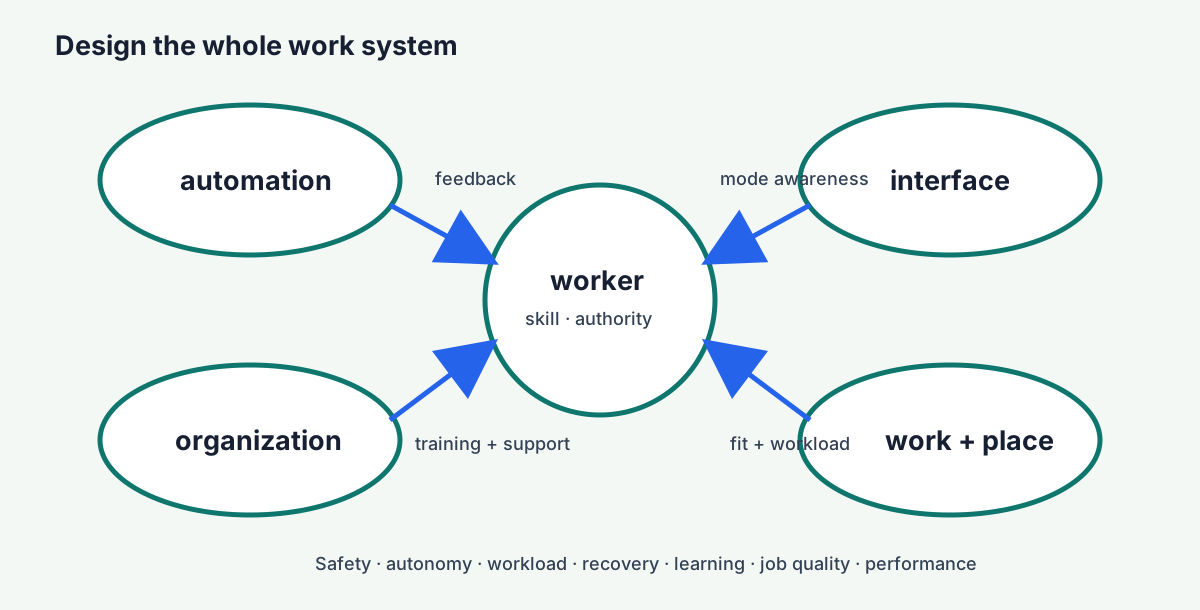
Automation with people in it: why the palletizer operators belong on the design team (they know the jams, the bad cardboard, the workarounds), deciding on purpose which jobs stay with people, an operator screen that answers 'what's wrong and what do I do,' and redesigning the job into a cell tender role rather than only counting heads.
- 4 min
- 4 steps
- 3 questions
- Lesson 69 of 78
In this lesson
- The people who know
- Who does what
- A screen that helps
- Redesign the job
Picking up where you left off.
The people who know
The operators who stack those cases every day know things no drawing shows: which cardboard crushes, how the sealer jams, the trick of tipping a case to free it, which pallet supplier’s boards are warped. MIT’s Work of the Future task force argues that technology’s effect on workers depends on choices about how it’s deployed, and that good outcomes come from involving workers and investing in their skills 1.
In practice:
- Put two operators from different shifts on the project team from the first study, not after the purchase.
- Bring them to the supplier’s factory test and let them run it.
- Ask them to try to break it: feed a crushed case, stop the forklift, change patterns mid-pallet.
Quick check
Their knowledge prevents designs that fail on day one.
Who does what
Decide on purpose which tasks go to the machine and which stay with people. A common split for the palletizer:
| Task | Robot | Person |
|---|---|---|
| Pick and stack good cases | ✔ | |
| Detect crushed or mislabeled cases | camera flags it | decides rework or scrap |
| Pallet change | ✔ (or a pallet dispenser) | |
| Pattern changeover | runs the stored program | selects it, verifies the first layer |
| Jam recovery | stops safely | clears it from outside the cell |
| Watching trends, improving | logs data | reviews and suggests changes |
Two traps. Leaving people only the leftovers (the jams and the odd jobs) makes a worse job than the one before. And leaving people to watch a machine for hours waiting for a rare failure is something humans do badly; give the tender real work between interventions.
Quick check
Give machines the repetitive work and people the judgment, on purpose.
A screen that helps
When the cell stops, the operator needs three answers fast: what stopped it, where, and what to do. “Stopped: case jammed at infeed photoeye PE-3. Open the infeed access door; the robot will stay stopped while it’s open.” Not “Fault 0x2F.”
Keep the layout the same on every screen, put the active alarm and its fix at the top, and show the cell state (running, waiting for pallet, stopped) where it can be read from 10 feet away. NIOSH’s robotics research center studies exactly these human–robot interaction questions as robots move closer to workers 2.
Quick check
An interface is for acting, not for admiring data.
Redesign the job
The old job was lifting. The new job, cell tender, is different: changeovers, quality calls, first-line troubleshooting, keeping the pallet and label supplies flowing, and reporting what breaks. It needs training (a half-day on the robot’s screens and safe recovery, more for the person who’ll do programming changes) and it should pay like a skilled job, because it is one.
If the automation frees a full position, decide in advance where that person goes. Plants that redeploy people into open jobs keep the trust they’ll need for the next project.
Try it
For the job you studied, write the who-does-what table and the five alarm messages operators will see most often, each saying what happened, where, and what to do.
Lesson complete
Nice work.
Sources for this lesson
- 1The Work of the Future - Building Better Jobs in an Age of Intelligent Machines. MIT Task Force on the Work of the Future. 2020. verifiedTask-level account of automation, new work creation, skills, technology diffusion, job quality, institutions, and shared prosperity. Cited at: task automation and new work.
- 2Center for Occupational Robotics Research. National Institute for Occupational Safety and Health. verifiedResearch on traditional, collaborative, mobile, wearable, autonomous, and other robots used by or near workers.
Further reading
- Collaborative Robotics. Stanford University. verifiedProject-based course on task objectives, perception, control, teammate modeling, communication, consensus, and human-robot collaboration.