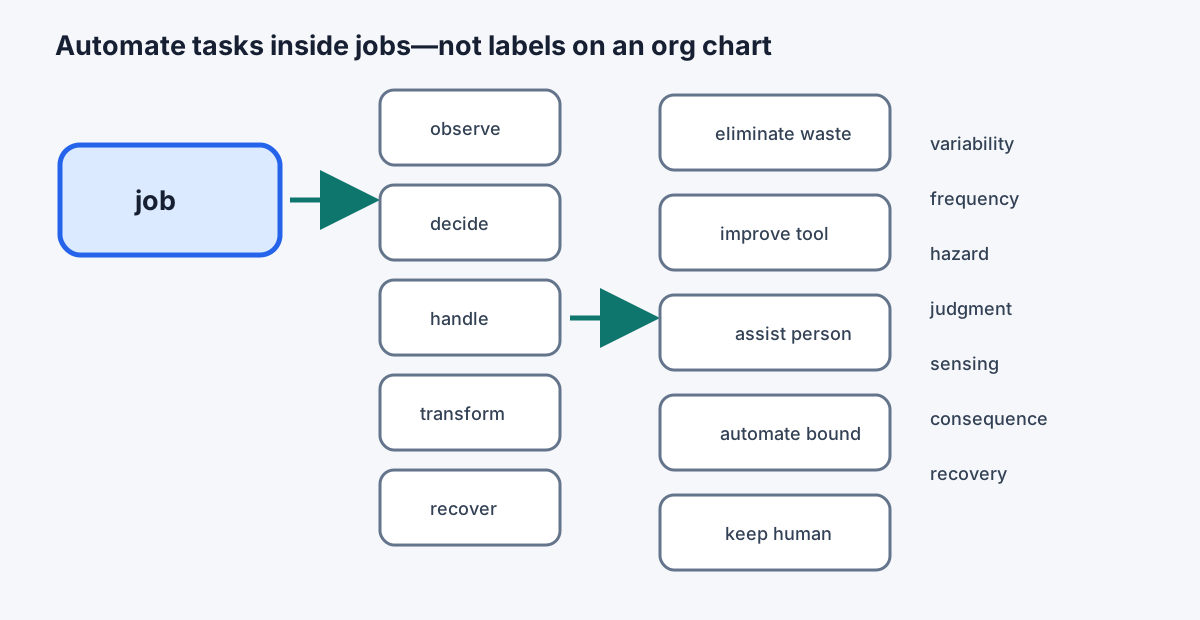
Observe the Task Before Automating It
Start with the work, not the robot. A worked case: one person stacking 44-pound cases of cheese from a conveyor onto pallets at the end of a packaging line. Watching 30 cycles across shifts, timing each step, separating the lifting from the walking, waiting, and jam-clearing, checking the lifts against the NIOSH lifting equation, and choosing among five fixes, of which a robot is only one.
- 5 min
- 5 steps
- 3 questions
- Lesson 67 of 78
In this lesson
- The job
- Watch the job
- The lifting
- What the robot would have to do
- Five ways to fix a job
Open alongside this lesson
-
The Work of the Future - Building Better Jobs in an Age of Intelligent Machines (opens in a new tab)
Use its task-level framing to challenge job-replacement shortcuts.
-
Robotic Systems for Smart Manufacturing Program (opens in a new tab)
Translate desired capability into measurable requirements and tests.
Picking up where you left off.
The job
A cheese plant’s packaging line ends at a conveyor. Cases of shredded cheese, each about 20 kg (44 lb), come off a case sealer at 6 a minute. One person picks each case off the conveyor, turns, and stacks it on a wooden pallet, 5 cases to a layer, 8 layers high. Then they wrap the pallet, call the forklift, and slide in an empty one. Management asks: can a robot do this?
MIT’s Work of the Future task force studied questions like this one across industries and found that automation changes tasks, not whole jobs, takes years to spread, and goes along with new kinds of work 1. So the first step isn’t picking a robot. It’s finding out what the job actually is.
Watch the job
Sit with the operators for 30 cycles on each shift, including the night shift, a product changeover, and a day the line ran short-staffed. Time each step. A summary might look like this:
| Task | Share of the shift | Notes |
|---|---|---|
| Pick and stack cases | 55% | lifts from belt height to floor and to chest height, with a twist |
| Wrap and label pallet | 12% | walk around the pallet with a stretch-wrap roll |
| Pallet change, wait for forklift | 10% | line backs up if the forklift is late |
| Clear jams at the case sealer | 9% | about 4 times a shift, 6 minutes each |
| Fix crushed or mislabeled cases | 6% | judgment: rework or reject |
| Waiting, other | 8% |
Ask the operators what makes a bad day. They’ll tell you things the timing sheet won’t: cases from one supplier’s cardboard crush on the bottom layer; the sealer jams when the tape roll is nearly empty; the last two layers are the ones that hurt.
Quick check
An automation concept built from one smooth hour will fail on the first jam.
The lifting
The stacking is the hazard. NIOSH’s lifting equation gives a recommended weight limit: start with a load constant of 23 kg (51 lb), the most nearly anyone can lift all day under ideal conditions, then multiply by factors that shrink it for how far the load is from the body, how low or high the hands start, how far it travels up or down, how much the person twists, how often they lift, and how good the grip is 2. The lifting index is the actual weight divided by that limit; above 1 means increased risk of back injury 2.
A 44 lb case lifted 6 times a minute, from a belt to a pallet on the floor, with a twist, starts close to the 51 lb ideal limit and loses ground on every factor. Measure the real distances and run the numbers: the bottom layers and the top layer will come out worst. That’s useful, because it tells you which lifts any fix has to remove first.
Quick check
A lifting index (load ÷ recommended limit) above 1 means increased risk.
What the robot would have to do
Split what you watched into kinds of work:
- Repetitive, predictable handling: picking identical cases and placing them in a fixed pattern. A good automation candidate.
- Support work: wrapping, labeling, pallet change. Can be automated separately (stretch wrappers and pallet dispensers exist) or stay manual.
- Judgment and recovery: deciding whether a crushed case is reworked or scrapped, clearing jams. Hard to automate and easy to forget.
Recovery deserves its own line in the study. If a robot picks a case in 4 seconds but a mis-pick takes a skilled person 8 minutes to sort out, the jam rate matters more than the robot’s speed.
Five ways to fix a job
- Eliminate the task: fix why the sealer jams (tape-roll sensor, a better cardboard spec).
- Simplify it: a pallet on a scissor lift or turntable keeps every lift near waist height and removes the twist.
- Help the person: a vacuum lift assist takes the weight.
- Automate part of it: a robot stacks, a person handles pallets, labels, and rejects.
- Automate the whole bounded task, and create the new work it needs: cell tending, maintenance, changeover programming.
Usually the answer is a mix, and the cheap fixes (1 and 2) come first, because automating a process that jams four times a shift just builds the jams into steel.
Try it
Pick a job you know (a workshop, a kitchen, a loading dock). Watch it for an hour, time the steps, and fill in the table above. Mark which tasks are handling, support, and judgment, and write one fix from each of the five categories.
Quick check
Eliminate and simplify first; automating a broken process hardens it into equipment.
Lesson complete
Nice work.
Sources for this lesson
- 1The Work of the Future - Building Better Jobs in an Age of Intelligent Machines. MIT Task Force on the Work of the Future. 2020. verifiedTask-level account of automation, new work creation, skills, technology diffusion, job quality, institutions, and shared prosperity. Cited at: task automation and new work.
- 2NIOSH Lifting Equation: Calculating Recommended Weight Limit (RWL). Canadian Centre for Occupational Health and Safety. verifiedRWL = LC x HM x VM x DM x AM x FM x CM, with a load constant of 23 kg (about 51 lb) under ideal conditions, reduced by multipliers for horizontal reach, hand height at the start, vertical travel, twisting (asymmetry), lift frequency and duration, and grip quality. The lifting index is the actual load divided by the RWL; above 1 means increased risk.
Further reading
- Center for Occupational Robotics Research. National Institute for Occupational Safety and Health. verifiedResearch on traditional, collaborative, mobile, wearable, autonomous, and other robots used by or near workers.
- Robotic Systems for Smart Manufacturing Program. National Institute of Standards and Technology. verifiedMeasurement science, performance metrics, test methods, interoperability, planning, agility, and collaborative workcell integration.