Safety, Human Work & Lifecycle Economics Package
The hazards automatic dust collection creates and how the design answers each: line voltage kept in listed devices, never starting against closed gates, a collector that now starts by itself (unplug it before emptying the bin, unplug the controller before clearing a gate), dust as a fire load, and complacency. Then the human side (what you stop checking), honest economics (about 11 minutes a week saved; the real payoff is fewer clogs and less fine dust), keeping it working without a network, and how the same package looks in a workplace.
- 5 min
- 5 steps
- 3 questions
- Lesson 76 of 78
In this lesson
- The safety file
- Human work: what changes for the person
- The economics, honestly
- Data and networks
- If this were a workplace
Picking up where you left off.
The safety file
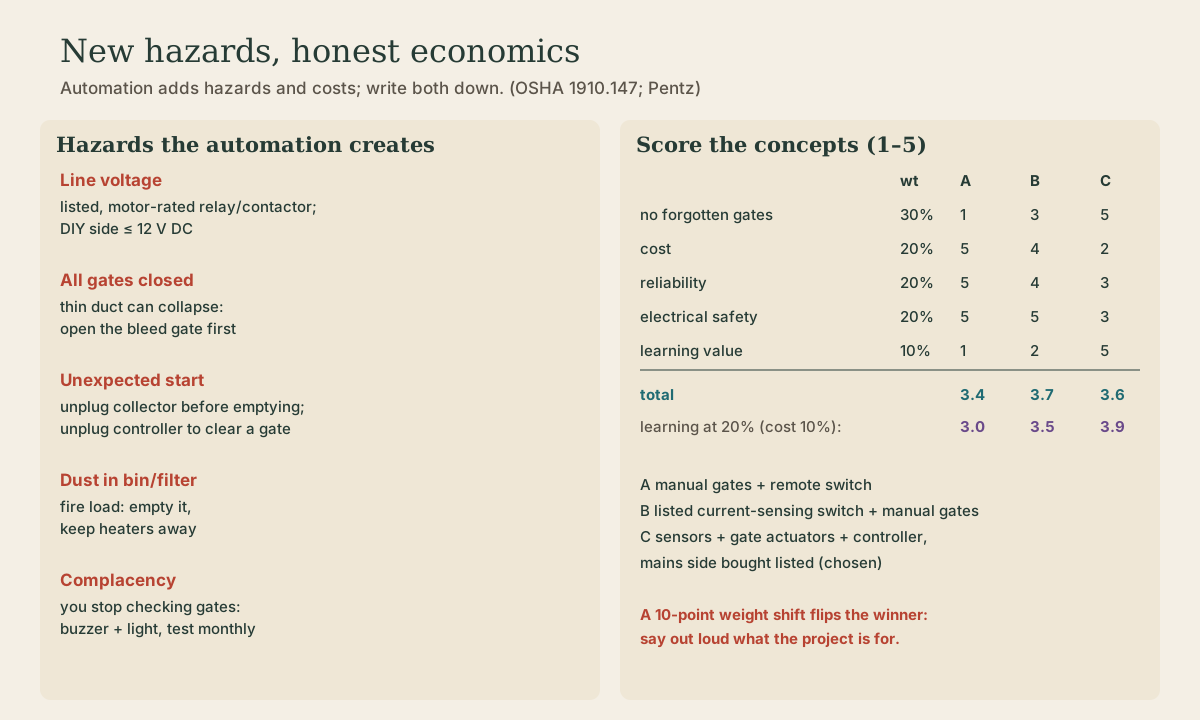
Automation solves one problem and creates others. A safety file lists each new hazard and what the design does about it, so nothing depends on remembering.
- Line voltage. The DIY electronics never touch it. The collector is switched by a listed relay or contactor rated for its motor; CTs go inside closed boxes. Low-voltage wiring is kept apart from line-voltage wiring.
- Collector against closed gates. Thin duct can collapse when the collector starts with no gate open 1. The make-before-break bleed-gate rule and the safe power-up state (bleed open, collector off) answer it, and the fault test in the next lesson proves it.
- Unexpected start. Before, the collector started only when someone flipped its switch. Now any tool can start it. So unplug the collector before emptying the bin, changing the filter, or reaching toward the impeller, and unplug the controller before clearing a jammed gate, since an actuator can move without warning. For cord-and-plug equipment, unplugging with the plug in your own control is what OSHA’s lockout standard accepts in place of a lock 2; it’s the right habit in a home shop too. Put a tag on the collector: “Starts automatically. Unplug before service.”
- Dust as fuel. The bin and filter hold the finest, driest dust in the shop. Empty the bin before it’s full (a full bin also cuts airflow) and keep heaters and sparks away from the collector. Pentz finds static on PVC duct can shock you but isn’t enough to ignite dust in a hobby system 1, so a shock is a nuisance, not an explosion risk.
- Complacency. Once the gates open themselves, you’ll stop looking at them. The buzzer and status light must be loud and obvious, and the system gets a monthly check: block a gate and confirm the fault fires.
Every safety function gets a test in the verification plan. A hazard with no test is a hope.
Quick check
Unplugging, with the plug in your control, is the cord-and-plug form of lockout.
Human work: what changes for the person
Even in a one-person shop, ask how the work changes:
- What you no longer do: walk to the gate and switch on every start, and remember to shut off.
- What you now have to do: read the status light, respond to a fault, empty the bin on schedule, and keep the controller’s settings and code backed up.
- What skill fades: the habit of checking the gate. Keep the manual bypass and labeled gates so the shop still works by hand, and so you still know how.
The economics, honestly
Costs: the actuators, limit switches, CTs, controller, power supply, enclosures, and a listed motor-rated relay add up to a couple hundred dollars for five gates, plus many evenings. Concept A’s remote switch costs a few tens of dollars.
Benefits: the log showed about 32 machine starts a week. If walking to the gate and switch takes about 20 seconds per start, that’s about 11 minutes a week. On time alone this never pays back the parts. The real benefits are the ones the log measured: no forgotten starts, no clogs, no gates left open starving the active drop, and so less fine dust escaping at the machine. Say that plainly in the review. A project justified on time savings it doesn’t have would fail the honesty test, even if it passes every other one.
Lifecycle: actuators and limit switches will wear; plan to replace them. The controller needs its code under version control and a spare board. Note what retirement looks like: if the system is removed, the gates still work by hand.
Quick check
32 starts a week × about 20 seconds is about 11 minutes.
Data and networks
It’s tempting to put the controller on Wi-Fi: logs on a phone, a dashboard of airflow. That’s fine for monitoring, but local control must not depend on the network. A tool running with no collection because a router rebooted is a failure of a safety function. NIST’s guidance for operational technology treats safety, reliability, and the physical process as constraints that networking and security choices must respect 3. Keep the state machine on the controller, give it no remote “start collector” command it can’t refuse, and change the default passwords on anything that is networked.
Quick check
Remote monitoring is fine; local control must not depend on it.
If this were a workplace
In a shop with employees, the same package grows a section on people: who loses tasks, who gains new ones (recovery, maintenance, fault response), whether the data could be used to track individuals, and whether the change builds skills or removes them. MIT’s Work of the Future report treats job quality, skills, and how a change is introduced as part of what automation does to work, not an afterthought 4. Write it even when it seems obvious; the workplace automation course’s palletizing case shows what it looks like in practice.
Gate 4
Pass when every hazard on the list has a design answer and a planned test, service tasks have a written unplug rule, the economics state what’s really gained, and the system works fully with the network down.
Lesson complete
Nice work.
Sources for this lesson
- 1Bill Pentz. Dust Collection Ducting. Bill Pentz Cyclone and Dust Collection Research. verifiedSmall-shop stationary tools need about 350 CFM to collect visible chips and about 1000 CFM for good fine-dust collection. Design air speed about 4000 FPM in vertical runs and 3000 FPM in horizontal runs (3800 minimum vertical, 2800 horizontal; 4500 for large chips). A 1.5 hp collector rated 1100 CFM maximum actually moves about 785 CFM through 6-inch duct, 550 through 5-inch, and 350 through 4-inch. Doubling airflow takes about four times the static pressure and much more horsepower. Thin 30-gauge duct can collapse if the system starts with no blast gates open. Static charge on PVC can shock you but experts find it insufficient to cause an explosion in hobby systems.
- 229 CFR 1910.147 - The Control of Hazardous Energy (Lockout/Tagout). Occupational Safety and Health Administration. verifiedU.S. general-industry minimum performance requirements for controlling unexpected energization, startup, and release of stored energy during service and maintenance.
- 3NIST SP 800-82 Rev. 3 - Guide to Operational Technology Security. National Institute of Standards and Technology. 2023. verifiedSecurity guidance for OT systems, including PLC, DCS, SCADA, physical-process interactions, reliability, performance, and safety constraints.
- 4The Work of the Future - Building Better Jobs in an Age of Intelligent Machines. MIT Task Force on the Work of the Future. 2020. verifiedTask-level account of automation, new work creation, skills, technology diffusion, job quality, institutions, and shared prosperity.