Dynamics: Doors, Wheels, and Coast-Down Tests
F = ma and its rotating twin, T = Iα, worked on shop and barn hardware: the force to start and stop an 80 kg sliding barn door (and why a soft-close damper matters), the inertia of a 14-inch bandsaw's wheels, how a belt reduction divides that inertia by the ratio squared, the 1.5-second spin-up, and how to measure friction with a stopwatch by timing the coast-down.
- 6 min
- 7 steps
- 3 questions
- Lesson 37 of 78
In this lesson
- Starting a barn door
- Spinning: the bandsaw
- Checking your answers
- Try it
Open alongside this lesson
-
Engineering Dynamics (opens in a new tab)
Use the kinematics and equations-of-motion units to extend the in-app model.
Picking up where you left off.
Dynamics is two equations used carefully: F = ma for things that slide and T = Iα for things that spin. A modeling course like MIT’s 2.003 dresses them up with coordinates and free-body diagrams 1, but the everyday job is the same: what force or torque does this motion need, and what happens when it stops? Two pieces of hardware cover most of it: a sliding barn door and a bandsaw.
Starting a barn door
An 80 kg door on a track. You want it moving at 1 m/s within half a second of pushing.
- Acceleration: a = Δv / t = 1 / 0.5 = 2 m/s².
- Force: F = ma = 80 × 2 = 160 N, about 36 lb, plus whatever the rollers resist.
Move the same door at the same speed but take a full second to get it going, and the push halves to 80 N. The force depends on how quickly you change the speed, not on the speed itself 2.
Stopping is the hard part
At 1 m/s the door carries kinetic energy ½mv² = ½ × 80 × 1² = 40 J. Whatever stops it has to soak up those 40 joules, and the average force is the energy divided by the distance it stops over 2:
| End stop | Stopping distance | Average force |
|---|---|---|
| Steel stop | 2 mm | 20,000 N (4,500 lb) |
| Rubber bumper | 20 mm | 2,000 N |
| Soft-close damper | 100 mm | 400 N |
Same door, same energy, a fifty-fold difference in force. That’s what tears out track bolts and cracks hangers, and it’s why a damper is worth the money on a heavy door. The same logic applies to a drawer, a gate, a falling tool, or a conveyor carriage hitting its end stop.
Quick check
The energy is the same (40 J), but average force = energy / stopping distance: about 400 N over 100 mm, versus 2,000 N over 20 mm and 20,000 N over 2 mm.
Spinning: the bandsaw
Rotation uses the same ideas with new names: torque T for force, angular acceleration α for acceleration, and moment of inertia I for mass. I depends on how far the mass sits from the axis: for a solid disk, I = ½mr²; for a thin rim, I = mr² 2. Mass at the rim counts double.
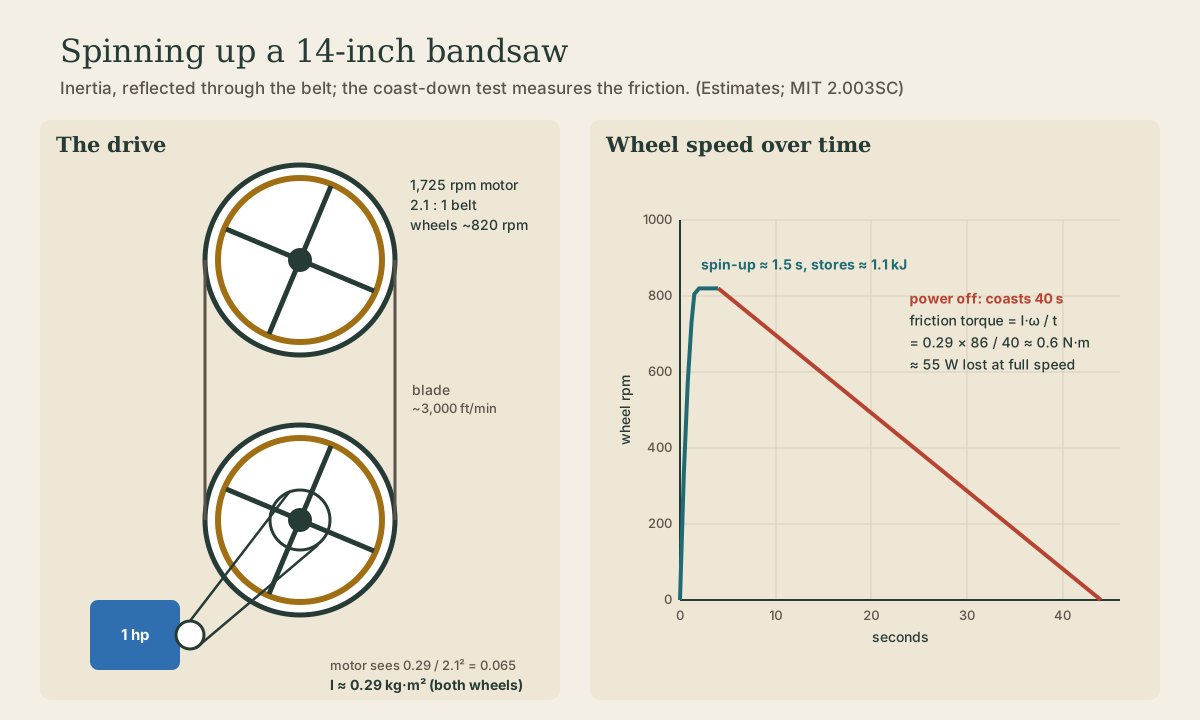
Take a 14-inch bandsaw. Treat each cast-iron wheel as a 9 kg disk with a 0.178 m radius:
- One wheel: I = ½ × 9 × 0.178² ≈ 0.14 kg·m². Both wheels: ≈ 0.29 kg·m². Real spoked wheels carry more of their mass at the rim, so the true value is a bit higher. These are estimates to show the method.
- A 1,725 rpm motor drives the lower wheel through a belt with about a 2.1:1 reduction, so the wheels turn about 820 rpm (86 rad/s). The blade speed is wheel circumference × rpm = 3.67 ft × 820 ≈ 3,000 ft/min.
- Stored energy at speed: ½Iω² = ½ × 0.29 × 86² ≈ 1.1 kJ. That’s why a bandsaw keeps running for a long time after you hit the switch.
Playback is optional. If the player is unavailable, open the video at its source.
Seen through the belt
The motor doesn’t feel 0.29 kg·m². Through a speed reduction, the load’s inertia as seen by the motor divides by the ratio squared: 0.29 / 2.1² ≈ 0.065 kg·m² 1. One factor of the ratio comes from the belt multiplying the motor’s torque; the other comes from the load turning slower, so it needs less angular acceleration.
A 1 hp motor at 1,725 rpm (181 rad/s) has a rated torque of P / ω = 746 / 181 ≈ 4.1 N·m. Induction motors deliver roughly double that while starting, so call it 8 N·m. The motor’s acceleration is then α = T / I = 8 / 0.068 ≈ 120 rad/s² (adding a little for the motor’s own rotor), and it reaches 181 rad/s in about 1.5 seconds. That’s about what you hear when you switch one on. Storing 1.1 kJ in 1.5 s is an average of about 730 W, close to the motor’s rating, which is a good sign the numbers hang together.
The same arithmetic explains why a big flywheel or a heavy lathe chuck on a small motor trips breakers or spins up slowly: the starting current lasts until the inertia is up to speed.
Quick check
Reflected inertia divides by the speed ratio squared. That’s why a reduction makes a heavy load easy for a small motor to accelerate.
The coast-down test
Friction is the hardest thing in a machine to calculate and the easiest to measure. Switch the saw off at full speed and time it to a stop. Say it takes 40 seconds.
If friction torque is roughly constant, the wheels decelerate steadily, and
T_friction = I × ω / t = 0.29 × 86 / 40 ≈ 0.6 N·m
At full speed that’s 0.6 × 86 ≈ 55 W going into bearings, tire flex, blade bending, and air drag. Do the test again after changing something (new bearings, less blade tension, a dried-out tire) and the change in coast-down time tells you how much friction you added or removed. If the saw coasts noticeably shorter than it used to, something is dragging.
Real coast-down curves fall faster at the start, because air drag and other speed-dependent losses are highest then, and slower near the end, where dry friction takes over. For a first estimate the straight line is fine.
Quick check
T = Iα = I·ω/t = 0.29 × 86 / 40 ≈ 0.62 N·m. A stopwatch and an inertia estimate are all you need.
Checking your answers
- Units: every term in an equation should come out in newtons, or newton-meters, or joules.
- Limits: double the mass and the acceleration should halve; take away the force and nothing should speed up.
- Energy: the energy a motor puts in during a move has to cover the kinetic energy gained plus the friction losses. If it doesn’t, a number is wrong.
Try it
Time the coast-down of a machine in your shop: a bandsaw, a lathe with the chuck on, a grinder. Estimate the rotating parts’ inertia from their weight and radius, compute the friction torque and the power lost at speed, and write the coast-down time on the machine. Next year, time it again.
Lesson complete
Nice work.
Sources for this lesson
- 1Engineering Dynamics. MIT OpenCourseWare. verifiedOCW Scholar course with lectures, worked problems, assignments, and exams on kinematics, rigid-body dynamics, and vibration.
- 2University Physics, Volumes 1–3. OpenStax (Rice University). verifiedOpen calculus-based physics. Vol 1 mechanics; Vol 2 thermodynamics and electricity & magnetism; Vol 3 optics & modern physics.