Moments, Supports & Distributed Loads
Moments with honest lever arms, replacing distributed loads by equivalent resultants, matching support reactions to the motion each support prevents, a worked simply supported beam, couples, and pressure and weight as distributed actions.
- 6 min
- 8 steps
- 3 questions
- Lesson 32 of 78
In this lesson
- Compute moments without guessing the lever arm
- Replace a load distribution without losing its effect
- Match support reactions to permitted motion
- Worked simply supported beam
- Couples and equivalent systems
- Pressure, weight, and other distributed actions
- Rule-of-thumb checks
Picking up where you left off.
A moment measures a force’s tendency to rotate a body about a point or axis. In planar work its signed magnitude is
where \(d_\perp\) is the shortest distance from point \(O\) to the force’s line of action. Sliding a force along that line does not change its moment; moving it sideways does.
MIT’s mechanics-of-materials material uses equilibrium and equivalent loading as the starting point for internal force, stress, and deformation 1. Preserve two quantities when replacing loads: the same net force and the same net moment about any point.
Compute moments without guessing the lever arm
In vector form, \(\mathbf{M}_O=\mathbf{r}\times\mathbf{F}\). In a planar problem,
This component form is often safer than searching visually for \(d_\perp\). State a sign convention once—commonly counterclockwise positive—and retain signs through the equations. Varignon’s theorem allows the moment of a force to equal the sum of the moments of its components, provided all components act at the same point.
Replace a load distribution without losing its effect
A distributed load \(w(x)\) in N/m becomes an equivalent resultant
acting at
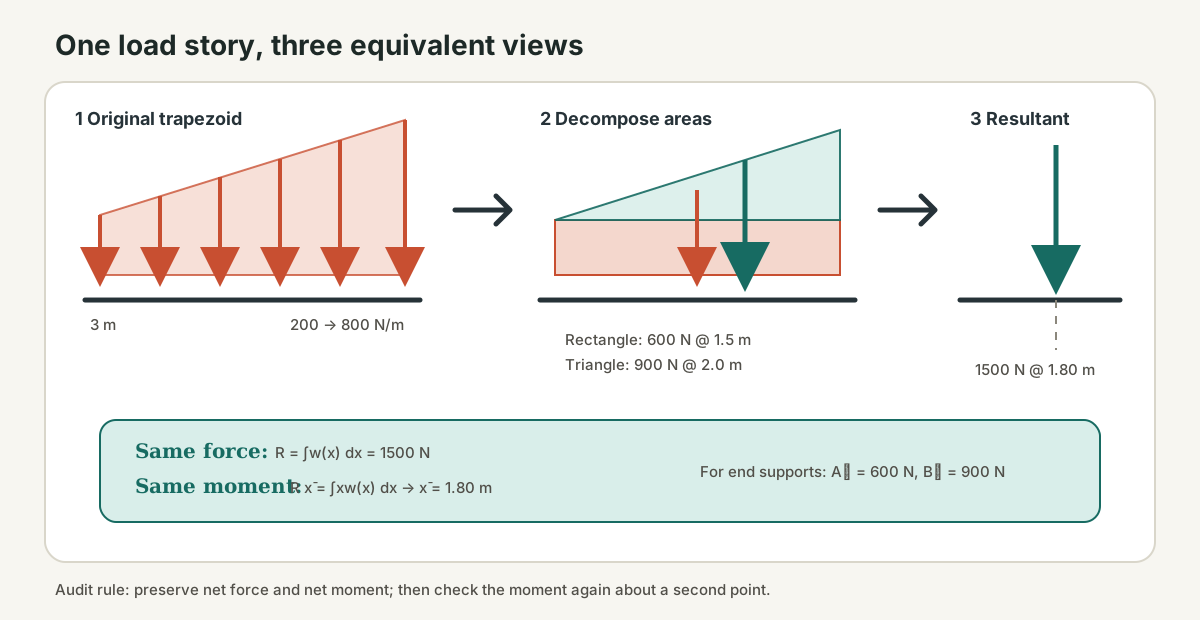
Graphically, \(R\) is the area under the load diagram and \(\bar{x}\) is its centroid. A uniform 800 N/m load over 1.5 m therefore becomes 1200 N acting at the segment midpoint, 0.75 m from either end. A triangular load peaks at one end; its resultant acts one-third of the base length from the high-intensity end.
Worked trapezoidal load
A 3 m beam carries a downward load increasing linearly from 200 N/m at the left to 800 N/m at the right. Decompose it into:
- a 200 N/m rectangle: 600 N acting at 1.5 m;
- a 0-to-600 N/m triangle: 900 N acting 2.0 m from the low-intensity end.
The total is 1500 N, and its location is
For simple supports at the ends, \(3B_y-1500(1.8)=0\), so \(B_y=900\) N and \(A_y=600\) N. The reaction shift toward the high-intensity end is a useful reasonableness check.
Match support reactions to permitted motion
A planar pin prevents translation in two directions; a roller prevents motion normal to its surface; a fixed support prevents both translations and rotation. Draw only those ideal reaction components. A real bearing arrangement may be intentionally locating at one end and floating at the other so thermal expansion does not create a hidden axial load.
Counting unknowns against three planar equilibrium equations is a first screen, not a proof of stability. Parallel reaction lines, concurrent reaction lines, tension-only members, or unilateral contacts can leave a mechanism even when the arithmetic count looks adequate.
Worked simply supported beam
A 2 m beam has a pin at A, a roller at B, and a uniform downward load of 600 N/m over its full length.
- Resultant: \(R=600(2)=1200\) N at midspan.
- Moments about A: \(2B_y-1200(1)=0\), so \(B_y=600\) N.
- Vertical equilibrium: \(A_y+B_y-1200=0\), so \(A_y=600\) N.
Symmetry predicts the same result, but the equations prove it. If the load covered only the left metre, its 600 N resultant would act 0.5 m from A; then \(B_y=150\) N and \(A_y=450\) N.
Quick check
The 600 N resultant acts 0.5 m from A: 2B = 600 × 0.5, so B = 150 N and A = 450 N.
Couples and equivalent systems
Two equal, opposite, parallel forces separated by distance \(d\) form a couple \(M=Fd\). Their net force is zero, but their moment remains. A pure couple is a free vector in rigid-body statics: its rotational effect is the same about every point. This is why a motor torque, wrench input, or fastener couple must not be discarded because the force arrows cancel.
Moving a force \(\mathbf{F}\) from point A to a parallel line through point B requires adding the couple
This force-couple equivalent is useful for reducing complex loads to a reference point such as a robot flange or bearing center. It does not mean the local stress state is unchanged; the equivalent system preserves rigid-body effect, not contact distribution.
Pressure, weight, and other distributed actions
Pressure acts normal to a surface and may vary with position. Body force such as weight is distributed through volume but becomes \(mg\) through the center of mass in a uniform gravitational field. Belt traction, seal drag, aerodynamic loading, and product accumulation may require measured or calculated distributions rather than one guessed point load.
When a distribution changes sign, its centroid may lie outside one signed region or the net resultant may be zero while a couple remains. Preserve positive and negative areas separately before combining them. OpenStax’s rotational-equilibrium treatment provides a useful independent review of torque signs and lever arms 2.
Rule-of-thumb checks
- The sum of vertical reactions must equal the total vertical load.
- A resultant must lie within a positive load distribution’s footprint.
- Reactions shift toward the side where the load’s centroid shifts.
- Treat a fixed support moment as an unknown reaction, not a decorative arrow.
Add two more checks: recompute the equivalent load’s moment about a second point, and integrate units explicitly. \(w\) in N/m integrated over metres must become N; \(xw\,dx\) must become N m.
Design exercise
Create a load table for a small conveyor section: belt and frame weight, product weight, tension, motor torque, and any jam load. Separate normal, startup, fault, and service load cases. Draw one FBD per case and solve reactions. Statics is not one timeless diagram; machines occupy states, and each state can create a different critical load.
Practice
The resultant equals the area under the load diagram and acts through that diagram’s centroid.
Practice
A force whose line of action passes through the selected point has zero moment about that point.
Lesson complete
Nice work.
Sources for this lesson
- 1Mechanics of Materials. MIT OpenCourseWare. verifiedOpen modules on stress, strain, trusses, torsion, bending, deflection, yielding, fracture, fatigue, and material properties. Cited at: equivalent loading.
- 2University Physics, Volumes 1–3. OpenStax (Rice University). verifiedOpen calculus-based physics. Vol 1 mechanics; Vol 2 thermodynamics and electricity & magnetism; Vol 3 optics & modern physics. Cited at: torque and rotational equilibrium.