Failure, Fatigue & the Structural Design Review
How parts actually fail: screening limit states, fatigue as a load-history problem, buckling starting from imperfections, fracture linking stress, flaw size, and toughness, fault and abuse loads as separate cases, and what a structural review package contains.
- 5 min
- 7 steps
- 3 questions
- Lesson 36 of 78
In this lesson
- Screen the limit states
- Fatigue as a load-history problem
- Buckling begins with imperfections
- Fracture links stress, flaw, and toughness
- Fault loads deserve their own cases
- A structural review package
Picking up where you left off.
Machines rarely fail as a uniform coupon under one perfect pull. They loosen, wear, buckle, crack at a shoulder, slip at a joint, overload during a jam, corrode, overheat, or drift out of alignment. MIT’s materials curriculum distinguishes elastic response, plastic flow, creep, fracture, and fatigue because each has different evidence and countermeasures 1.
Screen the limit states
- Yield: permanent deformation under peak combined stress.
- Buckling: instability of a slender compression member, often before material yield.
- Fatigue: crack initiation and growth under fluctuating stress.
- Fracture: unstable crack growth when toughness is insufficient for stress and flaw size.
- Creep: time-dependent deformation at relevant temperature and stress.
- Wear and fretting: surface loss or damage from contact and small oscillatory motion.
- Joint failure: slip, separation, embedment, bolt fatigue, weld cracking, or thread stripping.
- Functional failure: excessive deflection, vibration, backlash, or alignment loss.
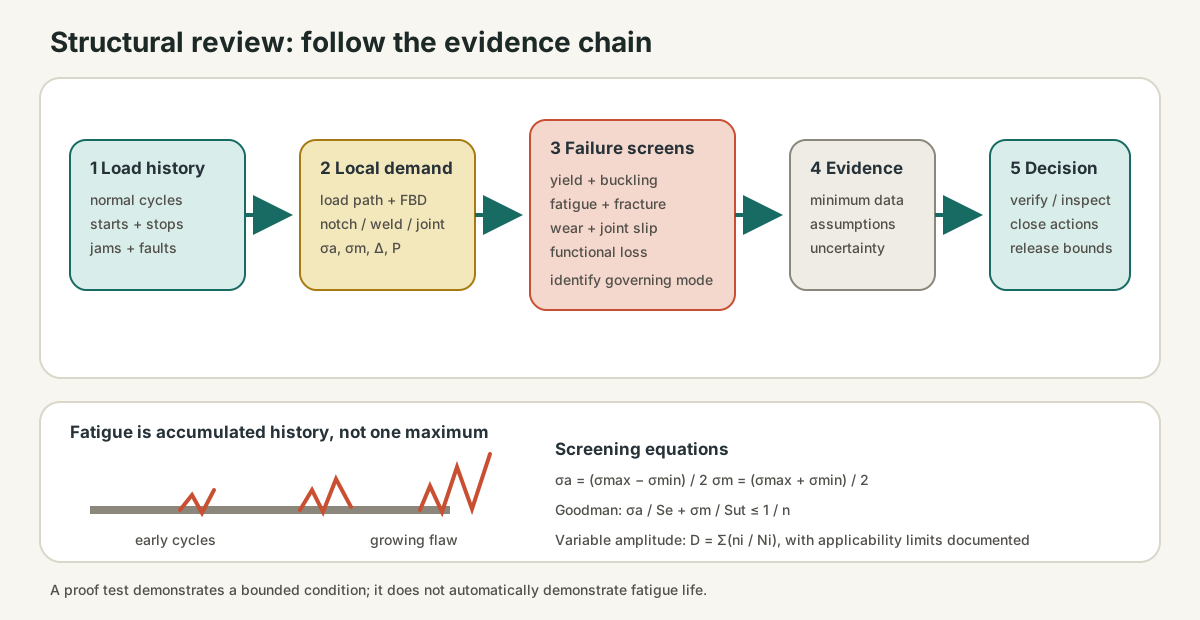
MIT’s mechanics and machine-design materials reinforce that the governing mode may sit in a connection, geometric discontinuity, or system interaction rather than the obvious member 2 3. For each mode, write the demand, resistance, corrections, and evidence separately.
Fatigue as a load-history problem
For a stress cycle with maximum \(\sigma_{max}\) and minimum \(\sigma_{min}\), define
Both alternating and mean stress matter. Surface finish, size, environment, notches, residual stress, and reliability change fatigue performance. A motor mount seeing 20 to 80 MPa has \(\sigma_a=30\) MPa and \(\sigma_m=50\) MPa. Calling it “an 80 MPa load” loses the cycle information.
An S–N curve relates stress amplitude to cycles for a particular specimen and test condition. Correct it cautiously for real geometry and environment. A simple modified Goodman screen is
If corrected \(S_e=160\) MPa and \(S_{ut}=500\) MPa, the example’s utilization is \(30/160+50/500=0.2875\), giving a nominal factor \(n\approx3.48\). This is a screening result, not proof: the local notch stress, spectrum, weld detail, residual stress, and applicability of an endurance limit still need review.
Variable-amplitude histories require cycle counting or a justified equivalent spectrum. A common cumulative-damage approximation is Miner’s rule,
It is convenient but does not capture load-sequence effects or every interaction. Preserve measured time histories when possible and include startup, stop, dwell, reversal, jam clearing, and transport—not only the steady production cycle.
Buckling begins with imperfections
Euler’s \(P_{cr}=\pi^2EI/(KL)^2\) describes an ideal straight elastic column. Real members begin crooked, carry residual stress, and connect through finite stiffness. Load eccentricity adds bending, and local plate buckling may precede global column buckling. Use effective length and an applicable standard or validated nonlinear analysis when the consequence warrants it. Bracing must have enough stiffness and a real load path; a line in CAD is not restraint.
Fracture links stress, flaw, and toughness
Fracture review asks whether a plausible flaw can become unstable at the applied stress. Material toughness, thickness, temperature, residual stress, weld quality, and inspection capability matter. Do not claim “no crack” merely because none is visible. Define the detectable flaw size, inspection interval, access, acceptance criterion, and what happens after an indication is found.
Damage-tolerant design assumes flaws may exist and manages growth through geometry, material, inspection, redundancy, or safe life. This is especially relevant where a crack can grow without obvious loss of function until final failure.
Quick check
Fatigue grows flaws over many cycles until fracture.
Fault loads deserve their own cases
Normal operation may not govern. Include hard stop, e-stop deceleration, dropped payload, jammed conveyor, seized bearing, pressure spike, off-center part, maintenance leverage, and transport. Define whether each is expected repeatedly, rare but survivable, or allowed to cause controlled sacrificial damage. Do not combine mutually exclusive extremes unless a governing rule requires it; do combine events that can credibly coincide.
A structural review package
- Annotated assembly and load path.
- Load-case table with sources, frequency, and combinations.
- FBDs, reactions, and internal-force diagrams.
- Stress, deflection, stability, and connection checks.
- Fatigue spectrum, concentration factors, and material evidence.
- Assumptions, uncertainty, exclusions, and sensitivity register.
- Verification plan: inspection, proof load, strain measurement, deflection test, or teardown.
- Decision log naming the governing limit state, open actions, owner, and release criterion.
Calculation, analysis, and test support different claims. A hand check can expose scale and load-path errors; finite-element analysis can resolve geometry within its assumptions; a proof test demonstrates survival of a bounded specimen and condition. None automatically demonstrates service life. Match each claim to evidence and retain traceability from requirement to result.
Safe verification
Use barriers, remote loading, controlled energy, and competent supervision for structural tests. Do not place a person on or near an unproven load-bearing mechanism. Increase load in bounded steps, inspect between steps, define stop criteria in advance, and treat unexpected noise, slip, or permanent set as data—not a dare to continue.
Course project
Complete the review package for a small machine frame or robot pedestal. Include one measured or estimated duty spectrum, one fatigue screen, one buckling screen, and one connection calculation. Your conclusion must name the governing limit state, numerical margin, evidence still missing, and the exact condition for release. Engineering confidence is calibrated: “calculation suggests” and “test demonstrates” are different claims.
Practice
Cyclic loading can initiate and propagate cracks at stress levels below one-time yield.
Practice
A structural review should connect loads to failure modes, margins, uncertainty, and verification evidence.
Lesson complete
Nice work.
Sources for this lesson
- 1Mechanical Behavior of Materials. MIT OpenCourseWare. verifiedUndergraduate treatment of elastic and plastic deformation, creep, fracture, and the processing-structure-property relationship. Cited at: mechanical response.
- 2Mechanics of Materials. MIT OpenCourseWare. verifiedOpen modules on stress, strain, trusses, torsion, bending, deflection, yielding, fracture, fatigue, and material properties. Cited at: structural response.
- 3Elements of Mechanical Design. MIT OpenCourseWare. verifiedModeling, design, integration, fabrication, and characterization of bearings, springs, gears, cams, mechanisms, shafts, drives, and connections. Cited at: failure and machine elements.