Heat Transfer: Designing a Backyard Sauna
Conduction, R-values, and heat capacity worked on a 6 × 7 ft wood-lined sauna held at 180 °F on a 20 °F day: Q = A·ΔT/R for walls, ceiling, door, and a window that loses six times what the same area of wall does; ventilation as the biggest single loss; heater sizing by the 1 kW per 50 ft³ rule with a glass allowance; the heat-up budget, where the air takes 0.2 kWh and the cedar and stones take over 5; and the time constant behind the hour it takes to come up.
- 6 min
- 7 steps
- 3 questions
- Lesson 40 of 78
In this lesson
- Conduction and R-value
- Losses through the walls
- Sizing the heater
- The heat-up budget
- Moisture
- Try it
Picking up where you left off.
A sauna is a box you’re trying to keep very hot while it’s very cold outside. Every design question is a heat-transfer question: how much leaks out, where, how big a heater keeps up, and how long it takes to come up to temperature. The same arithmetic sizes insulation for a house, a shop, or a well pit.
The example: a backyard sauna, 6 × 7 ft and 7 ft tall (294 ft³), lined with cedar, held at 180 °F on a 20 °F winter day. That’s a temperature difference ΔT of 160 °F.
Conduction and R-value
Heat conducts through a slab at a rate proportional to its area and the temperature difference, and inversely to its resistance:
Q = A × ΔT / R
(Q in Btu/h, A in ft², ΔT in °F, R in the familiar R-value units) 1. R is thermal resistivity times thickness, and resistances in layers add 2. The underlying material property is thermal conductivity k; lower is better insulation. From the Wood Handbook 2:
| Material | k (W/m·K) |
|---|---|
| Steel | 45 |
| Glass | 1.0 |
| Concrete | 0.9 |
| Softwood lumber | 0.10–0.14 |
| Mineral wool | 0.036 |
Wood conducts about a tenth as well as glass and two to four times as well as insulation. That’s why a cedar lining feels comfortable to touch at 180 °F, why a log wall alone is only a modest insulator, and why a window is a hole in your heat budget.
Losses through the walls
Assume a framed wall with insulation, foil, and cedar lining at about R-12 overall (framing lowers it from the batt’s rating), an R-20 ceiling, and a floor that stays much cooler than the air near the ceiling:
| Surface | Area | R | Loss (Btu/h) |
|---|---|---|---|
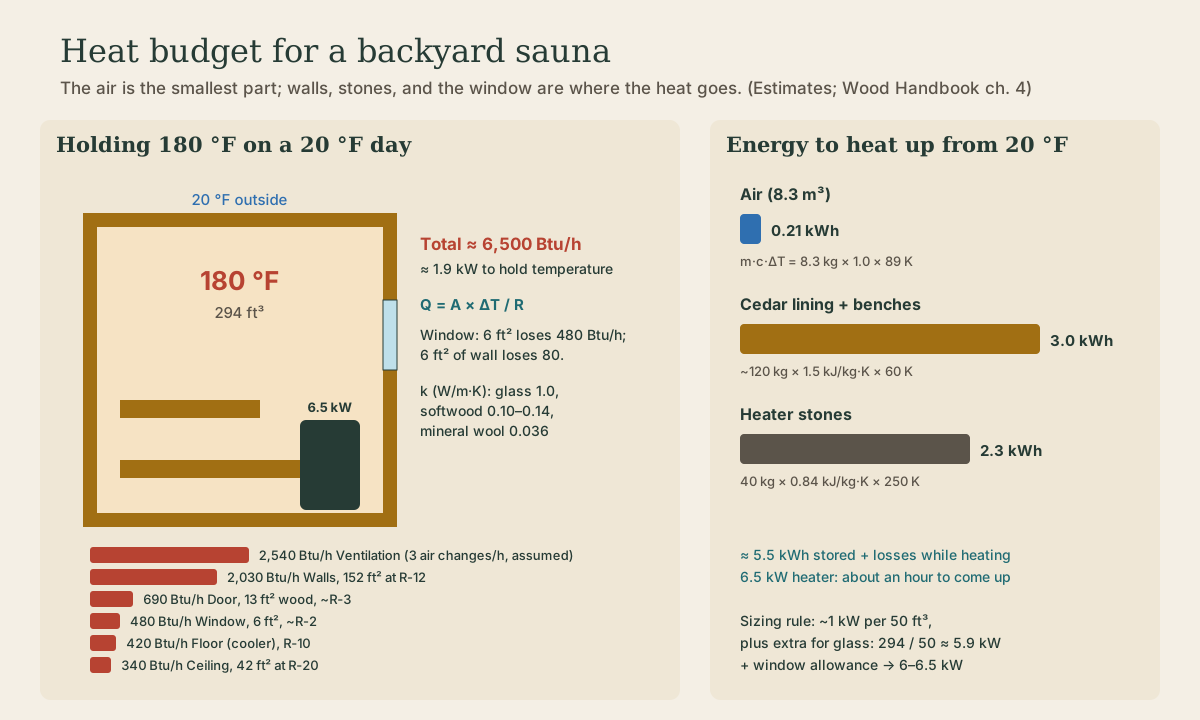
| Walls | 152 ft² | 12 | 152 × 160 / 12 ≈ 2,030 |
| Ceiling | 42 ft² | 20 | ≈ 340 |
| Floor (ΔT ≈ 100 °F) | 42 ft² | 10 | ≈ 420 |
| Solid wood door, 2 in | 13 ft² | ~3 | ≈ 690 |
| Double-pane window, 2 × 3 ft | 6 ft² | ~2 | ≈ 480 |
The window is the lesson. Its 6 ft² lose 480 Btu/h; the same 6 ft² of wall would lose 80. That’s why heater makers add an allowance for glass: Harvia adds 2 ft³ to the room volume for every square foot of glass, tile, or stone 3.
Ventilation
A sauna needs fresh air, and every cubic foot that leaves takes its heat with it. At an assumed 3 air changes per hour, 882 ft³/h of 20 °F air is heated by 160 °F. Air holds about 0.018 Btu per ft³ per °F, so
0.018 × 882 × 160 ≈ 2,540 Btu/h
That’s the single biggest loss, more than all the walls. It’s also why the vent arrangement matters as much as insulation thickness.
Total ≈ 6,500 Btu/h ≈ 1.9 kW just to hold temperature.
Quick check
Q = A·ΔT/R, so for equal area and ΔT the loss scales as 1/R: 12/2 = 6.
Sizing the heater
The common rule from heater sellers is about 1 kW per 50 ft³ of room, with roughly 1 kW more per 11 ft² of glass, and 10–20% extra for drafty or poorly insulated builds 4. For this room: 294 / 50 ≈ 5.9 kW, plus a bit for the window, so a 6 to 6.5 kW heater, rounding up between sizes 4.
That’s more than three times the 1.9 kW holding load. The extra is what gets the room hot in a reasonable time.
Quick check
294 ft³ / 50 ≈ 5.9 kW. Glass adds to that; round up between sizes.
The heat-up budget
Heating something up takes energy E = m × c × ΔT, mass times specific heat times temperature rise 5. Starting from 20 °F (−7 °C) and going to 180 °F (82 °C), a rise of 89 K:
- Air: 294 ft³ is 8.3 m³, about 8 kg of air at roughly 1.0 kJ/kg·K: 8 × 1.0 × 89 ≈ 750 kJ ≈ 0.2 kWh.
- Cedar lining and benches: about 120 kg of wood. The Wood Handbook gives dry wood’s heat capacity as about 1.2 to 1.4 kJ/kg·K at these temperatures, more with some moisture 2. Call it 1.5, and an average rise of 60 K since the back of the boards lags the surface: 120 × 1.5 × 60 ≈ 10,800 kJ ≈ 3 kWh.
- Heater stones: say 40 kg of granite-like stone at 0.84 kJ/kg·K 5, heated about 250 K above the starting temperature because the rocks run far hotter than the room: 40 × 0.84 × 250 ≈ 8,400 kJ ≈ 2.3 kWh.
About 5.5 kWh stored, plus the losses while it heats. At 6.5 kW, that’s roughly an hour to come up. The air is almost nothing. You’re heating the wood and the rocks, and that stored heat is what makes a sauna feel steady and what gives a good löyly when water hits the stones.
Playback is optional. If the player is unavailable, open the video at its source.
Time constant
Any lump of material with heat capacity C, losing heat through resistance R, approaches its final temperature exponentially with a time constant τ = R × C 1. After one τ it’s about 63% of the way there; after three, about 95%. A sauna with heavy stones and thick paneling has a big C. It heats slowly, but it also holds its heat after the heater shuts off. A thin-walled box with a small stove heats fast and cools fast.
Quick check
8 kg of air takes about 0.2 kWh. The 120 kg of wood and 40 kg of stones take about 3 and 2.3 kWh.
Moisture
Water thrown on the stones flashes to steam that pushes into the walls. The Wood Handbook notes that wood’s conductivity rises with moisture content 2, and wet insulation insulates poorly and rots framing. That’s why sauna walls put a foil vapor barrier behind the paneling, with an air gap, on the hot side of the insulation.
Try it
Sketch your own building, sauna or shop, and list each surface with its area and an R-value. Compute Q for each at your design temperatures and rank them. Then estimate the air change loss. The top two lines on the list are where your money goes.
Lesson complete
Nice work.
Sources for this lesson
- 1Introduction to Heat Transfer. MIT OpenCourseWare. verifiedUndergraduate modeling and design methods for conduction, convection, and radiation.
- 2Wood Handbook, Chapter 4: Moisture Relations and Physical Properties of Wood. USDA Forest Service, Forest Products Laboratory. 2021. verifiedThermal conductivity of structural softwood at 12% MC 0.10-0.14 W/m-K (0.7-1.0 Btu in/h ft2 F), versus aluminum 216, steel 45, concrete 0.9, glass 1, plaster 0.7, mineral wool 0.036; R-value is resistivity times thickness. Heat capacity of dry wood cp0 = 0.1031 + 0.003867 T (kJ/kg K, T in K), about 1.2-1.4 near room to sauna temperature, higher with moisture, nearly independent of species.
- 3Simple Sauna Sizing: Sizing Your Harvia. Harvia. 2023. verifiedMeasure the room in cubic feet; for each square foot of cold surface (glass, tile, brick, concrete, stone; excluding the door) add 2 cubic feet to the volume before choosing the heater.
- 4How Many Kilowatts Do You Need for a Sauna Heater? A Simple Sizing Guide. The Sauna Place. verifiedAbout 1 kW per 50 cubic feet of interior; add roughly 1 kW per 11 square feet of glass; under-insulated or breathier builds need 10-20% more; round up between sizes.
- 5University Physics, Volumes 1–3. OpenStax (Rice University). verifiedOpen calculus-based physics. Vol 1 mechanics; Vol 2 thermodynamics and electricity & magnetism; Vol 3 optics & modern physics.