Energy and Efficiency: Heating With Wood
The first law as bookkeeping: draw a boundary around a wood stove, count energy in and out, and define efficiency as what you wanted over what you paid for. Worked numbers: 25.3 million Btu in a cord of oak, 70% stove efficiency, cords needed by species for a 50 million Btu winter, cost per delivered million Btu across fuels, power versus energy, where the losses go, and why an air tool takes 7 to 8 times the energy of an electric one.
- 7 min
- 6 steps
- 4 questions
- Lesson 39 of 78
In this lesson
- One cord of oak
- Cords for a winter
- Cost per delivered Btu
- Compressed air is the expensive way
- Try it
Picking up where you left off.
The first law of thermodynamics says energy isn’t created or destroyed, only moved and converted 1. In practice that makes it a bookkeeping rule: draw a boundary around something, count everything that crosses it, and the books have to balance:
energy in = energy out + change in energy stored
Then efficiency is just what you wanted out divided by what you paid for. Everything hard about energy problems comes down to drawing the boundary in the right place and not missing a line in the ledger. A wood stove is a good place to practice.
One cord of oak
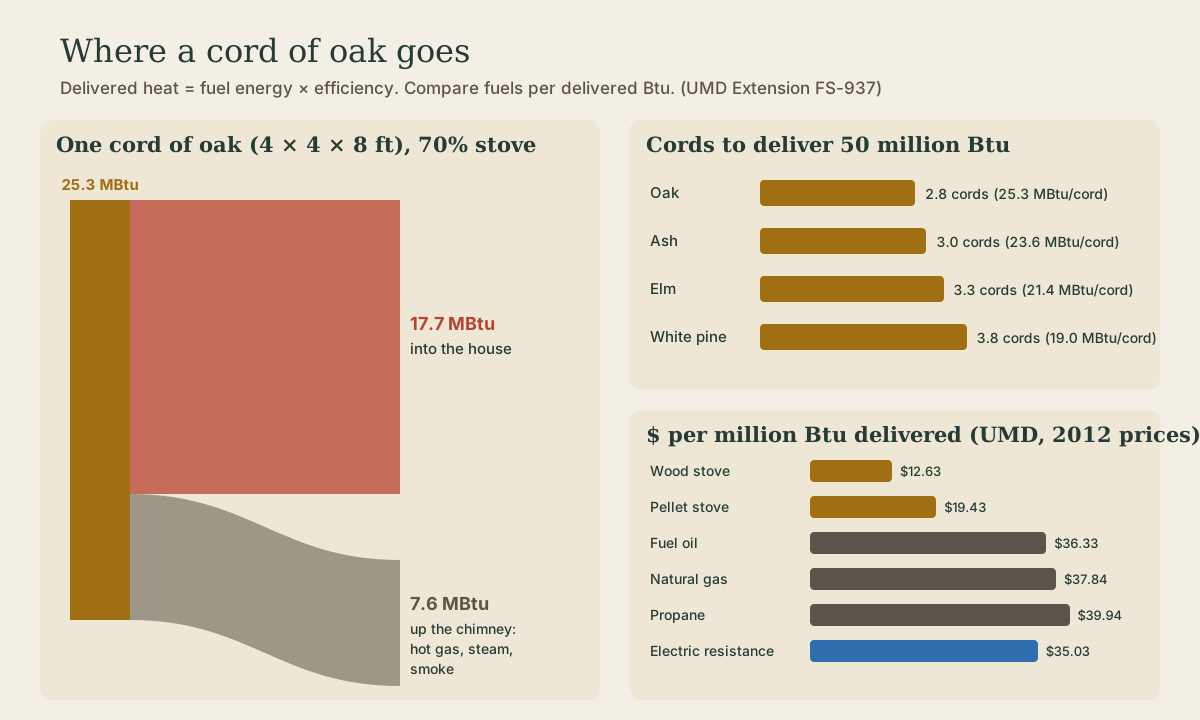
A full cord is a stack 4 × 4 × 8 feet, 128 cubic feet. If it’s delivered in a pickup, it isn’t a full cord 2. A cord of seasoned oak holds about 25.3 million Btu of chemical energy 2. (One Btu warms a pound of water by 1 °F; 1 kWh = 3,412 Btu, so a cord of oak is about 7,400 kWh.)
Draw the boundary around the stove and chimney:
- In: 25.3 million Btu in the wood, plus room air drawn in to burn it.
- Out, useful: heat into the room through the stove body and from radiation.
- Out, lost: hot flue gas, water vapor from the wood’s moisture and from burning hydrogen, and any unburned smoke and gas.
At the 70% efficiency the Maryland Extension uses for a wood stove 2:
- 25.3 × 0.70 ≈ 17.7 million Btu into the house
- ≈ 7.6 million Btu up the chimney
Where the 30% goes
- Flue heat. The gases leave hot. Some of that is unavoidable: a chimney only drafts if the gas inside is warmer than the air outside. But a flue that’s too hot means heat you paid for is leaving.
- Water. Wet wood spends energy boiling its water out before it burns well. The Maryland guide says split wood needs 6 to 9 months stacked and covered to season, and the clock starts at splitting, not felling 2.
- Smoke. Smoke is fuel that didn’t burn. If you can smell smoke from a stove, the fire or the appliance is running inefficiently 2. Modern EPA stoves add preheated secondary air above the fire to burn the gases.
Playback is optional. If the player is unavailable, open the video at its source.
Quick check
Delivered = 25.3 × 0.70 ≈ 17.7. The other 7.6 million goes up the chimney.
Cords for a winter
Suppose the house needs 50 million Btu of delivered heat over a winter. At 70%, that’s 50 / 0.7 ≈ 71 million Btu of wood. Divide by the energy per cord 2:
| Species | Million Btu per cord | Cords needed |
|---|---|---|
| Oak | 25.3 | 2.8 |
| Ash | 23.6 | 3.0 |
| Elm | 21.4 | 3.3 |
| White pine | 19.0 | 3.8 |
Pine isn’t “weaker” fuel. Pound for pound, dry woods are similar. But a cord measures volume, and pine is lighter, so a cord holds less wood by weight. That’s why you’d haul, split, and stack a third more of it. Seasoned pine is fine for kindling and fast fires; it just makes more work.
Power versus energy
A stove rated at 40,000 Btu/h is a power rating: how fast it can deliver heat. The 50 million Btu is an energy total over the season. Dividing one by the other is a useful check: 50,000,000 / 40,000 = 1,250 hours of full output, or about 7 hours a day for six months. If the house needs more than the stove can deliver on the coldest night, no amount of wood will help. That’s a peak-power problem, not an energy problem.
Quick check
By weight, dry woods are fairly similar; by the cord, density decides: oak 25.3 versus white pine 19.0 million Btu.
Cost per delivered Btu
To compare fuels fairly, compute the cost of a delivered million Btu:
cost per delivered MBtu = price per unit ÷ (MBtu per unit × efficiency)
The Maryland Extension did exactly this at 2012 prices 2:
| Fuel and appliance | Price | Efficiency | $ per delivered MBtu |
|---|---|---|---|
| Wood stove | $200/cord | 70% | 12.63 |
| Pellet stove | $250/ton | 78% | 19.43 |
| Fuel oil furnace | $3.93/gal | 78% | 36.33 |
| Natural gas furnace | $2.95/therm | 78% | 37.84 |
| Propane furnace | $2.85/gal | 78% | 39.94 |
| Electric resistance | $0.12/kWh | 98% | 35.03 |
The prices are old; the method isn’t. Redo it with what you actually pay. Resistance electric at 17¢/kWh, for example, works out to 0.17 / (0.003412 × 0.98) ≈ $51 per delivered million Btu. Wood that you cut yourself costs saw fuel, a splitter, and your back, but no cash.
What the second law adds
The first law says energy is conserved. The second says it flows downhill: heat moves from hot to cold on its own, and you can never turn all of a pile of heat back into work 1. For heating, that’s harmless: turning fuel or electricity into heat is the one conversion that’s easy to do at nearly 100%. But for making motion it’s a hard limit: engines and compressors always throw away heat.
Quick check
That’s how the Maryland table gets $12.63 per million Btu for wood and $35.03 for resistance electric at 12¢/kWh.
Compressed air is the expensive way
A compressor turns electricity into motion, motion into pressure, and pressure back into motion at the tool. Compressing air heats it, the tank and lines cool it back to room temperature, and that heat is gone. Add leaks and pressure drops, and the DOE’s compressed-air sourcebook puts it bluntly: an air motor needs at least 7 to 8 hp of compressor power for every 1 hp at its shaft 3. In other words, a pneumatic tool uses 7 to 8 times the energy of an electric tool doing the same work 3.
So the ledger for a shop says: air tools are light, simple, and spark-free, but for anything that runs a long time (sanding a tabletop, running a die grinder all afternoon) the electric version is cheaper to run and lets a smaller compressor keep up.
Quick check
Compression heats the air and that heat is thrown away; then there are leaks, pressure drops, and the air motor’s own losses.
Try it
Pick one: a stove, a water heater, or your air compressor. Draw the boundary, list every energy flow across it, and estimate one season’s or one month’s energy and cost. Then name the biggest loss line and one thing that would shrink it: drier wood, a lower thermostat setting, or a leak fixed.
Lesson complete
Nice work.
Sources for this lesson
- 1Thermodynamics and Propulsion. MIT OpenCourseWare. verifiedUndergraduate notes and problems on state, heat, work, the first and second laws, entropy, steady-flow energy, and efficiency.
- 2Buying & Storing Firewood & Pellets (FS-937). University of Maryland Extension. 2012. verifiedFuel cost comparison (2012 prices, EIA heating calculator): wood stove $200/cord at 70% = $12.63 per MBtu; pellet stove $250/ton at 78% = $19.43; natural gas $2.95/therm at 78% = $37.84; coal $10.67; oil $3.93/gal at 78% = $36.33; propane $2.85/gal at 78% = $39.94; electric $0.12/kWh at 98% = $35.03. Million Btu per cord: oak 25.3, ash 23.6, elm 21.4, sycamore 20.7, walnut 21.8, white pine 19.0. A full cord is 4 x 4 x 8 ft; split wood needs 6-9 months stacked and covered to season; smoke from a stove is a sign of inefficient burning.
- 3Improving Compressed Air System Performance: A Sourcebook for Industry (3rd ed.) and Fact Sheet 7, Compressed Air System Leaks. U.S. Department of Energy and Compressed Air Challenge. 2016. verifiedAir motors need a minimum of 7 to 8 hp of compressor power per hp of shaft output; pneumatic tools cost 7-8 times the energy of electric tools for the same output. Fact sheet 7 (2026 rev.): leaks can waste 20-30% of output, well maintained under 10%; for start/stop compressors, leakage % = T x 100 / (T + t) with on-load time T and off-load time t, measured with all tools off; find leaks with ultrasonic detectors or soapy water; most leaks at couplings, hoses, fittings, regulators, traps, thread sealant. Raising header pressure 2 psi raises energy use about 1.6-2% in systems near 100 psig.
Further reading
- University Physics, Volumes 1–3. OpenStax (Rice University). verifiedOpen calculus-based physics. Vol 1 mechanics; Vol 2 thermodynamics and electricity & magnetism; Vol 3 optics & modern physics.
Previous: Vibration: Mounting a Compressor and a Dust Collector