Pipe Flow: Running Water to the Barn
Pressure, flow, lift, and friction worked on a buried 400-foot polyethylene line from the house pressure tank to a barn hydrant: continuity and water speed by pipe size, 0.433 psi per foot of lift, friction from a published PE table (3/4-inch versus 1-inch at 6 gpm), why doubling flow roughly quadruples friction, why the velocity term in Bernoulli hardly matters here, and the step-by-step pressure budget Alberta Agriculture uses for pasture pipelines.
- 6 min
- 6 steps
- 4 questions
- Lesson 41 of 78
In this lesson
- What goes in comes out
- Lift
- Friction
- The pressure budget
- Try it
Picking up where you left off.
Run a water line from the house to the barn and three things take pressure away between the tank and the hydrant: lift (going uphill), friction (water rubbing along the pipe), and whatever the outlet needs to actually deliver water. Get the budget wrong and the barn gets a trickle, worst of all when the tank is at the bottom of its cycle. Alberta Agriculture’s pasture-pipeline guide lays the design out in steps 1; this lesson walks through them with the physics underneath.
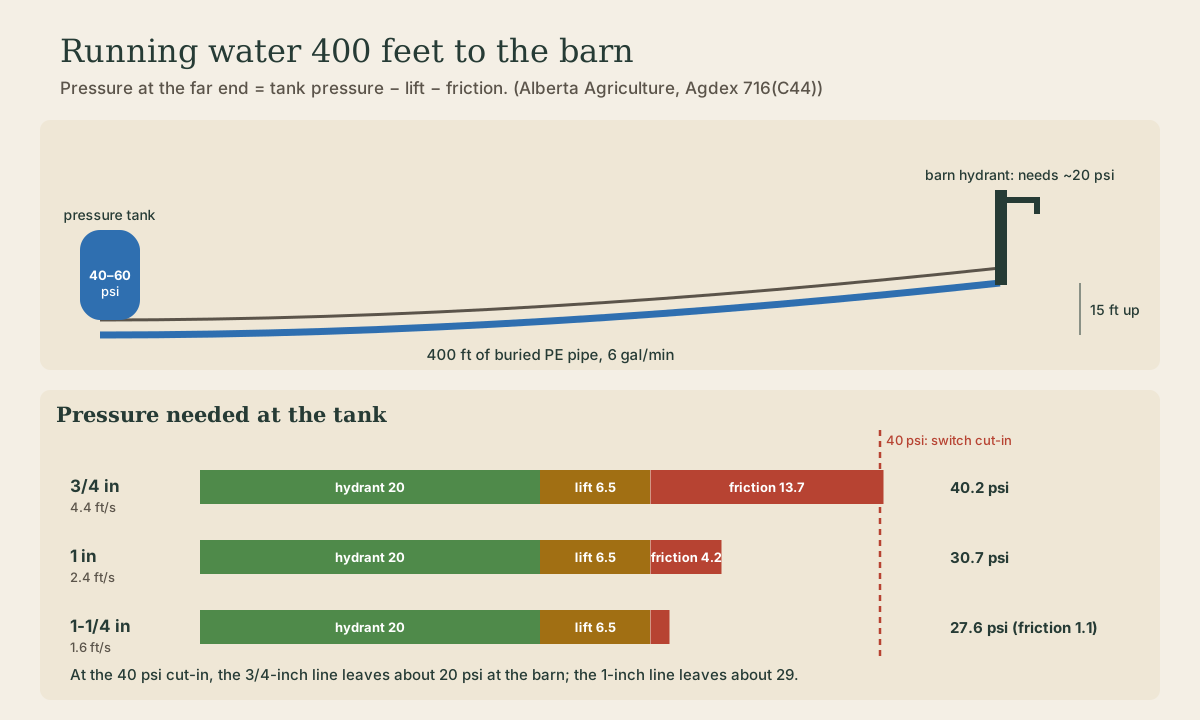
The example: a buried PE line, 400 feet from the pressure tank to a frost-free hydrant at the barn, which sits 15 feet higher. You want 6 gallons per minute with about 20 psi at the hydrant to run a hose or fill a stock tank through a float valve (float valves can need anywhere from 5 to over 20 psi 1).
What goes in comes out
Draw a boundary, a control volume, around any stretch of pipe. Water barely compresses, so in steady flow what enters is what leaves 2. The volume flow Q is the same all the way along:
Q = v × A
so where the pipe is smaller, the water moves faster. At 6 gpm (23.1 in³/s), using the inside diameters of PE pipe 1:
| Pipe | Inside area | Water speed |
|---|---|---|
| 3/4 in | 0.44 in² | 4.4 ft/s |
| 1 in | 0.79 in² | 2.4 ft/s |
| 1-1/4 in | 1.23 in² | 1.6 ft/s |
The same idea, mass in equals mass out, works for air in a dust duct, gas in a flue, or water through a pump.
Quick check
Continuity: what goes in comes out, so Q = v × A is the same everywhere along the pipe.
Lift
A column of water 1 foot tall pushes down with 0.433 psi at its base 1. (The other way around: 1 psi holds up 2.31 ft of water.) Climbing 15 feet costs
15 × 0.433 ≈ 6.5 psi
whether the water is moving or not. Going downhill gives that pressure back.
Quick check
0.433 psi per foot × 15 ft ≈ 6.5 psi, flowing or not.
Friction
Moving water drags on the pipe wall and loses pressure along the length. Engineers calculate it from pipe roughness, diameter, and speed, but for small water lines the practical tool is a friction table. Alberta’s table for PE pipe, in psi lost per 100 feet 1:
| Flow (US gpm) | 3/4 in | 1 in | 1-1/4 in |
|---|---|---|---|
| 3 | 0.95 | 0.29 | 0.08 |
| 6 | 3.43 | 1.06 | 0.28 |
| 12 | (too fast) | 3.82 | 1.01 |
Two patterns to remember:
- Friction rises much faster than flow. Double the flow from 6 to 12 gpm in 1-inch pipe and the loss goes from 1.06 to 3.82 psi per 100 ft, about 3.6 times.
- One pipe size up cuts friction by about two-thirds. At 6 gpm, going from 3/4 to 1 inch drops the loss from 3.43 to 1.06.
For the 400-foot run at 6 gpm: 3/4-inch loses 4 × 3.43 ≈ 13.7 psi; 1-inch loses 4 × 1.06 ≈ 4.2 psi.
Why Bernoulli’s speed term barely matters
Bernoulli’s equation balances pressure, height, and speed along a streamline 3. The speed part is the velocity head, v²/2g. At 4.4 ft/s that’s 4.4² / 64.4 ≈ 0.3 ft of water, about 0.13 psi. It’s tiny next to 6.5 psi of lift and 13.7 psi of friction. In water lines, height and friction dominate. Velocity head matters at nozzles, in fast ducts, and wherever flow speeds up sharply.
Playback is optional. If the player is unavailable, open the video at its source.
Quick check
Four times the flow costs about 13 times the friction. Friction grows a bit less than the square of flow, but much faster than the flow itself.
The pressure budget
Add it up the way the Alberta guide does: outlet pressure + friction + lift = pressure needed at the tank 1.
| Pipe | Outlet | Lift | Friction | Needed at tank |
|---|---|---|---|---|
| 3/4 in | 20 | 6.5 | 13.7 | 40.2 psi |
| 1 in | 20 | 6.5 | 4.2 | 30.7 psi |
| 1-1/4 in | 20 | 6.5 | 1.1 | 27.6 psi |
The tank doesn’t hold a steady pressure. On a common 40/60 switch it swings between 60 and 40 psi. At the bottom of the cycle the 3/4-inch line delivers 40 − 6.5 − 13.7 ≈ 20 psi at the barn, just barely enough, and less if two hoses run at once. The 1-inch line keeps about 29 psi. The guide’s advice: if the total is too high, go up a pipe size and recalculate 1. The pipe costs a little more once; the extra pressure is there for the life of the line.
Fittings, the hydrant itself, and long hoses add losses too. Each elbow or valve behaves like a few extra feet of pipe, which is another reason to leave margin.
Quick check
Friction eats 13.7 psi. The 1-inch line loses only 4.2 and keeps about 29 psi at the barn at cut-in.
Try it
Measure a run you care about: house to garden, well to barn, or tank to coop. Find the height change, pick a flow rate, look up the friction for two pipe sizes, and fill in the budget. If the lower switch pressure minus lift and friction leaves less than what the outlet needs, size up.
Lesson complete
Nice work.
Sources for this lesson
- 1Pasture Pipeline Design (Agdex 716(C44)). Alberta Agriculture. verifiedDesign steps: peak daily use, required flow, compare with pump and well, float valve pressure (5 to over 20 psi), friction loss from table (PSI per 100 ft of PE pipe; nominal size is inside diameter), lift at 0.433 psi per foot, total pressure; upsize pipe if too high; typical plastic pipe rated 75 psi, many systems deliver up to 60 psi. Table 2 at 6 US gpm: 3/4 in 3.43, 1 in 1.06, 1-1/4 in 0.28 psi per 100 ft; at 3 gpm 1 in 0.29; at 12 gpm 1 in 3.82.
- 2Fluid Dynamics. MIT OpenCourseWare. verifiedUndergraduate course on pressure, control volumes, conservation laws, pipe flow, dimensional analysis, boundary layers, lift, and drag.
- 3University Physics, Volumes 1–3. OpenStax (Rice University). verifiedOpen calculus-based physics. Vol 1 mechanics; Vol 2 thermodynamics and electricity & magnetism; Vol 3 optics & modern physics.