Material Selection as a Load-Environment Decision
Choosing woods for the treadle lathe from what each part has to do: the treadle as a beam loaded about 600,000 times a year (a worked stress of 3.3 MPa against ash's 106 MPa modulus of rupture, and why fatigue, knots, and slope of grain govern instead), material indices for a light stiff beam (E^1/3 / ρ favors ash over maple and oak), property scatter (16 percent CV for MOR, 22 for MOE), and how ash, sugar maple, and white oak differ mainly in weight and seasonal movement.
- 5 min
- 6 steps
- 3 questions
- Lesson 45 of 78
In this lesson
- Start from what each part does
- What the treadle does
- Rank with an index
- Properties are distributions
- Environment joins the load case
- What to take from this
Picking up where you left off.
Start from what each part does
Material choice starts with the job, not the material. Go part by part through the treadle lathe:
- Treadle: a lever loaded by a foot about 100 times a minute. It needs strength against repeated bending and enough stiffness not to feel springy, and it’s lighter to rock if it’s light.
- Frame and legs: carry the bed and resist the rocking of the treadle. Weight here helps; a heavy lathe doesn’t walk across the floor.
- Bed: must stay straight and flat so the headstock and tailstock stay in line (the next lesson).
- Pitman: a strut in tension and compression. Straight grain matters more than species.
- Flywheel: its only material property that matters is mass at the rim (the last lesson).
What the treadle does
Model the treadle as a beam pivoted at the back, held by the pitman 24 inches out, with the foot at 36 inches. Suppose the foot pushes with 400 N. The largest bending moment is at the pitman: 400 N × 12 in (0.305 m) ≈ 122 N·m.
Try a 1½ × 3-inch (38 × 76 mm) section on edge. Its section modulus is S = bh²/6 = 0.038 × 0.076² ÷ 6 ≈ 3.7 × 10⁻⁵ m³, so the bending stress is 122 ÷ 3.7 × 10⁻⁵ ≈ 3.3 MPa. Clear white ash at 12 percent moisture has a modulus of rupture of 106 MPa 1, more than 30 times higher. The foot end deflects well under a millimeter.
So static strength isn’t what decides this part. Repetition does: at 100 strokes a minute, two hours a week, the treadle sees about 600,000 load cycles a year. The Wood Handbook’s fatigue data show wood with small knots or a 1-in-12 slope of grain has lower fatigue strength than clear, straight-grained wood, and a combination of the two is lower still 1. That points straight at a method from green woodworking: rive the treadle from a straight log, so the split follows the fibers and they run unbroken from end to end, and round the transition near the pivot so there’s no sharp corner to start a crack.
Quick check
Rive the treadle from straight-grained ash so the fibers run its full length.
Rank with an index
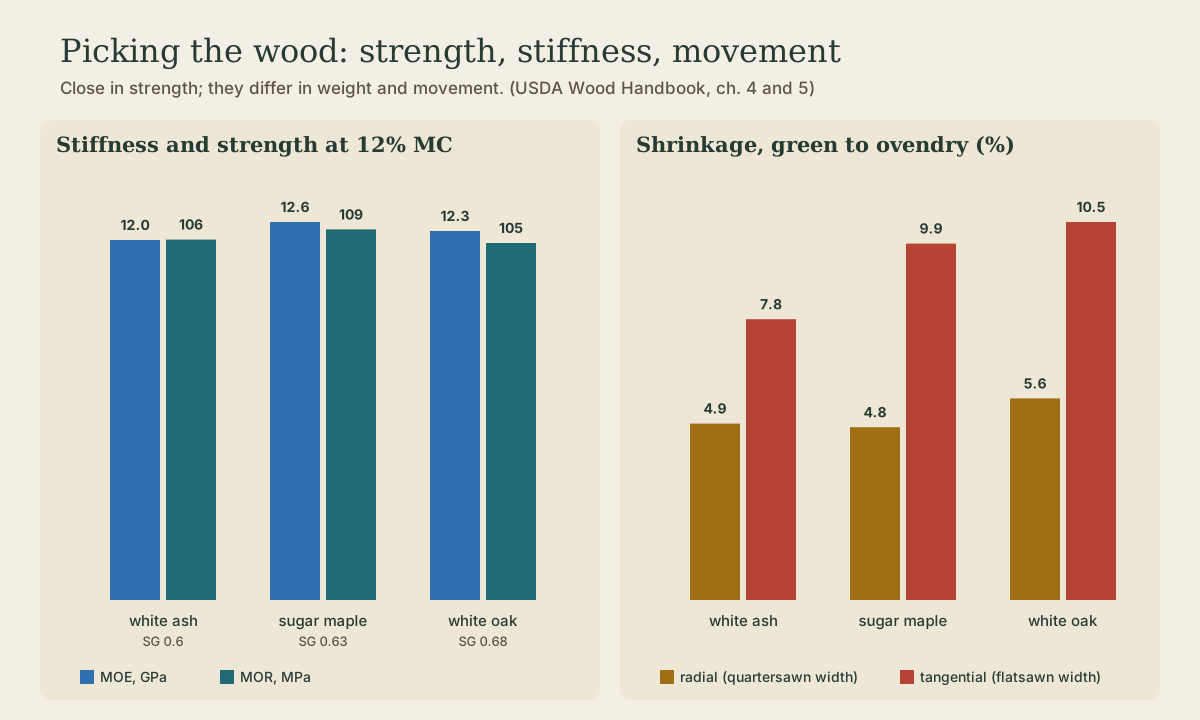
When you can choose a beam’s depth, a stiffer material lets you use less of it. For a light beam of fixed width and given stiffness, the material index to maximize is E^(1/3) ÷ ρ (stiffness per weight), and for given strength it’s MOR^(1/2) ÷ ρ. Using Wood Handbook values at 12 percent moisture 1, with E in GPa and specific gravity for ρ:
| Wood | E (GPa) | MOR (MPa) | SG | E^(1/3)/SG | MOR^(1/2)/SG |
|---|---|---|---|---|---|
| White ash | 12.0 | 106 | 0.60 | 3.82 | 17.2 |
| Sugar maple | 12.6 | 109 | 0.63 | 3.69 | 16.6 |
| White oak | 12.3 | 105 | 0.68 | 3.39 | 15.1 |
The three are within a few percent in strength and stiffness. Ash wins the indices because it’s lightest, which fits its long use for tool handles and other parts that get swung and flexed. White oak’s extra weight is welcome in the frame and legs. Sugar maple is the hard, wear-resistant choice for the bed ways.
Quick check
Ash scores about 3.8, maple 3.7, oak 3.4 (with E in GPa and specific gravity).
Properties are distributions
Every number in that table is an average of small, clear, straight-grained test pieces. Real boards scatter around it: the Wood Handbook gives average coefficients of variation of about 16 percent for modulus of rupture and 22 percent for modulus of elasticity 1. A board two standard deviations low has about two thirds of the average strength, before any knot. Large margins, like the 30-plus here, absorb that; tight ones need graded stock or testing.
Quick check
The table numbers are averages of small clear specimens.
Environment joins the load case
A lathe in an unheated Wisconsin shop goes from damp summer air to dry, heated winter air. Wood swells and shrinks with that, mostly across the grain. Green to ovendry, white ash shrinks about 4.9 percent radially and 7.8 percent tangentially, sugar maple 4.8 and 9.9, and white oak 5.6 and 10.5; along the grain it’s only 0.1 to 0.2 percent 2. Ash moves least across the grain of the three. Movement is what loosens joints in winter and pushes parts out of line, so it becomes a design input for the frame joinery and the centers (the next lesson).
What to take from this
Start from each part’s job. The treadle’s static stress is tiny (3.3 MPa against 106), so fatigue governs: rive it from straight-grained ash, because knots and grain slope cut fatigue strength. Indices like E^(1/3)/ρ rank woods for light, stiff parts; ash, maple, and oak are close in strength and differ mainly in weight and movement. Handbook values are averages with 16–22 percent scatter, and seasonal moisture change is part of the load case.
Lesson complete
Nice work.
Sources for this lesson
- 1Wood Handbook, Chapter 5: Mechanical Properties of Wood. USDA Forest Service, Forest Products Laboratory. 2021. verifiedTable 5-3a, clear wood at 12% MC: white ash SG 0.60, MOR 106 MPa, MOE 12.0 GPa, work to maximum load 115 kJ/m3; sugar maple 0.63, 109 MPa, 12.6 GPa, 114; white oak 0.68, 105 MPa, 12.3 GPa, 102.
- 2Wood Handbook, Chapter 4: Moisture Relations and Physical Properties of Wood. USDA Forest Service, Forest Products Laboratory. 2021. verifiedPublic U.S. government chapter on hygroscopicity, equilibrium moisture content, fiber saturation, shrinkage, swelling, and species data.