Shafts, Bearings, Gears & Power Transmission
Sizing the treadle lathe's power train: a flywheel by stored energy (E = ½Iω²; a 20 kg cast-iron rim stores about 104 J at 100 rpm against 12 J used by a cut through a dead point, while a bare plywood disk stores 10 J and stalls), a step-pulley belt ratio (22-inch groove to 3, 4, or 5 inches gives about 730, 550, or 440 rpm), spindle torque and belt pull, ball bearing life L10 = (C/P)³ (fatigue is millions of hours away, so dust and fit are the real limits), and overhang deflection.
- 6 min
- 6 steps
- 3 questions
- Lesson 44 of 78
In this lesson
- Size the flywheel
- The belt
- Torque and belt pull
- Spindle bearings
- Stiffness, not strength
- What to take from this
Picking up where you left off.
Size the flywheel
The last lesson ended with the dead points: twice per turn the foot can’t drive the crank, and the flywheel has to coast through. It also has to keep the spindle turning while a gouge bites. So size it by energy.
A spinning wheel stores kinetic energy E = ½Iω², where I is its moment of inertia and ω its speed in radians per second. For a wheel with nearly all its mass in the rim, I ≈ mr². For a solid disk, I = ½mr².
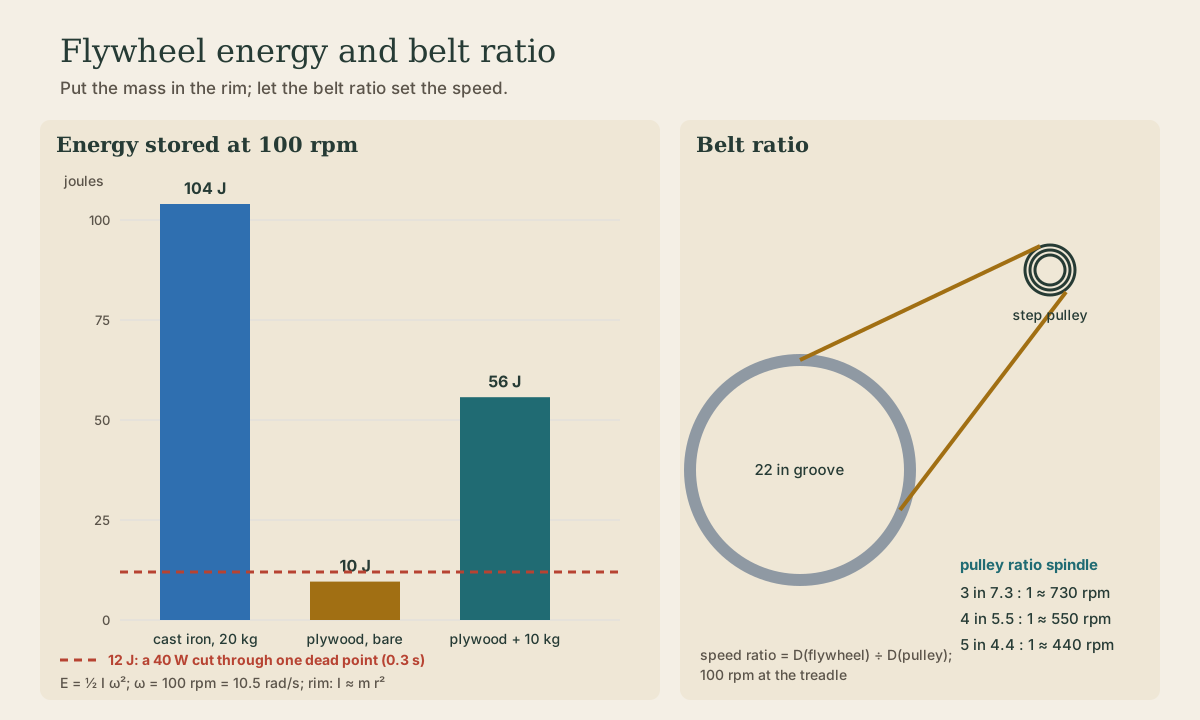
At 100 treadle strokes a minute, ω = 100 × 2π ÷ 60 ≈ 10.5 rad/s. Compare three 24-inch (r = 0.305 m) wheels:
- Cast iron, about 20 kg mostly in the rim (the kind salvaged from old treadle machines): I ≈ 20.4 × 0.305² ≈ 1.9 kg·m², so E ≈ ½ × 1.9 × 10.5² ≈ 104 J.
- Bare ¾-inch birch plywood disk: about 3.8 kg, I = ½mr² ≈ 0.18 kg·m², E ≈ 10 J.
- The plywood disk with 10 kg of steel bolted near the edge (at about 0.29 m): I ≈ 1.0 kg·m², E ≈ 56 J.
Now the demand. Suppose a cut takes 40 W. Half a turn at 100 rpm lasts 0.3 s, so passing through one dead point under cut uses about 40 × 0.3 = 12 J that the foot isn’t supplying. The cast wheel drops to √(92/104) ≈ 94 percent of its speed, a 6 percent dip you barely feel. The weighted plywood dips about 11 percent. The bare plywood disk has less energy stored than one dead point uses: it stalls. Put the mass at the rim.
Quick check
That’s why bolting steel near a plywood wheel’s edge works.
The belt
The flywheel turns at foot speed, about 100 rpm, far too slow for spindle turning. A belt from a groove in the flywheel rim to a small pulley on the spindle steps the speed up by the ratio of their diameters. From a 22-inch groove:
| Spindle pulley | Ratio | Spindle speed |
|---|---|---|
| 3 in | 7.3 : 1 | ≈ 730 rpm |
| 4 in | 5.5 : 1 | ≈ 550 rpm |
| 5 in | 4.4 : 1 | ≈ 440 rpm |
A step pulley with all three lets you slow down for big bowls and speed up for thin spindles. The flywheel keeps its energy; the belt trades torque for speed. A tensioner, or a hinged headstock, takes up stretch.
Quick check
Speed ratio = driver diameter ÷ driven diameter.
Torque and belt pull
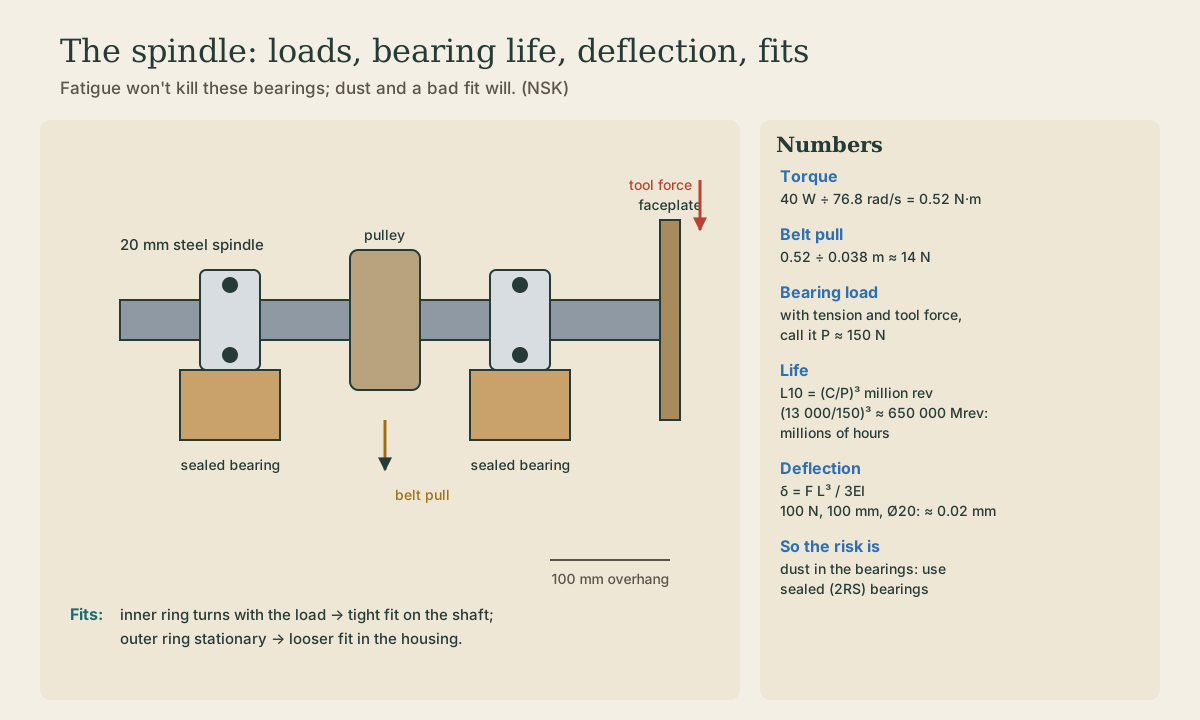
Power is torque times speed, so at 730 rpm (76.8 rad/s), a 40 W cut is a torque of 40 ÷ 76.8 ≈ 0.52 N·m at the spindle. On a 3-inch pulley (radius 0.038 m), that’s an effective belt pull of 0.52 ÷ 0.038 ≈ 14 N. Belts need some extra tension to grip, and the gouge pushes on the work too; call the worst load on a spindle bearing about 150 N. The point of rough numbers like these is to find which parts are working hard. Here, nothing in the spindle is.
Spindle bearings
Use two sealed deep-groove ball bearings on a 20 mm steel spindle, one near each end of the headstock. Rolling bearings fail eventually from fatigue, and their catalog rating is built around it 1:
- The basic dynamic load rating C is the load a bearing can carry for one million revolutions at 90 percent reliability.
- The basic rating life L10, the life that 90 percent of a group of identical bearings will reach, is L10 = (C/P)³ million revolutions for ball bearings, where P is the actual equivalent load 1. Double the load and life drops to one eighth.
A 20 mm-bore bearing of this type has a C on the order of 13 kN in maker catalogs (look up the exact one you buy). With P = 150 N, L10 = (13,000 ÷ 150)³ ≈ 650,000 million revolutions, millions of hours at 730 rpm. Fatigue is not the risk. What actually ends a bearing in a woodshop is dust getting into it and a bad fit letting a ring creep on its seat; NSK lists noise, vibration, and heat as practical ends of bearing life too 1. So: buy sealed (2RS) bearings, shield them from shavings, and get the fits right (lesson 4).
Quick check
Here the load is so small that life is still enormous; dust is the real threat.
Stiffness, not strength
A faceplate or chuck overhangs the front bearing. Treat it as a cantilever: deflection δ = FL³ ÷ 3EI. For a 20 mm steel spindle (I = πd⁴/64 ≈ 7.9 × 10⁻⁹ m⁴, E = 200 GPa) with 100 N on a 100 mm overhang, δ ≈ 0.02 mm. Stress is tiny too. For lathe spindles the usual checks are deflection and runout, not breaking; keep overhangs short and bearings far apart. MIT’s machine design course treats shafts the same way, checking stiffness and bearing arrangement alongside strength 2.
What to take from this
Size the flywheel by energy: E = ½Iω², mass at the rim. A 20 kg cast rim stores about 104 J at 100 rpm, eight times what a cut through one dead point needs; a bare plywood disk stalls. A belt from a 22-inch groove to a 3–5 inch step pulley gives about 440–730 rpm. Spindle loads are small (0.5 N·m, about 150 N on the bearings), so ball bearing fatigue life, L10 = (C/P)³, is effectively unlimited: dust and fit are the real limits, and stiffness matters more than strength.
Lesson complete
Nice work.
Sources for this lesson
- 1Dynamic Load Ratings and Fatigue Life (ABCs of Bearings). NSK. verifiedBasic rating life L10 is the number of revolutions (or hours) that 90 percent of identical bearings reach before rolling-fatigue flaking; the basic dynamic load rating C is the constant load giving an L10 of one million revolutions. For ball bearings L10 = (C/P)^3 million revolutions, so doubling the load cuts life to one eighth. Bearing life in practice also ends from noise, vibration, torque, or temperature.
- 2Elements of Mechanical Design. MIT OpenCourseWare. verifiedModeling, design, integration, fabrication, and characterization of bearings, springs, gears, cams, mechanisms, shafts, drives, and connections.