Robot Dynamics, Trajectories & Motion Control
The manipulator equation and what each term means, how trajectory timing creates forces, trapezoidal versus S-curve profiles, feedforward plus feedback control, a worked joint-torque screen, and checking demand across the whole workspace.
- 2 min
- 5 steps
- 3 questions
- Lesson 57 of 78
In this lesson
- Timing creates force
- Feedforward and feedback
- Worked torque screen
- Verify across the workspace
Picking up where you left off.
Robot dynamics are often written
The terms represent configuration-dependent inertia, velocity effects, gravity, friction, actuator torque, and external wrench. Stanford’s course progresses from kinematics through Newton-Euler dynamics to joint and operational-space control 1.
Timing creates force
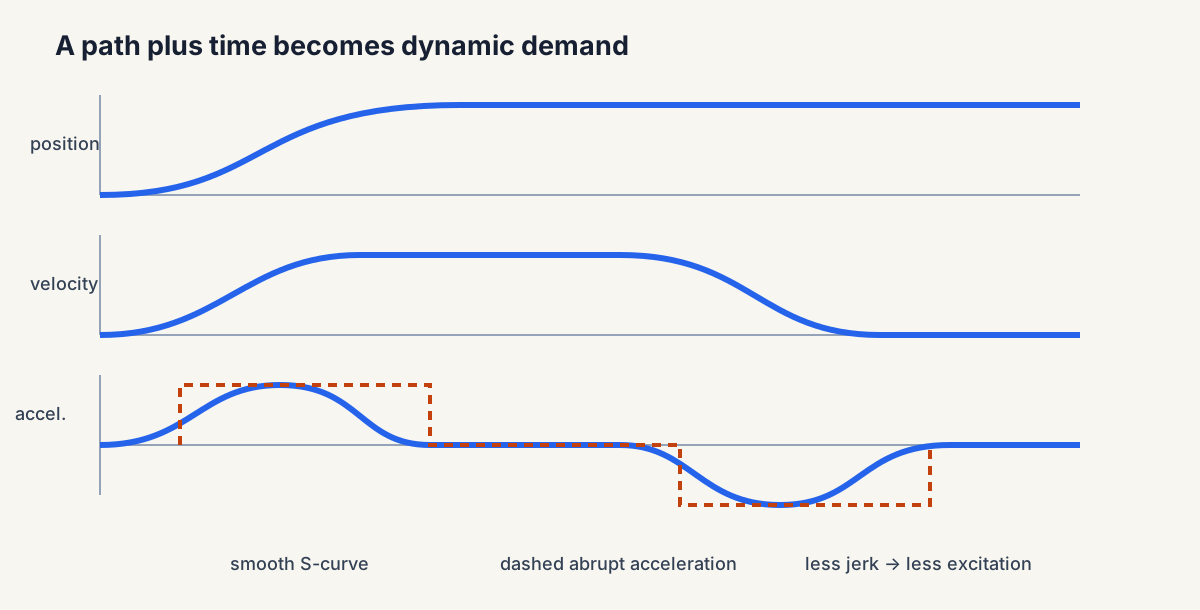
A geometric line can be executed with many time laws. Trapezoidal velocity profiles bound velocity and acceleration but introduce acceleration steps. S-curves bound jerk and often reduce excitation, load shift, and wear. The best cycle time includes motion plus settling, sensing, process time, and recovery—not just commanded travel.
Feedforward and feedback
Feedback corrects mismatch; feedforward supplies predicted gravity, inertia, or friction effort. A joint controller might combine model-based terms with PD error correction. The model reduces routine error; feedback supplies robustness. Neither excuses actuator saturation, delay, calibration, or structural flexibility.
Worked torque screen
A joint sees reflected inertia 0.08 kg·m² and must accelerate at 12 rad/s². Inertial torque is 0.96 N·m. Add worst-case gravity 1.8 N·m, friction 0.25 N·m, and a 20% modeling allowance: roughly \(1.2(0.96+1.8+0.25)=3.61\) N·m before transmission efficiency and dynamic coupling refinement.
Quick check
1.2 × (0.96 + 1.8 + 0.25) ≈ 3.61 N·m, before transmission efficiency.
Verify across the workspace
Payload torque, Jacobian conditioning, gravity, collision clearance, cable bend, and thermal duty change with pose. Test high-demand corners, not only the convenient center.
Motion study
Plan the same pick move with trapezoidal and S-curve profiles. Compare peak velocity, acceleration, jerk, estimated torque, predicted flexible-mode excitation, and total settle-to-tolerance time. Choose based on good-part cycle time and mechanism life.
Practice
The path is geometric; timing adds velocity, acceleration, jerk, and dynamic demand.
Practice
Aggressive commands can excite the machine and leave more residual vibration or tracking error.
Lesson complete
Nice work.
Sources for this lesson
- 1CS223A / ME320 - Introduction to Robotics. Stanford University. verifiedCurrent physics-based syllabus covering spatial transformations, kinematics, Jacobians, dynamics, motion and force control, and vision-based control. Cited at: course timeline.
Further reading
- Introduction to Robotics. MIT OpenCourseWare. verifiedMechanisms, kinematics, planning, dynamics, controls, actuators, sensors, networks, interfaces, embedded software, laboratories, and a team robot project.
- Analysis and Design of Feedback Control Systems. MIT OpenCourseWare. verifiedUndergraduate course in transfer functions, time and frequency response, stability, loop shaping, state variables, observers, and digital control.